Richard Carroll Interview – Part Two

My interview with Richard Carroll continues…

ANDREW PETERS:  The ice is broken and I think I can ask you the “big question.”  What happened that night at Fire Island?

RICHARD CARROLL:  [clears throat] Basically, I put myself in a really bad situation.  Me and my cousin Matty dropped Ecstasy, we went to a club, threw back a lot of drinks, and this guy offered me GHB.  Honestly, there’s not much I remember from there.  GHB’s the kind of drug you have to be careful with.  Take a little, and you’re feeling great.  Take too much, and you’re basically comatose.  Obviously, I took too much.

AP:  So you overdosed?  There was also sexual assault involved.

RC:  Yeah. It took me awhile to accept the sexual assault part.  Y’know in the club scene, the “boothstore” scene, a lot of scenes, the boundaries are really blurry.  These weren’t guys who cornered me and attacked me.  We met at the club, dosed up together, things got pretty hot and heavy on the dance floor and I ended up going home with them, though I barely remember it.

AP:  That made it hard to accept the experience as rape?

RC:  Yeah, it definitely did.  For a long while, I kept asking myself what did I do wrong?  Or was I imagining that what happened wasn’t consensual or did I have the right to be angry at the guys for what happened?

AP:  Do you think it’s also harder to reconcile because we don’t normally think of men as victims?

RC:  For sure, that’s part of it.  I mean I had been in a lot of crazy situations before and never thought of myself as a victim.  Plus, I’m being really honest here, there’s the whole fantasy aspect .  I mean, if I imagined something like that happening, going home with a group of guys, did that give me the right to be upset about it after it actually happened?  And things are different in the gay world.  People have three-ways, four-ways, orgies, and drugs are almost always involved.   Now maybe nine times out of ten, that situation is totally safe.  But in my case, that one night changed my life forever.

AP:  A lot of people will think you’re very brave in coming forward about it.  Was there also an aspect of pressure to not say anything because of how it reflects on the gay party scene?

RC:  I hear what you’re saying.  For me, that didn’t figure in as much.  Maybe because I didn’t live through the experience.  I didn’t have to face people I knew from that scene and deal with people’s reactions.  It was a lot more of an internal struggle.  But once I got past that, it really wasn’t so hard to tell my story.  I mean sexual abuse or rape are things that affect a lot of people.  If I can be honest about it, maybe that helps someone else.

AP:  So you could be a role model after all.

RC:  Maybe.

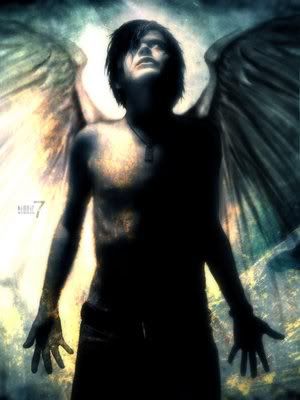
AP:  Your story is about becoming an angel.  That has a lot of religious connotations that bothered you at first.

RC:  It did.  Until I understood what it was really about.  I mean, I haven’t converted to Christianity or anything.  Being an angel has nothing to do with that.

AP:  You’re a Jewish angel?

RC:  I’m a “cultural Jewish” angel.

AP:  Very cool.  So, what’s it like being “on the other side?”

RC:  Not as different as you might think.  I mean, there are days when I forget that it’s any different.  The people are different.  The places are different.  Angels travel between two worlds – the mortal world and the afterlife.  And in a way, we’re not really part of either of them, which was kind of lonely at first, but then you discover there’s other people, other angels like you.

AP:  And I understand you have a love interest.

RC:  [cocks head and blushes] Yeah.  I met someone.

AP:  Allright.  I think I know who my next interview is going to be.  But Richard, we’re just about out of time.  We’re going to have to move on to the speed round.

RC:  Ok.

AP:  Here goes.  Ultimate Pop Diva:  Lady Gaga or Madonna?

RC:  Madonna.

AP:  Wow – that’s kind of a surprise.  When were you born?  Like 1989?

RC:  You gotta respect your elders.

AP:  Good enough.  OK.  NYC neighborhood:  Chelsea or Hell’s Kitchen?

RC: East Village, man!

AP:  Allright.  Time to update my questions.  How ’bout Starbucks or Dunkin’ Donuts?

RC:  Starbucks.  Iced Coffee with a double shot of espresso.  Can’t beat it.

AP:  Social Networking:  MySpace or Facebook?

RC:  I had accounts on both of them, but I’d have to go with Grindr.

AP:  You’re not sticking to my questions.  What the hell is Grindr?

RC:  It’s an Iphone app.  You browse through people’s profiles, see where they’re at and find out if they want to meet up.

AP:  Oh!  Kinda like GPS, right?  Guess I’m really showing my age here.  Lemme see if I’ve got anything left in my script here.  Designer jeans:  True Religion or Diesel?

RC:  That’s a hard one.  I’m gonna have to go with Diesel.

AP:  Ok.  Fantasy date:  Robert Pattinson or Taylor Lautner?

RC:  Pattinson by a landslide.

AP:  Great.  That’s all we have time for.  I think you scored three out of six.  Thanks again, Richard.  This has been really fun.  Are you up for sticking around if visitors to the site have questions?

RC:  Sure.
Who is Richard Carroll?

I thought I’d do something different this week and interview the main character from my work-in-progress WHEN THE FALLEN ANGELS FLY.  This is the first half of a two-part interview.

Some background:  Richard Carroll is a 21-year-old Hamilton College student who gained notoriety when his  body was found on a beach in Fire Island.  An investigation into his death uncovered frightening details of a night spun out of control by sex and drugs.  This interview marks the first time Richard has spoken to the media since his death.

ANDREW PETERS:  Richard, thanks so much for taking the time to let me interview you.

RICHARD CARROLL:  No problem.

AP:  A lot of readers will be interested in what happened to you, but I thought we’d start off with a little bit about your background.  You’re a Jersey Boy, right?

RC:  Yep.  I grew up in Teaneck.

AP:  Jersey Boys have a reputation for being nice guys.  Do you find that true?

RC:  Um…yeah.  I guess you could say that.  I mean, growing up in Jersey it’s pretty hard to be pretentious and all superior.  Maybe that’s where it comes from.  That and the clean living. [ironic smirk]

AP:  In your book, you touch on some of the tougher spots in your childhood and adolescence.  How do you feel those experiences shaped you?

RC:  Look:  I think everyone has had their share of hard knocks to deal with.  I don’t think my experiences were so character-defining or special.   Yeah – my parents got divorced when I was thirteen.  It was pretty horrible at the time.  Looking back, I recognize it was the best thing for the two of them, but sure, I still carry my resentments.  My dad was having an affair.  My mom can be a really difficult person.  The divorce was messy – fighting, using my sister and I as pawns, long stretches of time without hearing anything from my dad.  I think my dad ultimately gave up and disappeared.  It was lame on one hand, understandable on the other.

AP:  You also had to face the additional challenge of coming out as gay.

RC:  Y’know, I never thought of it as a challenge.  Actually, discovering I was gay was something that I think saved me in a way.  It gave me an out when things were batshit crazy at home.  I could get on the Internet, hook up with guys, just get out of the house and into my own space.

AP:  So you never had any doubts, mixed feelings?  You never got any rip for being gay?

RC:  In my high school, you got rip if you didn’t listen to the right music or have the right cell phone or if you participated in lame cliché’s like pep rallies and school dances.  Being gay didn’t figure in so much as maybe being overweight or having really bad skin.  Sure there were a few homophobic dicks but everyone pretty much hated them anyway.

AP:  Your dad is Irish Catholic, your mom Eastern European Jewish.  How did that affect the way you identify culturally.

RC:  Well, Jewishness is passed down from the mother, so I’m Jewish by default.  But neither one of my parents were very ethnic or religious.  My mom considers herself a “cultural Jew,” which means you don’t go to temple for any of the holidays but you eat all the appropriate food.  I guess I’m pretty much the same way.  Religion skivves me.

AP:  If your story got picked up by a major publishing house, you’d be one of very few gay heroes in mainstream literature.  Does that prospect put a burden on you?  Are you a role model?

RC:  If I’m a role model, there’s a lot of people headed for disaster.  [Laughs]  A role model.  For what?  How to turn your life into a fabulous tragedy?

AP:  You do party a lot and have a lot of sex and drink and do drugs.  Do you think that obviates the chance for readers to relate to you in a positive way?

RC:  I don’t know.  I guess I can’t really control how people relate to me.  I have trouble relating to myself at times.  If people want to judge me for the choices I’ve made, they have every right to do that.  I think I see where you’re going with the whole “gay role model” thing.  I understand it.  Gay people need more role models, for the kid who’s getting the shit beaten out of him at school or the young guys who’re being unsafe ’cause they think they’ll find love by having sex.  But being a role model was never on my mind while I was out partying.  And I wasn’t in some crazy spiral of depression over how horrible it is to be gay.  I was just trying to live my life.

AP:  Who were your role models?

RC:  [Long pause.  Smiles.] Probably not the right ones, I guess.  My cousin Matty.  He was always this sort of unattainable epitome of cool for me.  He looks like this model/surfer dude, and everyone he meets falls in love with him.  He’s just really good with people.  And talented too.  He’s like this amazing deejay.

And my Grandmom Rini.  She managed to keep me and my sister somewhat sane when my mom and dad were splitting up.  Just a really great person.  [wipes his eyes and scowls].  Man, you’re getting me all emotional!

AP:  Just call me Barbara Walters.  We’ll take a break and get back to some questions next week.

First draft finished!

Ahead of schedule, I finished the first draft of my novel last night.  It stands at 287 pages, 75K words.  I’m excited to have reached the end, but there’s a sense of sadness that comes with the completion of this writing phase.  No more jotting down fresh ideas for the story on the train, in between meetings at work, or via e-mails to myself.  Permission to write whatever I want has been officially withdrawn.  It’s on to the editing phase where hours (days sometimes) worth of work will be mercilessly annihilated with the stroke of a delete button; weakly-executed through-lines will test my faith; and there’ll be no quick fixes for areas of contrived plotting, character inconsistencies and cringe-worthy passages.

Yes, I’m being a bit of a drama queen about this.  But I’ve been through editing a novel manuscript before (THE REGISTRATION) and it was pretty horrific.  So maybe it’s like rounds of chemotherapy, getting easier each time.  Maybe it’s all in the right attitude.  I will be approaching my edits differently, taking the advice of writing guru Jack Bickham.  I’m setting the manuscript aside for a couple of weeks.  The idea is to let the brain cells regenerate and new ideas emerge.

In the meantime, I’ll be turning back to some of my short fiction projects.  I recently posted IN A WINE PHASE on gayauthors.org, a fantastic on-line writer’s community.  I’m continuing to look for a home for MIKE’S POND.  Maybe I’ll even churn out a new story during this break.

Oh – and why the pic of Robert Verdi?  I love his new show!!

This and That

The big news this week:  I’ll be writing a book review for La Bloga, the award-winning blog for Latino/Latina literature!!  La Bloga features news and views from a wide range of Hispanic authors and poets and has frequently included gay and lesbian writers such as Michael Nava.  I’ll be reviewing John Rechy’s groundbreaking City of Night.

Then, in the “boo hoo” category, I received my third rejection for MIKE’S POND.  My pity party lasted about 12 hours, and now I’m looking for another journal to sub to.

I’m closing in on the end of WHEN THE FALLEN ANGELS FLY.  280 pages.  72.5K words!!  I’m wrapping up the climactic scene, and I have the denouement to work out.  Feeling pretty optimistic about having the full first draft done by the end of the month.

What inspires me this week:  the Olympics.  My Honey-Bunny (HB) and I have been watching all of the events.  Plenty of tragedy and drama so far, from the heartbreaking death of Georgian luger Nodar Kumaritashvili, the wipe-out of two Korean skaters in the short track final and Canadian skier Alexandre Bilodeau ending his country’s gold medal drought on the moguls.  I have to confess that it’s been hard for me to root on the US team.  Maybe it’s the strident TV coverage.  The US always comes across as cocky bullies, and I find myself pulling for the underdogs, which is pretty much athletes from every other country.  Big news – the US leads the medal count!  What a surprise.  We’re the wealthiest nation in the world with more resources going into athletic training than any other country in the world.  It takes a kid on skates in a sequined body suit with a pink tassel for me to get behind the US team.  Go Johnny Weir!!

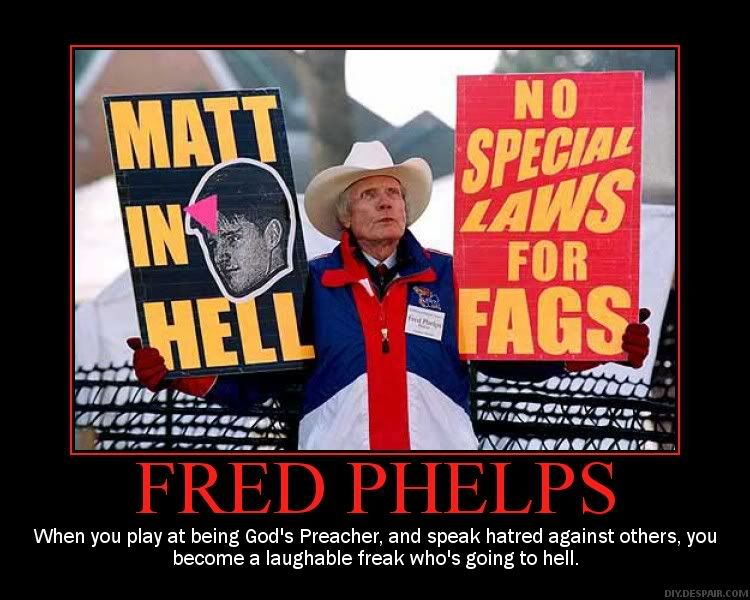
On Complex Villains – Fred Phelps

I recently came across a fascinating story about the Reverend Fred Phelps of the Westboro Baptist church.  Jon Michael Bell interviewed Phelps and his family in the mid-90’s, but his reporting, under the book title “Addicted to Hate”, was never published due to a dispute with the publisher.  Bell’s short, nine-chapter book circulates the Internet like a viral video.  It caught my eye because I’m drawn in by stories with complex villains.   I tend to view people as multi-dimensional in my life and my writing.  Tell me someone is “bad,” and I’ll spend hours working out the counterpoint.  The same goes for saints and heroes.  I guess I don’t like being told how I should think, and I believe there’s humanity in every individual, no matter how despicable their choices and behaviors.  That doesn’t mean I don’t believe in personal responsibility, punishment or making amends.  But I feel that by casting folks as pure evil, we miss an opportunity to understand human nature and ultimately to learn from it.

Most people know Fred Phelps as an audacious, gay-hating evangelist.  He coined the motto:  “God Hate Fags,” and turned it into a communications campaign.  He pickets the funerals of people who died from AIDS, and he protests memorials for hate crimes victims, most famously Matthew Shepherd.  His views are too extreme for even anti-gay Christian groups like Focus on the Family.  He calls these slightly tolerant folks “fag-enablers” or “fags” themselves.  He’d be a frightening guy if he hadn’t become a caricature, lampooned on late night talk shows, Howard Stern and, of course, Jerry Springer.   “Family values” Republicans dismiss him as a fringe element (Phelps actually campaigned for Al Gore in the 1980’s), and he and his family/congregation (they’re pretty much one in the same) have been barred from entering the UK.

What people might not know is that Phelps had a career as a civil rights attorney in the 60’s and 70’s and helped overturn Jim Crow laws in the Midwest.  He even received an award from the NAACP  in 1987.  Phelps was since disbarred for harassing a female witness and perjury, but he’s an intelligent, well-educated man.  It makes me wonder what was the turning point for this guy?  What led him to launch into a monolithic campaign to save America by destroying gays?  He doesn’t conform to our comfortable beliefs about what makes a person homophobic – lack of education and/or ignorance.  I find it very hard to believe that Phelps intellect cannot grasp the concept of human diversity, the fact that homosexuality is not communicable, that AIDS comes from a virus, not a class of people.

When reporter Bells interviewed Phelps’  adult children, some of the answers came out.  Two of his sons and one daughter describe terrifying scenes of domestic abuse directed toward them and their mother.  It was physical and not surprisingly verbal.  One of Phelps’ sons believes that Phelps turned his rage toward gays after his kids were too old to abuse.  They paint a portrait of a sadistic man intolerant of any deviation from his authority, and they believe that their siblings who remain loyal to their father (Phelps has a total of 13 children) haven’t come forward about the abuse because they are living in fear.

The picture coming together for me is a person who is paranoid-delusional with a persecution complex rooted in deep-seated insecurity.  Phelps attacks those he’s afraid of – children he will one day be unable to control and gays who challenge his shaky hold on masculinity.  Somewhere in his development, I think Phelps’ sense of self was deeply fractured, an injury he could only repair by creating a fantasy of self-importance with conspirators always threatening to bring him down.   Even when Phelps was working for civil rights, colleagues remember him as fiercely oppositional, a crusader; it was always him against the world.  Maybe Phelps was victimized himself as a child.  Maybe the abuse was sexual, which is why his rage turned toward gays.  None of this is so extraordinary really.  There are plenty of people with similar psychological profiles in our mental health system:  narcissistic or borderline personality and bi-polar depressives.  From a diagnostic standpoint, there is plenty of evidence of Phelps’ maladaptive coping.  It lost him his job and his relationships with his family and most certainly many friends.  One of his sons also reports that Phelps abused crystal meth.

Still, Phelps manages to function better than most folks with severe mental illness.  He’s a functional delusional, not a one-dimensional monster, but dangerous through his destructive acts toward others and himself.  A great inspiration for storytelling.