About andrew

Andrew J. Peters writes fantasy for readers of all ages. His titles include the Werecat series, a finalist in The Romance Reviews' Readers' Choice Awards, Poseidon and Cleito, The City of Seven Gods, and two books for young adults: The Seventh Pleiade and Banished Sons of Poseidon. He grew up in Buffalo, New York, studied psychology at Cornell University, and spent most of his career as a social worker and an advocate for LGBT youth. He lives in New York City with his husband Genaro and their cat Chloë.

Short Story Acceptance!!

After a bit of a publishing drought, I just got notified that my short story “In A Wine Phase” was accepted by the quarterly e-zine Wilde Oats.  The issue is slated to come out in August.

I wrote “In A Wine Phase” about a year ago.   It’s a quick look at a relationship in trouble, a 7-year itch kind of story, and it also deals with the meaning of family for gay men.  The story got a pass from another journal with some feedback from the editor, so I took another shot at it recently.  Really cool that sometimes when you put the extra work in, it pays off.

All in all, this is a pretty damn exciting time as I also have a column coming out shortly in La Bloga featuring an interview with YA author Alex Sanchez.  The article should be out this coming Sunday or the next.

So tonight:  a glass of champagne, a cigarette and feet up on the couch.

Can Two Men Tango?

My partner and I started tango classes about a week ago.  This was a big deal, me being profoundly rhythm and coordination-challenged, him being hostilely disposed to social organizations of any type and fairly intolerant of learning curves.

Our prior dance experience consisted of an awkward, argumentative two-step that opened up the dance floor at our wedding.  And we have been seen dancing the typical free form, no contact bob and shimmy that gay men do at clubs, inspired by a few drinks or out of obligation to the fact that we are, after all, gay men.

He’s actually a quite a good dancer.  He can salsa and merengue and his vogueing  was admired in certain circles during the 1990’s.  I have been occasionally acclaimed, and more often reprehended for my tendency to throw a lot of shoulder action into my dancing.

Tango lessons have leveled the playing field.  This was a pleasant surprise, and, as he explains, it’s a lot harder being choreographed than just moving your body to the beat.  I, on the other hand, prefer being choreographed.  I enjoy rules, proven, trustworthy rules.  I need instructions for every part of my body because left to its own devices, it’s not pretty.  So, we’re both stumbling through the lessons, quick to accuse each other when we make a mistake, yet each determined to get it right.

There’s still something strange to me watching two men dance the tango.  Perhaps it’s a vestige of internalized homophobia, which I thought I had overcome through numerous public displays of affection and tempting disapproval from my sixtyish Romanian hairdresser when I confirmed once and for all that I wear a wedding ring because I’m married to a man and even agreeing to enter my name as the “wife” at the Macy’s bridal registry.

There’s a great line from comedian Bob Smith (also a Buffalo native) which I’ll paraphrase:  “As gay men, my partner and I demand our equal right to display affection in public as long as we can maintain the right to avoid affection in the privacy of our own home.”  This is something I can relate to though Hunny-Bunny (H.B.) sees it the other way around.

Anyway, my point is that I have to get over this hang-up over watching two men tangoing.  I have no problem watching two men do other kinds of intimate things together, not that I’m a voyeur or a porn-addict, I’m just saying I’m being a bit hypocritical.

As long as there are no mirrors involved, I feel perfectly comfortable dancing the tango with other men.  I do find it easier to lead than to follow but I think anyone would.   It’s pretty tough to remember your steps while trying to keep in synch with your partner.  Luckily, due to a decided height advantage, I end up leading H.B. most of the time.

But the cool thing about our tango class is that it’s “open role.” This means the program operates with the mantra, repeated by the instructors with a certain pride and fervor:  “Everyone leads.  Everyone follows.”  This is how it really should be in the world.   No one should be stuck in the same role, stressed out by constantly setting the pace or having to politely endure being led by someone who really has no idea what he’s doing.

Which brings me (finally) to my insight of the day.  I like being gay because it gives me a right to be flexible with gender roles.  There are times when I’m happy being gruff and domineering and others when I prefer to be coy and wouldn’t mind being on the receiving end of a little chivalry.

In the meantime, I’ll work on my same-sex tango-phobia.  I think it’s a good thing to push oneself on these issues.  Our instructors have invited us to join a queer tango troupe performing at various public venues.  That would be the ultimate test.

Richard Carroll Interview – Part Two

My interview with Richard Carroll continues…

ANDREW PETERS:  The ice is broken and I think I can ask you the “big question.”  What happened that night at Fire Island?

RICHARD CARROLL:  [clears throat] Basically, I put myself in a really bad situation.  Me and my cousin Matty dropped Ecstasy, we went to a club, threw back a lot of drinks, and this guy offered me GHB.  Honestly, there’s not much I remember from there.  GHB’s the kind of drug you have to be careful with.  Take a little, and you’re feeling great.  Take too much, and you’re basically comatose.  Obviously, I took too much.

AP:  So you overdosed?  There was also sexual assault involved.

RC:  Yeah. It took me awhile to accept the sexual assault part.  Y’know in the club scene, the “boothstore” scene, a lot of scenes, the boundaries are really blurry.  These weren’t guys who cornered me and attacked me.  We met at the club, dosed up together, things got pretty hot and heavy on the dance floor and I ended up going home with them, though I barely remember it.

AP:  That made it hard to accept the experience as rape?

RC:  Yeah, it definitely did.  For a long while, I kept asking myself what did I do wrong?  Or was I imagining that what happened wasn’t consensual or did I have the right to be angry at the guys for what happened?

AP:  Do you think it’s also harder to reconcile because we don’t normally think of men as victims?

RC:  For sure, that’s part of it.  I mean I had been in a lot of crazy situations before and never thought of myself as a victim.  Plus, I’m being really honest here, there’s the whole fantasy aspect .  I mean, if I imagined something like that happening, going home with a group of guys, did that give me the right to be upset about it after it actually happened?  And things are different in the gay world.  People have three-ways, four-ways, orgies, and drugs are almost always involved.   Now maybe nine times out of ten, that situation is totally safe.  But in my case, that one night changed my life forever.

AP:  A lot of people will think you’re very brave in coming forward about it.  Was there also an aspect of pressure to not say anything because of how it reflects on the gay party scene?

RC:  I hear what you’re saying.  For me, that didn’t figure in as much.  Maybe because I didn’t live through the experience.  I didn’t have to face people I knew from that scene and deal with people’s reactions.  It was a lot more of an internal struggle.  But once I got past that, it really wasn’t so hard to tell my story.  I mean sexual abuse or rape are things that affect a lot of people.  If I can be honest about it, maybe that helps someone else.

AP:  So you could be a role model after all.

RC:  Maybe.

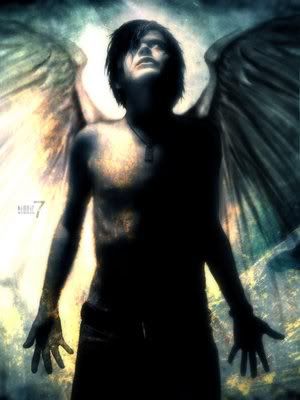
AP:  Your story is about becoming an angel.  That has a lot of religious connotations that bothered you at first.

RC:  It did.  Until I understood what it was really about.  I mean, I haven’t converted to Christianity or anything.  Being an angel has nothing to do with that.

AP:  You’re a Jewish angel?

RC:  I’m a “cultural Jewish” angel.

AP:  Very cool.  So, what’s it like being “on the other side?”

RC:  Not as different as you might think.  I mean, there are days when I forget that it’s any different.  The people are different.  The places are different.  Angels travel between two worlds – the mortal world and the afterlife.  And in a way, we’re not really part of either of them, which was kind of lonely at first, but then you discover there’s other people, other angels like you.

AP:  And I understand you have a love interest.

RC:  [cocks head and blushes] Yeah.  I met someone.

AP:  Allright.  I think I know who my next interview is going to be.  But Richard, we’re just about out of time.  We’re going to have to move on to the speed round.

RC:  Ok.

AP:  Here goes.  Ultimate Pop Diva:  Lady Gaga or Madonna?

RC:  Madonna.

AP:  Wow – that’s kind of a surprise.  When were you born?  Like 1989?

RC:  You gotta respect your elders.

AP:  Good enough.  OK.  NYC neighborhood:  Chelsea or Hell’s Kitchen?

RC: East Village, man!

AP:  Allright.  Time to update my questions.  How ’bout Starbucks or Dunkin’ Donuts?

RC:  Starbucks.  Iced Coffee with a double shot of espresso.  Can’t beat it.

AP:  Social Networking:  MySpace or Facebook?

RC:  I had accounts on both of them, but I’d have to go with Grindr.

AP:  You’re not sticking to my questions.  What the hell is Grindr?

RC:  It’s an Iphone app.  You browse through people’s profiles, see where they’re at and find out if they want to meet up.

AP:  Oh!  Kinda like GPS, right?  Guess I’m really showing my age here.  Lemme see if I’ve got anything left in my script here.  Designer jeans:  True Religion or Diesel?

RC:  That’s a hard one.  I’m gonna have to go with Diesel.

AP:  Ok.  Fantasy date:  Robert Pattinson or Taylor Lautner?

RC:  Pattinson by a landslide.

AP:  Great.  That’s all we have time for.  I think you scored three out of six.  Thanks again, Richard.  This has been really fun.  Are you up for sticking around if visitors to the site have questions?

RC:  Sure.

Who is Richard Carroll?

I thought I’d do something different this week and interview the main character from my work-in-progress WHEN THE FALLEN ANGELS FLY.  This is the first half of a two-part interview.

Some background:  Richard Carroll is a 21-year-old Hamilton College student who gained notoriety when his  body was found on a beach in Fire Island.  An investigation into his death uncovered frightening details of a night spun out of control by sex and drugs.  This interview marks the first time Richard has spoken to the media since his death.

ANDREW PETERS:  Richard, thanks so much for taking the time to let me interview you.

RICHARD CARROLL:  No problem.

AP:  A lot of readers will be interested in what happened to you, but I thought we’d start off with a little bit about your background.  You’re a Jersey Boy, right?

RC:  Yep.  I grew up in Teaneck.

AP:  Jersey Boys have a reputation for being nice guys.  Do you find that true?

RC:  Um…yeah.  I guess you could say that.  I mean, growing up in Jersey it’s pretty hard to be pretentious and all superior.  Maybe that’s where it comes from.  That and the clean living. [ironic smirk]

AP:  In your book, you touch on some of the tougher spots in your childhood and adolescence.  How do you feel those experiences shaped you?

RC:  Look:  I think everyone has had their share of hard knocks to deal with.  I don’t think my experiences were so character-defining or special.   Yeah – my parents got divorced when I was thirteen.  It was pretty horrible at the time.  Looking back, I recognize it was the best thing for the two of them, but sure, I still carry my resentments.  My dad was having an affair.  My mom can be a really difficult person.  The divorce was messy – fighting, using my sister and I as pawns, long stretches of time without hearing anything from my dad.  I think my dad ultimately gave up and disappeared.  It was lame on one hand, understandable on the other.

AP:  You also had to face the additional challenge of coming out as gay.

RC:  Y’know, I never thought of it as a challenge.  Actually, discovering I was gay was something that I think saved me in a way.  It gave me an out when things were batshit crazy at home.  I could get on the Internet, hook up with guys, just get out of the house and into my own space.

AP:  So you never had any doubts, mixed feelings?  You never got any rip for being gay?

RC:  In my high school, you got rip if you didn’t listen to the right music or have the right cell phone or if you participated in lame cliché’s like pep rallies and school dances.  Being gay didn’t figure in so much as maybe being overweight or having really bad skin.  Sure there were a few homophobic dicks but everyone pretty much hated them anyway.

AP:  Your dad is Irish Catholic, your mom Eastern European Jewish.  How did that affect the way you identify culturally.

RC:  Well, Jewishness is passed down from the mother, so I’m Jewish by default.  But neither one of my parents were very ethnic or religious.  My mom considers herself a “cultural Jew,” which means you don’t go to temple for any of the holidays but you eat all the appropriate food.  I guess I’m pretty much the same way.  Religion skivves me.

AP:  If your story got picked up by a major publishing house, you’d be one of very few gay heroes in mainstream literature.  Does that prospect put a burden on you?  Are you a role model?

RC:  If I’m a role model, there’s a lot of people headed for disaster.  [Laughs]  A role model.  For what?  How to turn your life into a fabulous tragedy?

AP:  You do party a lot and have a lot of sex and drink and do drugs.  Do you think that obviates the chance for readers to relate to you in a positive way?

RC:  I don’t know.  I guess I can’t really control how people relate to me.  I have trouble relating to myself at times.  If people want to judge me for the choices I’ve made, they have every right to do that.  I think I see where you’re going with the whole “gay role model” thing.  I understand it.  Gay people need more role models, for the kid who’s getting the shit beaten out of him at school or the young guys who’re being unsafe ’cause they think they’ll find love by having sex.  But being a role model was never on my mind while I was out partying.  And I wasn’t in some crazy spiral of depression over how horrible it is to be gay.  I was just trying to live my life.

AP:  Who were your role models?

RC:  [Long pause.  Smiles.] Probably not the right ones, I guess.  My cousin Matty.  He was always this sort of unattainable epitome of cool for me.  He looks like this model/surfer dude, and everyone he meets falls in love with him.  He’s just really good with people.  And talented too.  He’s like this amazing deejay.

And my Grandmom Rini.  She managed to keep me and my sister somewhat sane when my mom and dad were splitting up.  Just a really great person.  [wipes his eyes and scowls].  Man, you’re getting me all emotional!

AP:  Just call me Barbara Walters.  We’ll take a break and get back to some questions next week.

Two Plugs and a Whoop Whoop

Busy time here with work-weeks extending into the weekend and house guests on the way.  So I just wanted to jot off a couple of plugs.

First, I encourage folks to check out Eric Mays’ Author Speaks series that got started earlier this month and will have interviews with Jordan Krall, Bill Fitzhugh, Anne Rice (yes, the Anne Rice) and yours truly (later this summer).

Next, Ganymede #7 is out with a fantastic assortment of poetry, new fiction and reprints of historical homoerotic literature.  I especially enjoyed the final installment of Scott Hess’ Bergdoff Boys, which is sort of a gay Sex in the City (if that’s not redundant) with interwoven themes of recovery, gay identity and gay marriage.  Short fiction by 20th century British author Denton Welch stood out as well.  His story “When I was Thirteen” is gay coming of age that goes from sweet and charming to horrific when a boy’s fascination with an older teen is discovered by his older brother.  Since this is National Poetry Month, I should mention some of the really amazing poets:  Saeed Jones, Ocean Vuong,  and Ivar Sild, among many fine contributors.

And now a “Whoop! Whoop!” (for no reason in particular).