About andrew

Andrew J. Peters writes fantasy for readers of all ages. His titles include the Werecat series, a finalist in The Romance Reviews' Readers' Choice Awards, Poseidon and Cleito, The City of Seven Gods, and two books for young adults: The Seventh Pleiade and Banished Sons of Poseidon. He grew up in Buffalo, New York, studied psychology at Cornell University, and spent most of his career as a social worker and an advocate for LGBT youth. He lives in New York City with his husband Genaro and their cat Chloë.

A Love Poem?!?

I had so much fun writing a poem last week that I tried it again.  It is National Poetry Month all month after all.

Before I get into it, I got some fantastic news this week.  I was asked to be interviewed for the “Author Speaks” series at Eric May’s ZomBicurious blog!!  More news on this to come.

And a writing update…my manuscript revision is poking along sort of in a breakthrough/breakdown rhythm.  Sadly, I’m currently feeling more on the breakdown beat, but, I remind myself, like the needlepoint wall-hanging in my former social work professor’s office:  “There’s Always Hope.”

As for this poem, I felt if I was going to express myself in poetry, which I do so rarely, I should do it on a subject that means a lot to me.  Our 9-year anniversary is coming up, and this one’s for you Honey-Bunny.

Nine

When We were younger, We, as in you and me, or Us,

You used to ask me to sing you a song,

Or tell you a bedtime story,

As we lay in bed,

Our bed,

Not a hand-me-down from an ex or a mattress and spring board bought on special delivery,

The bed we picked out together and were reminded of in monthly bills,

Like the slices of our wedding cake we ate each month on the day of our anniversary.

~

You made me wonder if men ever lose their innocence,

Was it a lie that we inevitably grow up?

Or does boyhood burrow like a pup in blankets,

Coaxed out at the sound of mischief,

Or the tone of a voice he likes.

~

So much of our life has been spent as boys,

Studying each others’ faces when the other one isn’t looking,

Sleep-ins, Mario Bros., late night cookies,

Repeated TV jingles that amuse and amuse us over and over again,

Alone, we are well-matched playmates,

Retreating from the complexities of life,

We invent a secret language,

Blushing when we lapse into our words in front of others,

Our words,

Which came to us as naturally as holding hands.

~

This is not to say we haven’t had our resentments,

Our cold silences,

As boys are apt to have from time to time,

Photo albums record thinning hair and tiny grooves on necks and foreheads,

How could it be when we have grown so young together?

With games and songs and bedtime stories,

And now this poem for you.

National Poetry Month

In 1996, the Academy of American Poets designated April as National Poetry Month so while I’m most definitely not a poet, I thought I’d challenge myself to contribute something here.  This free-form verse was inspired by a memory from Amherst Junior High School, an ugly period of my adolescence.  Hope I did it justice.

Garbled Messages

We called her Garbled Messages,

Because, she spoke in fetal words,

Quivering, breathe-y, spitty words,

If you stood too close, you got sprayed in the face,


We never got that close or paid her much attention,

But the classroom silenced,

Shook up like a soda bottle ready to foam and cackle,

Whenever it was her turn to speak.

While we became sly masters of witticism,

The put-down:  Pass the ball, ass-face,

Quit being such a Gaylord,

Don’t stick out your tongue unless you’re gonna use it,

And the turns of phrase:  Twat did you say?

I cunt hear you.  I have an ear infuck-tion.  I need some penis-cillin.

We illuminated subtexts everywhere,

Since the subtext of everything was always sex.

I never looked at Garbled Messages,

Too much, though I wondered,

Was she retarded?  The greatest shame of Junior High,

She seemed the same as other girls,

Pretty even, though she wore a lot of make-up,

And dressed in ironed blouses and wool skirts,

Like her mom wanted her to bypass junior, senior high completely,

And go out into the world as a Secretary.

Still, we called her Tard and Dufus and Bocey,

At least behind her back,

Bocey, I later learned, derived from,

Board Of Cooperative Educational Services,

The place where all the Special Ed. kids went after lunch,

In the bus known popularly as the Retard Wagon,

I wish I could say that I never used those words,

But I did, so this is my confession.

What Dr. Seuss Taught Me About Homophobes

I don’t often blog about current events, but there have been so many things happening in the arena of gay rights, I felt like chiming in this week.  This post also gives me a chance to explain my long-held, personal conviction that Dr. Seuss taught us everything we need to know about the politics of exclusion.  More on that later.

It’s nearing prom season, and each year for the past 15 years or so, there have been news stories big and small on the fracas over lesbian and gay couples attending.  It’s a positive sign that more teenagers are feeling comfortable coming out as gay.  Unfortunately, for many of them, participating openly and normatively in high school traditions requires lawsuits, grassroots activism and a big whooping of community outrage.

The gay/prom debate has been the source of literary and cinematic inspiration, vis-a-vis Aaron Fricke’s personal memoir “Reflections of a Rock Lobster” and the Canadian flick “Prom Queen” with Kids in the Hall’s Scott Thompson.

This year, a prom story made national headlines, morning news shows and even Ellen.  Constance McMillen, an 18-year-old senior at a public, rural Mississippi school, challenged a prom policy of heterosexual-only dates, and the school district responded by cancelling the prom for all students.   The logic was thus:  if no students get a prom, no one’s civil rights are violated.  Seems more like an elementary school teacher’s policy to me, e.g.  “You can’t chew gum in class unless you have enough for everyone.”   The problem is, by high school, kids understand the concept of individuality.  Not everyone wants a stick of your banana-mango gum, and that’s just fine.  Constance knew the score, and she got help from the ACLU.  The case went to a federal judge who ruled that Constance’s constitutional rights were violated but a trial will be underway later in the year.  As a sidebar, cancelling everything for everybody has been a gay exclusion strategy on numerous occasions when students have tried to start Gay/Straight Alliance clubs; the school district bans all student clubs.

We also have in the news a Pentagon committee reviewing the Bill Clinton era military policy “Don’t Ask, Don’t Tell.”  So far, they’ve determined that the policy has, at times, been unfairly implemented.  This, after 17 years of enforcing a system of privilege for heterosexual military men and women and discharging over 13,000 gay troops.   But it takes time, they say, to evaluate how gays can be better integrated while ensuring the rights of all (read:  heterosexual) servicemen and women.  Meanwhile, gays serve openly in the armed forces of just about every other industrialized country:  the United Kingdom, France, Russia, Israel, to name a few.

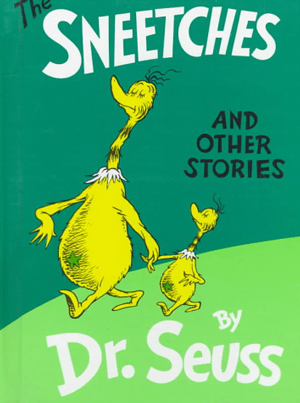
This brings me to “The Sneeches” by Dr. Seuss.

“Now, the Star-Bellied Sneetches had bellies with stars.

The Plain-Belly Sneetches had none upon thars.

Those stars weren’t so big.  They were really so small.

You might think such a thing wouldn’t matter at all.”

But the stars mattered quite a bit to the Sneetches, and when a fast-talking salesman with a star-making machine shows up, chaos ensues.  Stars on bellies become déclassé with the help of the salesman’s star-removal machine; then, as the nouveau starred Sneetches go through the removal machine, stars become chic again, and over and over, the symbol of privilege changes, culminating in a frantic assembly line of Sneetches running from one machine to the other.  They end up losing track completely of who had stars on their bellies in the first place.  The lesson:

” The Sneetches got really quite smart on that day.

The day they decided that Sneetches are Sneetches.

And no kind of Sneetch is the best on the beaches.

That day, all the Sneetches forgot about stars and whether

They had one, or not, upon thars.”

I don’t know if Dr. Seuss had gay rights in mind when he wrote the story, but for me, it’s always captured the essence of the debate.  Whether it’s homophobes talking about how opening marriage to same-sex couples will tarnish their sacred institution.  Or “moderates” saying they would never deny gay people their rights, but Marriage is for heterosexuals and gay couples can be recognized just fine through “domestic partnerships” or “civil unions.”  Or a school board that would rather forgo a high school prom than condone the participation of gay couples.  Or military generals claiming it’s just not so simple as to allow gay people to serve openly in the armed forces—it’s an organization steeped in centuries of heterosexual tradition, after all.

Yes, the answers are often simple.  Many of us learned them in a children’s picture book.

The Post-est with the Most-est

All that title means is that I’m feeling a bit silly tonight.  Maybe because posting here buys me a break from the big re-drafting of my novel, a process I started about a week ago.  I wrote a new opening scene that I’m pretty happy with, but it’s hard people, hard!

In the meantime, I continue reading.  I recently finished Anne Rice’s ANGEL TIME, and I’ll share my impressions here.

A brief synopsis:  ANGEL TIME is the story of a hitman named Toby O’Dare who is visited by an angel and given a chance to redeem himself by traveling back to 13th century England to save a community of persecuted Jews.

My previous attempts to read Anne Rice were aborted after the first twenty or so pages.  Having gotten through ANGEL TIME from cover to cover, I’m feeling more positively disposed to Ms. Rice.  I think she’s at her best when she’s “telling” versus “showing.”  She writes long, introspective passages that at times achieve brilliance.   Against her LeStat series, ANGEL TIME is a comparatively slim volume, which is perhaps why I didn’t have as hard a time with it.

But on the whole, I could’ve done with less exposition and less of Toby O’Dare’s constant contemplation.  The first half of the book is almost entirely backstory – a compelling backstory for sure, but rendered at a pace that left me anxious for some action.  The second half, which deals with Toby’s mission to save a Jewish family falsely accused of murdering their daughter (a common circumstance during the Christian fanaticism of 13th century Europe), moves along with much more suspense and intrigue.   The story rings true, the characters come to life, and it makes for enjoyable historical fiction.

I do have a new appreciation for Anne Rice’s unique sensibility, which appeals to so many gay men.  Her toughened hitman Toby plays the lute!  I thought that was pretty damn cool.  Plus Toby cries, both in sorrow and happiness, through something like 25 percent of the story, and he has a deep emotional connection to his angel savior Malchiah.  One could imagine that something more than loving reverence could develop between the two (maybe it’s forthcoming in the series’ next installment).  Anyway, as a reader, I felt that somewhere in ANGEL TIME’s tragic, supernatural world, there was a place for me, and that’s big props to the author and quite unexpected.

It’s hard to evaluate ANGEL TIME without dealing with Anne Rice’s strident religiosity.  She has publicly and self-righteously announced that she has given up writing about vampires and witches in order to devote her literary projects to Jesus.  As such her portrayal of angels is literal, with few surprises, and gets a bit “message-y” for us non-Christian readers.  Let me qualify that.  I don’t mind novels with a message, but I veer away from stories where the message is accept Jesus as your lord and savior or perish in eternal hell.  There’s some of that familiar refrain in ANGEL TIME.  But the story also speaks to the possibility of redemption even for those who have done “unforgivable” things, an intriguing concept that I think resonates beyond the Christian community.

Are you a cat or are you a Cat?

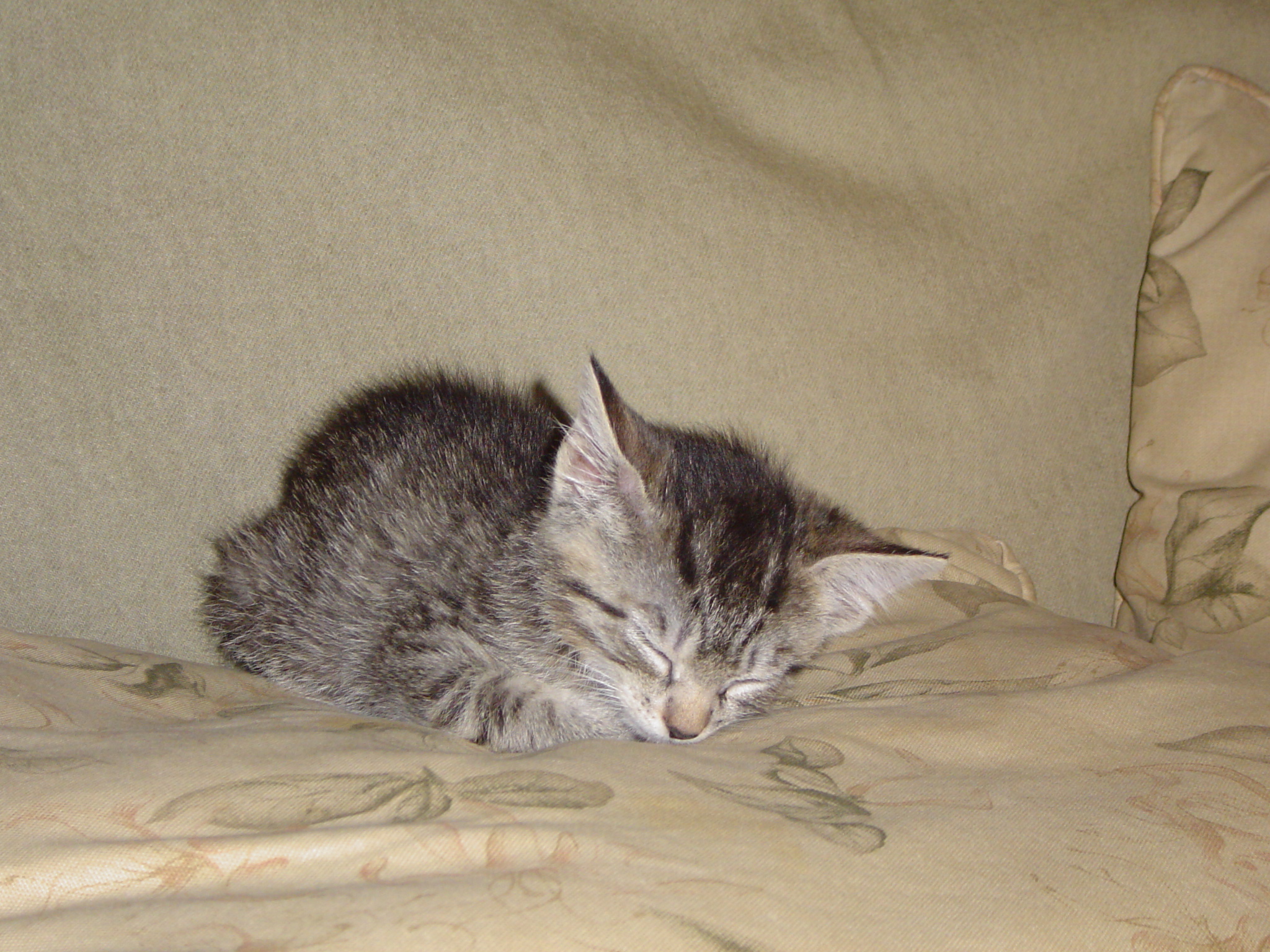
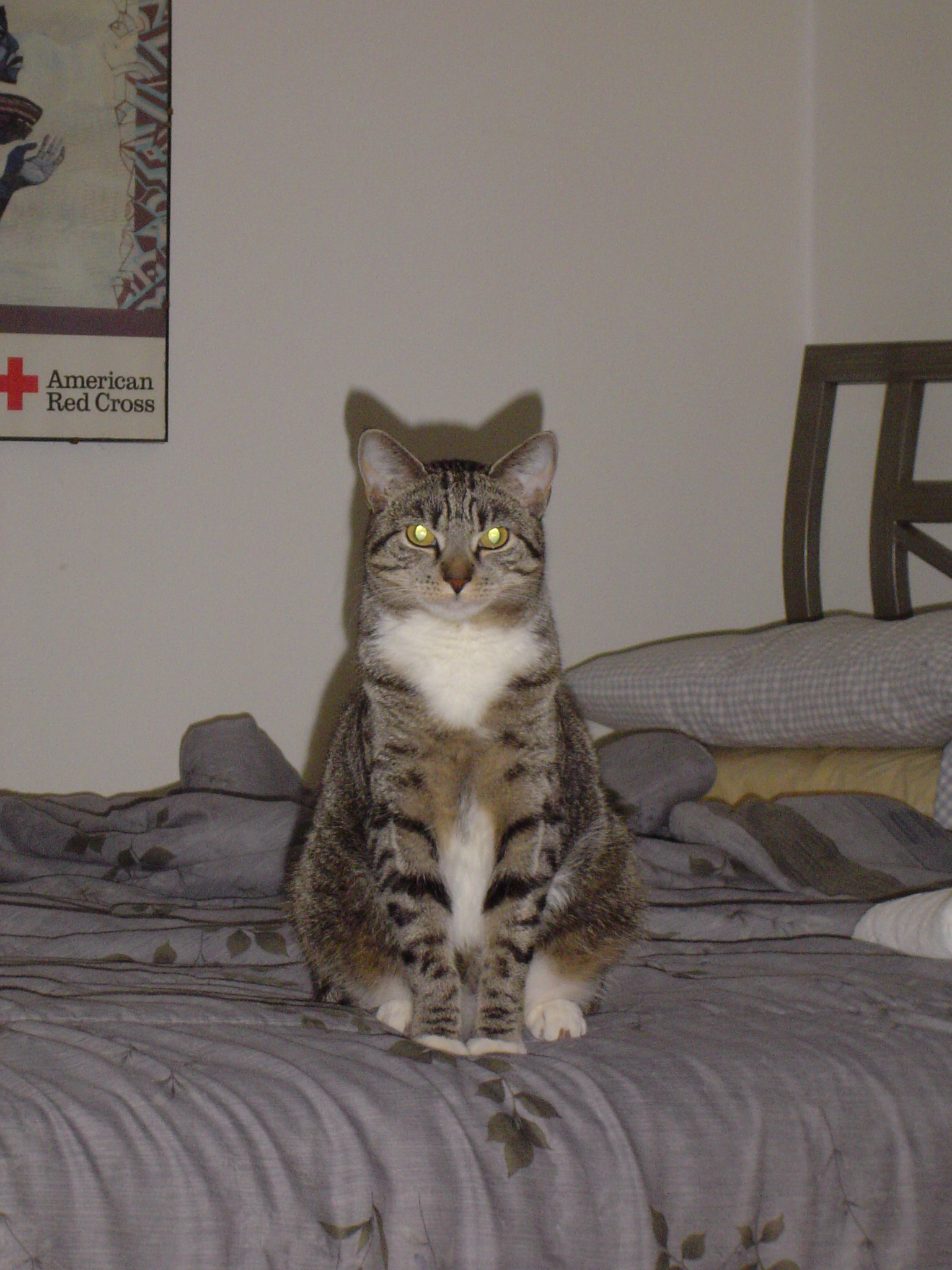
It was only a matter of time before I put up a post about Chloë, Miss Chloë the vet tech calls her at the animal clinic.  She’s my tiger-stripe domestic short hair, and she keeps me company every night while I’m typing on my desktop (or playing on-line Scrabble during my too frequent literary lapses).  My partner and I have a two-bedroom apartment and I’ve dubbed the guest bedroom:  “Chloë’s room,” sometimes to discourage unwanted houseguests, as in “Sorry, but Chloë doesn’t like sharing her room.”  But before Chloë came along, the guest bedroom was my home office so we’ve worked out a co-habitation arrangement—she’s not allowed to jump on the computer desk and I’m not allowed to harass her while she’s sleeping under the guest bed.  Actually, neither of us follow these rules, and we end up glowering at each other for stretches of time over the invasion of our respective personal spaces.  But we never stay angry at each other for long.

The title of this post references Gregory Maguire’s Wicked series (the “animals” and “Animals” that inhabit Oz), and like a true Maguire geek, at least once a week I take Chloë aside and ask her the question.  Chloë is immensely interested in household chores like sweeping, dusting, cleaning the toilet and washing the dishes.  It’s awfully annoying to have someone watching you do all the work without even offering to help out a little.  So my partner and I fantasize sometimes that we could dress up Chloë in a maid’s uniform and cap and have her bus our dinner dishes, tidy up the kitchen, mop the bathroom every now and then.  The least she could do is clean up her own litterbox considering she is so fascinated when I do it.

Chloë doesn’t think much of books.  She prefers television, but when it comes to entertainment, she’ll forsake any kind of media for the joy of attacking my shoe laces or batting around a shiny piece of foil.  She’s really quite a tom boy.  When we bought her a fancy glass beaded collar, she was insufferably tetchy and greatly relieved when we took it off of her.  But in case any Christian evangelists are thinking that her unladylike tendencies (she’s downright bullying at times) are the result of her upbringing by two dads, let me make this clear:  she was born that way.  At six weeks old, she used to chase me around the apartment like Davey going after Goliath.  I like to tell our friends that Chloë is a lesbian, but really, Chloë keeps her own counsel regarding matters of the heart.  It wouldn’t matter to me if Chloë chose a boy cat or a girl cat.  I’m open minded that way.

Someday I’ll write a story about Chloë.  It will have to involve birds, toilet flushing, chewing up flower arrangements, cracker boxes—all her favorite things.  I envision something in the thriller genre, maybe a detective novel, though she doesn’t have a long enough attention span for a convoluted plot.  Or mayble I’ll write a story in the vein of M. Night Shyamalan.  Like most cats, Chloë can see dead people.