Gay Pride and Political Awakenings

June 2010.  LGBT Pride events are happening across the country to commemorate the 1969 Stonewall Riots.  Some nifty trivia: in Germany and Switzerland,  the Pride celebration is called Christopher Street Day (CSD) because the riots,  considered the spark that ignited a Gay rights movement in the US and around the world, happened on Christopher Street in New York City.  Another reason why NYC really is the center of the universe.

Gay Pride rankles some people.  And not just non-gays but gay folks too.  You hear the angry questions:  Why do gays need a parade?  Why isn’t there a Straight Pride march?  Why does Gay Pride have to be so in your face with drag queens, dykes on bikes and leather daddies?

My thoughtful answer is:  Gay Pride is about community celebration and empowerment.

My less thoughtful but more gratifying answer is:  Sorry but you just don’t get it.

I saw my first Gay Pride parade when I was five years old.  My family went to Provincetown every summer for vacation , and it’s a great oddity of my childhood that years before I would come to terms with my sexuality, I was immersed in the gayest community in the Northeast.

I remember the parade seemed to just up and happen all around us—men in wigs and impossibly high heels, shirtless guys holding hands, floats filled with people wearing so much make-up I thought they were clowns.  I wasn’t scared, more curious than anything, and I certainly had no idea what it was all about.  But my parents quickly ushered me and my brother down a side street and away from the commotion.

We stopped going to P-Town a few years later when my mom heard about a deadly disease infecting gay men and worried that it was contagious.  Our family vacation moved to “safer,”  more “family friendly” places like Nantucket and Kennebunkport, Maine.

I wouldn’t see another pride parade until I was twenty-two years old.

But my social-political consciousness started growing before that and continues to grow today.  The seeds were planted early, and I credit my mom.  Notwithstanding her past squeamishness about gay people (she’s become a quiet but adamant supporter of gay rights since then), she instilled in me strong values, wrapped up in something she told me at a young age:  “Your only obligation in life is to help make the world a better place.”

I took her words to heart.  In grade school, I used part of my allowance to make contributions to the National Wildlife Federation.  In junior high, I passionately debated gun control against my NRA-influenced peers.  For my high school newspaper, I wrote op-eds against censorship in music and anti-youth discrimination by local merchants.   And while lacking the ability to accept myself personally, I always stood up for gay rights.

My first real foray into political activism happened when Operation Rescue, Randall Terry’s pro-life extremist group, came to Buffalo to picket abortion clinics.  A bunch of us, all guys, decided to participate in an early morning counter protest.  Admittedly, it was an impulsive decision—we’d been up all night drinking beer (we were college students).   We held up signs, chanted and stared down the faux-fetus-wielding bible-thumpers.

In the dim light of wintry upstate New York, that was my moment of recognizing political power.  It was some parts internal and some parts external.  I felt with certainty that what I was doing was important and right.  I was surrounded by people who also believed as I did, and they believed, we believed together that we could make a difference.  I sought out that experience again and again at college demonstrations for divestment from South Africa, Earth Day rallies, anti-war protests (the first Persian gulf war:  NO BLOOD FOR OIL) and many, many gay rights causes.  And in recognizing my political power, I began to recognize myself.

Nowadays, I go to Gay Pride events to support the organizations, hold hands proudly with my partner, and feel the rush of thousands of us taking over the streets.

Somewhere at every parade there’s someone, young or old, taking part for the first time.  Somewhere,  someone is awakening to his or her political power.

Happy Pride!!
What Dr. Seuss Taught Me About Homophobes

I don’t often blog about current events, but there have been so many things happening in the arena of gay rights, I felt like chiming in this week.  This post also gives me a chance to explain my long-held, personal conviction that Dr. Seuss taught us everything we need to know about the politics of exclusion.  More on that later.

It’s nearing prom season, and each year for the past 15 years or so, there have been news stories big and small on the fracas over lesbian and gay couples attending.  It’s a positive sign that more teenagers are feeling comfortable coming out as gay.  Unfortunately, for many of them, participating openly and normatively in high school traditions requires lawsuits, grassroots activism and a big whooping of community outrage.

The gay/prom debate has been the source of literary and cinematic inspiration, vis-a-vis Aaron Fricke’s personal memoir “Reflections of a Rock Lobster” and the Canadian flick “Prom Queen” with Kids in the Hall’s Scott Thompson.

This year, a prom story made national headlines, morning news shows and even Ellen.  Constance McMillen, an 18-year-old senior at a public, rural Mississippi school, challenged a prom policy of heterosexual-only dates, and the school district responded by cancelling the prom for all students.   The logic was thus:  if no students get a prom, no one’s civil rights are violated.  Seems more like an elementary school teacher’s policy to me, e.g.  “You can’t chew gum in class unless you have enough for everyone.”   The problem is, by high school, kids understand the concept of individuality.  Not everyone wants a stick of your banana-mango gum, and that’s just fine.  Constance knew the score, and she got help from the ACLU.  The case went to a federal judge who ruled that Constance’s constitutional rights were violated but a trial will be underway later in the year.  As a sidebar, cancelling everything for everybody has been a gay exclusion strategy on numerous occasions when students have tried to start Gay/Straight Alliance clubs; the school district bans all student clubs.

We also have in the news a Pentagon committee reviewing the Bill Clinton era military policy “Don’t Ask, Don’t Tell.”  So far, they’ve determined that the policy has, at times, been unfairly implemented.  This, after 17 years of enforcing a system of privilege for heterosexual military men and women and discharging over 13,000 gay troops.   But it takes time, they say, to evaluate how gays can be better integrated while ensuring the rights of all (read:  heterosexual) servicemen and women.  Meanwhile, gays serve openly in the armed forces of just about every other industrialized country:  the United Kingdom, France, Russia, Israel, to name a few.

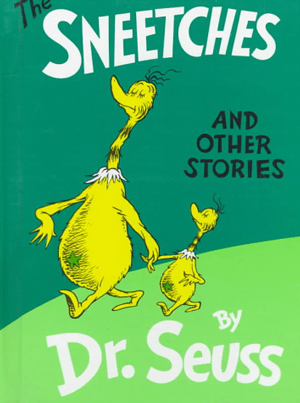
This brings me to “The Sneeches” by Dr. Seuss.

“Now, the Star-Bellied Sneetches had bellies with stars.

The Plain-Belly Sneetches had none upon thars.

Those stars weren’t so big.  They were really so small.

You might think such a thing wouldn’t matter at all.”

But the stars mattered quite a bit to the Sneetches, and when a fast-talking salesman with a star-making machine shows up, chaos ensues.  Stars on bellies become déclassé with the help of the salesman’s star-removal machine; then, as the nouveau starred Sneetches go through the removal machine, stars become chic again, and over and over, the symbol of privilege changes, culminating in a frantic assembly line of Sneetches running from one machine to the other.  They end up losing track completely of who had stars on their bellies in the first place.  The lesson:

” The Sneetches got really quite smart on that day.

The day they decided that Sneetches are Sneetches.

And no kind of Sneetch is the best on the beaches.

That day, all the Sneetches forgot about stars and whether

They had one, or not, upon thars.”

I don’t know if Dr. Seuss had gay rights in mind when he wrote the story, but for me, it’s always captured the essence of the debate.  Whether it’s homophobes talking about how opening marriage to same-sex couples will tarnish their sacred institution.  Or “moderates” saying they would never deny gay people their rights, but Marriage is for heterosexuals and gay couples can be recognized just fine through “domestic partnerships” or “civil unions.”  Or a school board that would rather forgo a high school prom than condone the participation of gay couples.  Or military generals claiming it’s just not so simple as to allow gay people to serve openly in the armed forces—it’s an organization steeped in centuries of heterosexual tradition, after all.

Yes, the answers are often simple.  Many of us learned them in a children’s picture book.

A Quickie

I’m jotting off a little post in the midst of a heavy work week and health insurance headaches (health insurance companies are Evil, medical facilities are Evil, they are all EVIL!!).  But I’m nearly done with an article on John Rechy’s City of Night, and it should be cross-blogged here and at La Bloga soon.  I haven’t returned to editing my novel, somewhat intentionally.  Now with two weeks distance from the last draft, fully de-pressurized I think, I’m ready to go back.  To get a leg up on “angel” novels, I started reading Anne Rice’s Angel Time.

And a word about the Oscars…

Sometimes it’s more about the acceptance speeches than the cinematic performances, isn’t it?  So while I’ve seen neither The Blind Side nor Crazy Heart, I was delighted that Sandra Bullock and Jeff Bridges won.  I did see Precious and loved that MoNique got Best Supporting Actress.  Beyond that, I decided it was time for me to see The Hurt Locker and Up In The Air.  Wish there had been more of Steve Martin and Alec Baldwin and less Best Picture segments.  I agree with the principle of nominating more movies to encourage folks to check out worthy, sleeper flicks, but it sure made the awards show drag.

Why I love Reality TV

I don’t watch a lot of television, but when I’m watching it’s usually Reality TV.  Some lazy Saturday mornings, I’ll veg out to Bravo for hours where the shows range from the highbrow (Top Chef) to the despicable (The Real Housewives Series) to borrow from New York Magazine’s Approval Matrix.  But I love them all.  In fact, I find I no longer have patience for network dramas and sitcoms.  There’s too much predictability.  And if I’m looking to get caught up in a plot, I’d rather watch a movie where things are wrapped up in a couple of hours, or better yet, read a book.

Everyone likes to pick on Reality TV whether they think it’s cruelly exploitative or a cesspool of pseudo-celebrity.  I agree in some cases it deserves both raps.  But for pure, instant gratification entertainment, I submit to you that Reality TV can’t be beat.

Reality TV has elevated the relatability of TV characters by replacing actors with average Joe’s and Jill’s.  And where the Reality stars are not average, it’s given us over-the-top, have-to-be-seen-to-be-believed characters that I don’t think would be possible to create in another format.  I’m talking about the “train wrecks.”  It started with Anna Nicole Smith, went through several derivations on VH1 (Flavor of Love, I Love New York) and is alive and well in any Bravo Real Housewives Series (Kim from Atlanta is my personal fave).  You could say on the one hand that people tune in for the voyeuristic thrill or to feel reassured about their own crummy lives by witnessing colossal acts of humiliation.

For me, train wreck Reality TV stars evoke complex emotions.  Amused disbelief–can this person be for real?  Unexpected moments of empathy–does the person realize how ridiculous they look and sound?  Insatiable curiosity–how will she feel when she watches the playback??  But even when Reality TV doesn’t employ train wreck characters, it pulls me in through the ever present question:  “If thrown in this situation, how would I react?”

As storytellers, Reality TV shows know that in order to have drama, you have to have conflict.  Yes, the conflict is often manufactured.  The worst example is Jerry Springer-style shows with their “surprise” guests and “shocking” confrontations.  But at its best, Reality TV knows how to heap on layers of conflict, all reaching a breaking point in the last five minutes of the show.  Someone gets voted out.  Someone wins the big challenge.  A contestant buckles under pressure and quits the show.  Then like a soap opera, the story goes on leaving you hungry for what will happen next.

Reality TV subscribes to a dubious set of values.  Physical beauty is everything.  Vanity is good.  It’s OK, even necessary, to win at the expense of other people.  It can play to all of the ugliest impulses of human beings (much like the Republican party).  But there are paradoxical moments that give me just enough reassurance that, as in the real world, things ain’t all bad.  Sometimes the little guy wins out.   When someone pushes themselves to reach a goal, there’s rewards (both intrinsic and material) to be had.  In the end, Reality TV’s dogged assertion that anyone can be famous is an infectious kind of optimism.  It may show people at both their best and their worst, but for me that central message is something worth tuning in for.

First draft finished!

Ahead of schedule, I finished the first draft of my novel last night.  It stands at 287 pages, 75K words.  I’m excited to have reached the end, but there’s a sense of sadness that comes with the completion of this writing phase.  No more jotting down fresh ideas for the story on the train, in between meetings at work, or via e-mails to myself.  Permission to write whatever I want has been officially withdrawn.  It’s on to the editing phase where hours (days sometimes) worth of work will be mercilessly annihilated with the stroke of a delete button; weakly-executed through-lines will test my faith; and there’ll be no quick fixes for areas of contrived plotting, character inconsistencies and cringe-worthy passages.

Yes, I’m being a bit of a drama queen about this.  But I’ve been through editing a novel manuscript before (THE REGISTRATION) and it was pretty horrific.  So maybe it’s like rounds of chemotherapy, getting easier each time.  Maybe it’s all in the right attitude.  I will be approaching my edits differently, taking the advice of writing guru Jack Bickham.  I’m setting the manuscript aside for a couple of weeks.  The idea is to let the brain cells regenerate and new ideas emerge.

In the meantime, I’ll be turning back to some of my short fiction projects.  I recently posted IN A WINE PHASE on gayauthors.org, a fantastic on-line writer’s community.  I’m continuing to look for a home for MIKE’S POND.  Maybe I’ll even churn out a new story during this break.

Oh – and why the pic of Robert Verdi?  I love his new show!!