Media Advisory and Fave Video of the Week

Two articles of mine go live in the span of two days.

First, an opinion piece “Diversifying books for teens,” inspired by #YesGayYa, will be up on La Bloga Sunday, October 9th.

Then, I have a review of DC Comics’ relaunched Aquaman #1 coming out Monday, October 10th as part of the Comics Project.  It’s hosted by writer Kelly Thompson, of the comics/graphic novel blog 1979semifinalist and 3 Chicks Review Comics.

Meanwhile, I’m querying, tarrying and not yet despairing.

Here’s my favorite video of the week.  #OccupyWallSt.  Social justice and collective action!

Embedly Powered

Short Story Publication News, and Other Stuff

Gotta say, I’ve had a patch of good stuff happening lately.  From my videotaped reading coming out earlier this week to getting an acceptance from Wilde Oats for my short story Mike’s Pond, I’m feeling pretty proud of meself, and lucky.

Wilde Oats Issue Nine will include my short, fictionalized memoir Mike’s Pond about growing up in suburban Western New York.  The issue comes out in December, and I’ll be sure to do a major blast on the release.

I also have a guest blog up today about working with LGBT teens in the suburbs.  It was a great opportunity offered to me by author/blogger Brandon Shire.  Brandon recently published The Value of Rain, a novel about a gay teen who gets sent to an institution to turn him straight.  He’s donating half of his book sales to LGBT youth agencies, and he was kind enough to do a plug for Pride for Youth, where I work.

I’m still following Yes Gay Ya, and working on an article about diversifying young adult literature.  Since Rachel Manija Brown and Sherwood Smith put out their testimonial on censorship, Colleen Lindsay leant her platform The Swivet to Joanna Stampfel-Volpe of Nancy Coffey Literary Agency to tell a different side of the story.

Stampfel-Volpe writes that the authors leaked the name of the agent they accuse (from Nancy Coffey); the agent never offered representation on the condition of cutting out a gay character or making him straight; and the Genreville article is a mean-spirited publicity stunt.

Only a fly on the wall knows the truth.

But out of the kerfuffle, there’s an opportunity to look critically at the status of LGBT YA, and how we can get more and better representation of LGBTs in literature.  That’s what I’m writing about.  Deep stuff.

Live Reading from The Seventh Pleiade

Pretty cool — thanks to the 2011 Lambda Literary Foundation retreat, I have my first videotaped reading.

It’s from my novel THE SEVENTH PLEIADE, an excerpt from midway through the story when things are heating up for the hero Aerander.

Let me know what you think!

Embedly Powered

via Vimeo


Back to the Grind

I’ve been tight-lipped here for a little while, owing to a walloping on a couple of fronts.

I’m teaching my first ever college class this semester, balancing that with my full time job, and trying to widely hedge my bets on an agent for The Seventh Pleiade.

(You can all put down your bets on how soon the mental breakdown will arrive).

So, on the agent front, I’ve got some folks reading my full manuscript. Cross your fingers!  Querying/pitching is pretty torturous, but at least this time around I am getting some response.

Also on my mind lately:   Lambda’s announcement about changing guidelines for its 24th annual awards.

Responding to strong criticism about restricting nominations to self-identified LGBT authors and poets, Lambda’s Board re-opened the field to all writers, excepting three categories that recognize authors in stages of their careers: debut, mid-career, and lifetime achievement.

I’ve got a heap of mixed feelings about the announcement.   On one hand, exclusion rarely feels right to me.  When authors — LGBT or not — write fresh and honest stories about queer people, they are part of a united fight against censorship and marginalization, which are still very real obstacles in publishing.   Increasing the number of good queer portrayals is something to be lauded whether the author is non-LGBT, like George R.R. Martin (Song of Ice and Fire), or gay, like YA author David Levithan (Boy Meets Boy, Wide Awake).

On the other hand, I believe there is a need to celebrate queer authorship specifically, to have an occasion where people step up to the podium and validate that being a queer author matters.   It’s not just about the content of our work.   Queer authorship is a tradition, a history, a common struggle, and a triumph.   By celebrating queer authors, we celebrate more than simply queer themed work, as though it were a genre of fandom, like sci fi or romance.   We’re celebrating, and creating, community.

According to Lambda’s Executive Director Tony Valenzuela, the organization does not anticipate the policy change to have an impact on the number of queer authors nominated.   There were no restrictions on nominees for most of the Lammy’s history (notwithstanding the period of 2009-2010, when a 2009 policy was in effect restricting most awards to LGBT authors).

In correspondence with Valenzuela, he pointed out to me that queer authors have always competed extremely well, even dominating the competition.   Says Valenzuela:   “I don’t see that changing anytime soon.”

The Queer Matrix Through the Decades

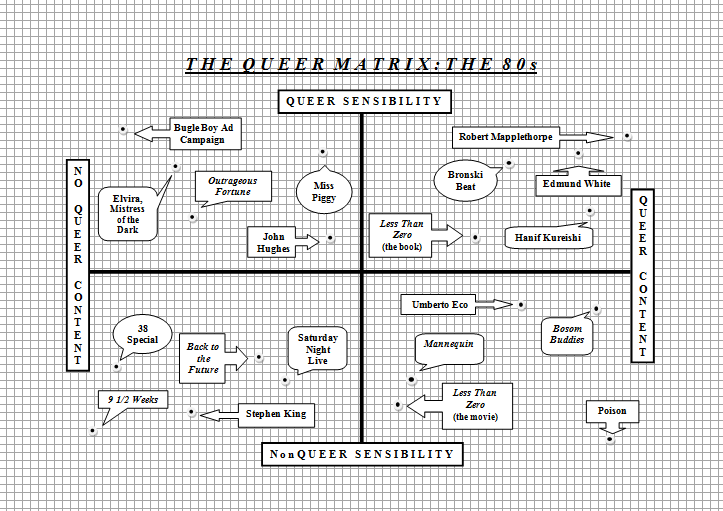
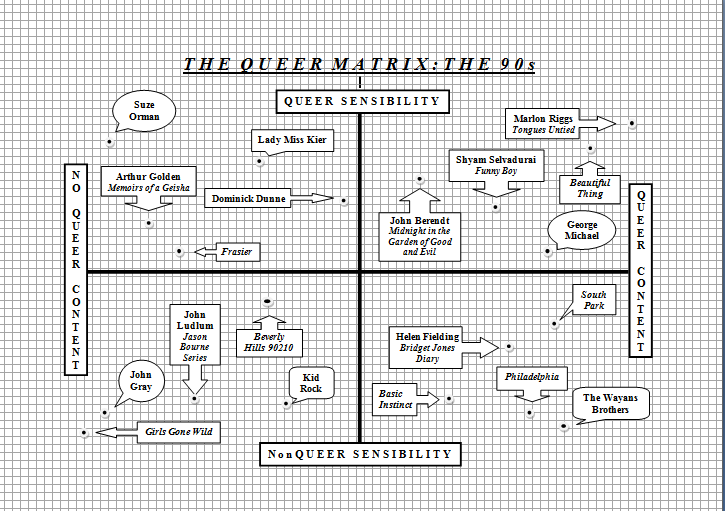
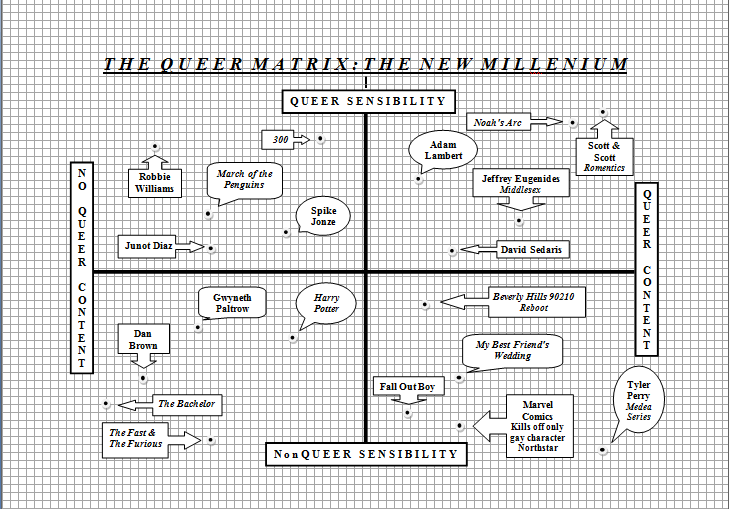
Hoping not to prove you can have too much of a good thing, I’m continuing my queer ponderings this week, visual arts-style, with new Queer Matrices.

I spent way more time on these than I’d like to admit, but the results are quite a bit more polished than last week’s laughable mock-up.  I guess I was the last to know:  you can’t do diddly in Paint.

Some definitions first…

The X axis is Queer Content, which could include portrayals of same sex love and relationships, homoeroticism, gender bending, trans experiences, drag, or any representation of queer culture, politics and/or community.

No Queer Content is the absence of any of these.

The Y axis is Queer Sensibility.  The way I define it is looking at the world with a queer lens, through which homoeroticism and same sex love are celebrated, transexuality is transcendent, queer oppression is illuminated and indicted, and heteronormativity is challenged, subverted, and asked to please leave the building.

Non Queer Sensibility is the opposite, meaning looking at the world with a non queer lens, through which heteronormativity is centralized, traditionalized and/or assumed, a gender binary is de rigueur, and opposite sex relationships are the default setting.

Now we’ll take a look at Queer Matrices through the decades…


So what’s next?  The Queer Matrix:  Boy Bands?  Disney?  Punk Music Icons?  I’m open to entertaining suggestions.