Gregory Maguire’s The Next Queen of Heaven

Showing how far behind I’ve gotten in my reading, I just finished Gregory Maguire’s late 2009 release The Next Queen of Heaven.

If you’ve poked around my site, you know Maguire is a literary hero of mine (maybe you noticed a particular sidebar icon).   My appreciation for Maguire is manifold:   his intricately re-imagined fairytale worlds, and the sly twists therein; his sense of humor—a winning combination of absurdity and crotchitiness; and his expert rendering of hapless anti-heroes.

The Next Queen of Heaven has all of these peculiarities to recommend it.   Even as a departure from Maguire’s retold fairytale stock, there’s still a backdrop of magic and myth, vis-a-vis the Virgin Mary and the simmering possibility of another Christmas “miracle” in the works.

A little synopsis:   40-something, thrice divorced Leontina Scales is desperately concerned about her 18-year-old daughter Tabitha, a foul-mouthed, intractable, near drop-out high school senior with a knack for sleeping around with small town losers.   So Leontina stages a paradoxical intervention.   She’ll show Tabitha the error of her ways by shaming her with a strong dose of bad behavior.   But the plan is thwarted when Leontina gets accidentally hit over the head by a falling Virgin Mary statuette, rendering her aphasic and unable to care for herself (or, maybe it was all part of her plan).

Not a bad premise, and combined with the setting—the marginal upstate New York town of “Thebes,” that’s inching toward Y2K with angsty superstition—things start off with plenty of quirky narrative drive.

I laughed out loud quite a bit while reading, particularly during Tabitha’s wry, fatalistic observations, and a hilarious Christmas pageant scene that is some of Maguire’s best literary humor ever.

In a sense, he’s freer to take things to extremes with an original story.   And, at the same time, there’s an added relatability to his contemporary characters.   Passages about Tabitha’s discovery of sexual pleasure, with the local bad news-heartthrob Caleb, are haltingly vivid (not graphic).   Brought in later to the story is co-protagonist Jeremy Carr, who can’t break free of a shattered love affair, or the small town Catholic community where his gayness is a dirty secret.  He’s the kind of guy most of us know, or have known.   The denizens of tNQoH’s Thebes are each uniquely handicapped by personal hang-ups, but not meanly so.   Even the homophobes, like Tabitha’s brother Hogan, manage to achieve a measure of redemption in their earnest, if misguided pursuits.

They’re doing the best they can with what life dealt them.

Maguire’s break into contemporary, realistic fiction (realistic applied loosely:::things approach send-up on occasion) is not without its uneven moments, however.   Things start out quick, drag in the middle a bit, then pick up nicely.

It’s an issue of the narrative drive not quite meeting the demands of the subject.   A degree of character floundering by Elphaba in Wicked, or Liir in Son of a Witch, worked well for Maguire’s epically lost heroes, where the scale of personal, even philosophical, discovery was vast.   But in a modern context, where the characters’ problems are “smaller” and more familiar, the meandering character journeys get a little sluggish.

For a good part of the story, Tabitha is on a search for Caleb, who has clearly moved on from their sexually-charged relationship, and I was anxious for her to move on too.   Same thing with Jeremy, who is shown in repeated scenes of passive snits with the guy who dumped him.

A plot diversion in which Jeremy’s gay men’s chorus (actually, a trio) has to negotiate rehearsal space at a neglected convent—the Sisters of Sorrowful Mysteries—provides a clever observation about what gays and nuns have in common in a heteronormative society.   But it doesn’t quite hit the wacky heights of life with the Maunts of the Cloister of Saint Glinda from the Wicked trilogy, of which it is a rather plain derivative; nor does it serve such a critical purpose.

As Maguire’s first work that explicitly deals with modern gay and bisexual men and their troubles, tNQoH treads familiar themes—AIDS, loneliness, estrangement from family—but the delivery is matter-of-fact and ultimately heart-warming.

Tabitha’s younger brother Kirk, the beleaguered “good son” of the family, is immensely charming, and a spot-on portrait of queer coming of age.   The bisexuality of Willem, Jeremy’s old flame, is handled equitably and effectively, forgoing a typical “is he or isn’t he?” debate (or at least, that’s up to the reader to decide).

Everyone, gay or non-gay, is looking to escape something, in most cases the social confines of Thebes itself.   Like much of Maguire’s work, the future of these embattled characters is unclear; but there is hope.   For Jeremy, it comes in an opportunity to get discovered while performing at an AIDS charity concert in New York City.

So, my bottom line:   the journeys here are worth following.  Will sexually-loose, ungoverned Tabitha make something of herself?   Will Jeremy transcend heartbreak and musical mediocrity?   And there’s worthwhile wisdom along the way, i.e. if you always do what you’ve always done, you’ll always get, what you’ve always got.

tNQoH gets my full-on recommendation, even if it doesn’t sustain the engrossing quality of Maguire’s re-imagined subjects, my favorites—Wicked, Son of a Witch, and Confessions of an Ugly Stepsister.

Randomness

Squeezing in a quick post this week while I’ve been writing around the clock, mainly for work (grant proposal) rather than my own projects (sigh).

I thought I’d just talk about some random things that inspired me this week…

1. Thor, the movie.

I’m usually disappointed by big budget, action/adventure Hollywood films, but Thor was so good, on so many levels.

First level—a fantasy world that is not a thinly veiled allegory for America, at its freedom-loving, platitude-wagging, jingoistic best.   (I love freedom too, but I prefer it with a touch of subtlety).

Second level—a hero who starts off as a (believable) jerk, and ends up as a (believable) hero.   Chris Hemworth plays it just right:   a swaggering, single-minded hunk when he needs to be, and a broken outcast, later, who quickly gets himself back on track.   Bravo.

Third level—Natalie Portman.   There is no role too cliche or doofy that she can’t make work.

2. An Archie comics character comes out.

I haven’t read the series since, erm, 1985, but I’m feeling the joy.   Positive LGBT media representations!!

3. Beta readers.

Just got myself a new one and—wow—she’s good.   Not all writers are good critiquers, and the opposite is true as well.   But this new online friend (I can’t reveal her name because she’s shy) really made my week with incredible, thoughtful feedback on a short story I’m getting ready to submit.   Thank you (you know who you are).

4. French Open Tennis.

The most obscure Grand Slam event is also, kinda, my favorite.   Because it’s an underdog kind of event, and it’s weird playing on clay, and there’s longer rallies, and spins, and strategy, and it takes place in Paris for chrissake!

This year it’s an open field on the women’s side, and, arguably, up for grabs between the top three seeded men. And two of my favorite longshot female players are still in the draw: Marion Bartoli and Li Na. Awesome.

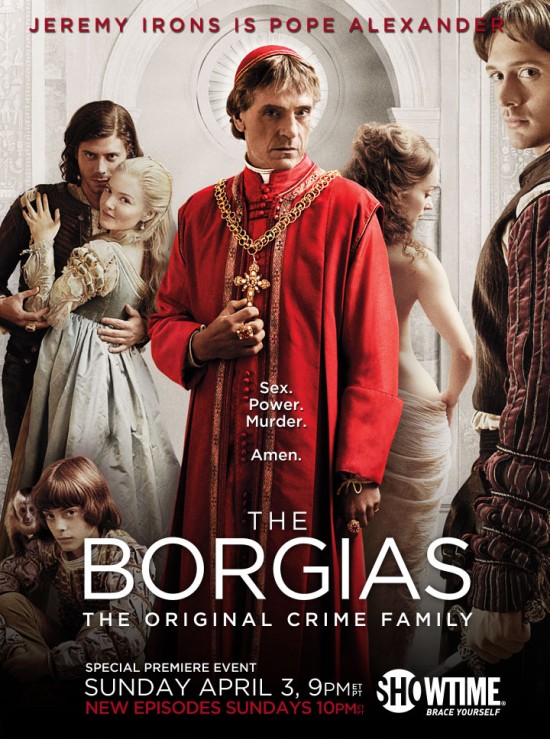
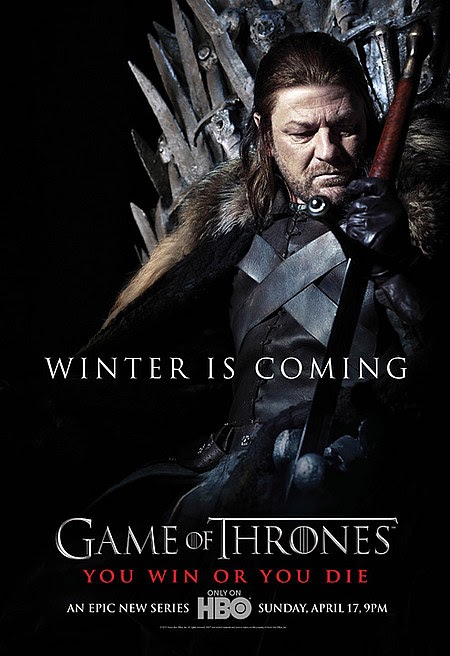
Mini-Series Wars: The Borgias vs. Game of Thrones

Epic family drama.   I cut my teeth on 80’s classics like The Thornbirds and Lace, and—more recently—was a huge fan of HBO’s Rome.

This Spring brought two promising series:   Showtime’s The Borgias and HBO’s Game of Thrones.   I’ve been DVR’ing both shows, and greedily watching them (in my pajamas) on Saturday mornings.

This week, I shall render judgment and declare one show the victor of the battle of my invention:   Mini-Series Wars.

Some might say:   it’s not a fair fight, they’re totally different genres, blah, blah, blah.   I say the shows are similar enough.   Look at the common tropes.

The perennially beleaguered family patriarch:   Jeremy Irons’ Rodrigo Borgia vs. Sean Bean’s Eddard Stark.

The seductive villainess:   Holliday Grainger’s Lucrezia Borgia vs. Lena Headey’s Cersei Lannister.

The brooding villain:   Francois Arnaud’s Cesare Borgia vs. Nikolaj Coster-Waldau’s Ser Jaime Lannister.

Plus, despite the disparate genres, both tread the same theme: the struggle for political power.

There are things to recommend each series.

The Borgias recreates a fascinating time in European history, centered around the scandalous Rodrigo Borgia who bought the papacy.

Game of Thrones brings to life a medievalish world based on George R.R. Martin’s epic fantasy novels.

The Borgias has halting sequences that are violent but effective, a few young actors who are easy on the eyes—Elyes Gabel (Prince Diem) who died too soon—and a scene stealing Holliday Grainger portraying Lucrezia Borgia in her formative years.

Game of Thrones has epic landscapes befitting its epic range, many original, compelling characters—Peter Dinklage’s Tyrion Lannister is my favorite—and a decent gay romance between King Robert’s younger brother Renly and the knight Ser Loras.

(The Borgias has nothing gay going on, unless you count Augustus Prew’s fey and demented Alphonso II of Naples, and let’s not).

Both series rely on complex political storylines, which can be difficult to render without dim sequences in which the characters recount their history, as though it’s the kind of thing they would naturally go on about with their bedmate after a vigorous snogging. The Borgias uses this device too frequently, I’m sorry to say.  Rodrigo Borgia quizzing his youngest son on the regions and rulers of Italy—in front of a map, no less—is one such flat contrivance.

Game of Thrones struggles with exposition as well, from the other side of the spectrum, i.e. spare explanation. Five episodes in, I still can’t say I understand the relationships between some of the characters, or remember their names, there’s so damn many of them.

So who wins the mini-series war?

I give it to Game of Thrones.

The deciding factor is character portrayal and development, and The Borgias, with all its rich material—the opportunity to bring a new spin to one of the most notorious families in history—doesn’t quite deliver.

It tries to cast light and shade on the villainous Borgias—succeeding to a degree via Irons’ Rodrigo and Grainger’s Lucrezia—but the other two main characters, brothers Cesare and Juan, are too lackluster to care about.  The acting is questionable but equally they don’t have much to work with.  The story does little to explore their motivations beyond a duty to protect their family, and their personal status as Italian Renaissance studs (yawn).

Minor characters do better, such as Colm Feore’s Cardinal Della Rosa, who confronts the inhumanity of a war he started, but there’s not enough of these subtle moments.

Game of Thrones is not without its weak spots. (Harry Lords’ poutily one-dimensionsal Viserys Targaryen leaps to mind).  But overall, there are plenty of characters to get behind, whether from the sincerity of their convictions—the bastard John Snow who wants to join the Night’s Watch—or guilty pleasure of rooting on a compelling bad guy, like Ser Jaime Lannister, or bad girl, vis-a-vis his sister Cersei.

Now, if I could figure out why Danaerys Targaryen being pregnant is such a threat to the entire kingdom, it would be all good.

The Donner Party Re-examined: Gabrielle Burton’s Impatient with Desire

In the spring of 1846, George Donner led his family and eighty pioneers on a trail of opportunity from Illinois to California.  They made it as far as the Sierra Nevada mountains but were trapped by a snow storm.   The mission turned desperate, and a horrifying legend was born.

Gabrielle Burton’s IMPATIENT WITH DESIRE is an intimate re-telling of the journey of the ill-fated Donner Party.   The story is told primarily through the letters and journal entries of Tamsen Donner, a schoolteacher and wife to George Donner, during the time they awaited rescue.

Burton is clear in labeling her work as a fictional account.   But it is based on nearly forty years of her research, a vigorous sideline of the author, which included a family vacation with her husband and five daughters to retrace the steps of the Donner trail.

I grew up with Burton’s youngest daughters Gabrielle and Charity in Amherst, New York, just outside of Buffalo, where the family was a bit of a quirky legend in itself.   While most of us returned from school breaks with tales of mild hijinks, the Burtons typically came back recounting adventures, like hitch-hiking across Alaska, on some journey of rare discovery.   Gabrielle, the mother, was a local literary celebrity, who knew cultural icons—well-beyond our suburban social set—like Gloria Steinem.

Burton, who has garnered praise for her portraits of women (her debut novel Heartbreak Hotel) and contributed extensively to feminist discourse over the past four decades, casts Tamsen Donner as a compelling heroine.   Tamsen is self-assured, well-educated, and an independent thinker.   She prefers collecting botanical specimens for her students to baking pies, she asks her pastor to remove the words “to obey” in her marriage vows, and she has clever observations on gender inequality in the 19th century, which still resonate today.   One of my favorites:

George (Donner) is the most equitable man I have ever met—though sometimes it seems to me that a man who simply acts like a decent human being gets undue praise.

The narrative never strays from Tamsen’s point of view, but she is a circumspect and reliable storyteller.   While stranded with her family at a makeshift camp, she records the daily life and the history.   Given the subject, I found myself squinting ahead to the inevitable conclusion of months of communal starvation.   But there are arresting stories of the hopes and tragedies of the pioneer women and men, before they reached an impasse in the mountains.   They are delivered in simple, haunting detail, such as the story of the Flemish immigrant Hardcoop, who was left behind by a trailing faction of the party when their progress through steep terrain required dismounting the wagons and pulling them along on foot.   Reflecting on the night when her husband tells her the news, Tamsen writes:

No matter how tightly I closed my eyes, all I could see was the same debased image:  an old man crawling toward disappearing wagons.

While Tamsen Donner takes on the role of historian to the party, for example, recording each death in her journal—whether stranger, loved one, or villain—with impartiality, the greater sum of her writings is the elucidation of one woman’s life.

Tamsen was the daughter of a Sea Captain, who encouraged her dream of traveling, at a time when women were expected to stay close to the home.  She was heartbroken by the death of her first husband and one of her sons, but she ventured beyond a life of widowhood to find happiness in a second marriage.  She was fiercely devoted to the promotion of her daughters, accepting the brand of unspeakable inhumanity so that they might survive.  Living under the authority of men, she emerges as much (or more so) as the leader who rallied her counterparts to take the chance to better their lives, and she stewarded morale and comforted them when grief and fear left them broken. Through her painful search for understanding of how a well-intentioned mission could have ended so terribly, she arrives at the conclusion:

I leave it on record that this adventure has gone more horribly wrong than anyone could ever have imagined, and I bear equal blame, as I would have deserved equal credit had it gone right.

IMPATIENT WITH DESIRE is available in hardcover, paperback and Kindle editions at many independent booksellers.

Rating Historical Fiction for the Classroom

I’ve been reading a lot of novels set in ancient times.   It’s a way to maintain the mood and sensibility of my work-in-progress, and  Ancient Greece and Rome were my favorite eras in Western Civ, way back in the day.

Writer Anne Bedichek Braden has launched an excellent website for teachers looking for good historical fiction to incorporate into their classrooms.   I met Anne over at Absolute Write.   She’s a former middle school teacher and currently a stay-at-home mom.   She says the website is one of her writerly projects during “nap time.”    She just completed a novel  1790: ON THE EDGE, which is a young adult mystery that takes place during a turbulent year when colonial Vermonters were deciding whether or not to join a fledgling country:   the United States.

Anne’s inspiration for Rating Historical Fiction came from her experience in the classroom.   She explains:

“When I was a social studies teacher, I loved using historical fiction in my classroom, but I rarely had time to branch out from the books I already knew.   I could find lists of titles and reviews of books online, but what I really needed to know was whether a book would engage my reluctant students and if it would spark meaningful discussions in my classroom.   Now that I’m a stay-at-home mom I have more time (amazing, eh?), so I started this blog to make it easier for busy teachers to find books that will work with their students.   Also, it’s good for me because as a writer of historical fiction I’m intent on reading as much as I can in the genre, and since the blog collects reviews of others’ favorite books, I’ve already gotten some excellent recommendations.”

For me, historical fiction assignments in middle and high school were hits and misses.   I loved Charles Dickens’ A TALE OF TWO CITIES, hated Stephen Crane’s THE RED BADGE OF COURAGE (as I recall, my book report was based on Cliff Notes), and was fairly apathetic about social studies staple INHERIT THE WIND (though it was the source of many witty fart jokes).   Promoting more recent, ‘relatable’ books is part of the plan for Anne’s site.

“Most teachers are familiar with the classics, but not as many know about the great books that are being published today.  I’m hoping I can collect reviews from teachers who are using recently published books and couple it with an interview of the author. ”

So far, Rating Historical Fiction has reviews of Howard Bahr’s Civil War-story THE JUDAS FIELD; Mildred Taylor’s Depression era/African American coming-of-age ROLL OF THUNDER, HEAR ME CRY; and Laurie Halse Anderson’s FEVER 1793 about the 18th century Yellow Fever epidemic in Philadelphia, just to name a few.   There are also first person accounts of the Holocaust, the Korean War, and the Cambodian Genocide.

Current titles lean toward U.S. history, and the 20th century particularly, but when I was given the opportunity to contribute, I quickly submitted a review of Annabel Lyon’s THE GOLDEN MEAN.   This is an absolutely fantastic book narrated by Aristotle during the period when he tutored the young Alexander the Great.  While highly sophisticated in language and content, I thought it was a great resource for advanced high school students and certainly those in college.  You can check out my review here.