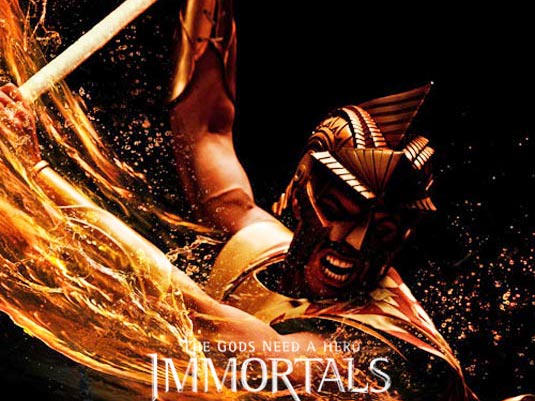
Why Immortals Failed

Sci fi blog i09 recently did an article:  “The 10 Most God-Awful Movies about Greek Mythology.”

Sadly, I have to say Immortals belongs on the list.  It’s definitely worse than #10 Percy Jackson & the Olympians, which I thought was good, harmless fun; and #1 Xanadu, which — c’mon now — never aspired to be more than cult-worthy camp.

I’d even give Clash of the Titans 2010 an edge over this year’s ancient Greek Hollywood tragedy.  At least CofT had a lot of great action sequences.

Immortals is loosely, woefully loosely, based on the story of Theseus, the demi-god founder of Athens, who famously slayed the Cretan Minotaur.  Nonsensical liberties with the source material was where the problems started for me.

Theseus is supposed to be the son of Poseidon, but in the movie he’s the son of Zeus.  His mother was the daughter of royalty, and the wife to a nobleman.  Immortals has his mother as an outcast peasant.  It seemed to me a dumb contrivance to cast Theseus as an underdog the audience *has to* get behind, and already I was annoyed.

Then, the movie muddles the story of the gods vs. the titans.  Here the gods — of whom there are curiously few — have defeated and banished the titans to imprisonment inside Mount Tartarus in a storyline that has more in common with Christian mythology (the exile of fallen angels) than anything ancient world-related.  The titans can be freed by a lost artifact called the Epirus bow (derivation unknown).  It’s a cool weapon, but what does it have to do with anything ancient Greek?

I won’t get bogged down in the other confusing details, because the greater transgression of the film is co-opting Greek mythology for a modern, Christian message.  Like the Clash of the Titans reboot, Zeus is basically the Christian Holy Father done up in Greek fantasy stylings.  It’s a story of good vs. evil, which has no place in the Greek belief system.  The gods were mercurial, ruthless at times, forgiving at others, most definitely to be feared, but flawed by jealousy and pride.  Their stories, their characters, were a reflection of human troubles.

When filmmakers portray that world with a Christian sensibility, they miss the point.  The stories of Theseus and other heroes weren’t about smiting evil and restoring humanity’s belief in a higher power.  They were about claiming glory in a ruthless world, and rarely were there happy endings.  Even after their amazing triumphs – Perseus fulfilling his destiny by slaying the gorgon Medusa or Jason returning with the Golden Fleece — the heroes are typically dogged by tragedy.  Perseus accidentally killed his grandfather, and went into a self-imposed exile.  Jason returned from his adventures to be killed by his wife.  The moral is that glory is fleeting.  There are no absolutes.  Good men come to bitter ends.  The gods keep us all in line.

On the plus side, I felt that Henry Cavill does a decent job as a low-key, reluctant hero, and his fighting sequences were fun to watch.  The costuming for the gods is delightfully over-the-top and sexy.  Mickey Rourke is a suitable dreadful villain (Hyperion) but his gravelly muttering bothered me in this instance.  Stephen Dorff is wasted as a disposable clichéd character – Theseus’ horny anti-establishment sidekick.  And the United Nations of Oracles — a quartet led by Slumdog Millionaire’s Freida Pinto — are just plain ridiculous.

I think a little more 300-style homoeroticism could’ve compensated for a general lack of inspiration.  But at least the men’s breastplates have nipples.

The Judy Gold Show

Got a chance to see Judy Gold’s Off-Broadway Show this weekend — the self-titled Judy Show — and it was absolutely hilarious.

The show hardly needs my humble little recommendation.  It’s been praised by the New York Times, New York Magazine, and Time Out New York.  It opened for a limited run over the summer and has been extended multiple times, most recently through November 27th.

Judy Gold fans will enjoy her stand-by Jewish mother schtick.  And the premise — “My life as a sitcom” — has plenty of nostalgic and ironic appeal for those of us Gen Xers who escaped through television during the discontents of a middle class, suburban dysfunctional upbringing.

As a journey through Judy’s childhood and young adulthood–a tall, awkward Jewish girl looking for love, acceptance and a break as a comedienne–it also has unexpectedly heartwarming moments.  A reflection on the early death of her father, who wanted to support Judy’s coming out, though she wasn’t ready to deal with it herself, is all poignancy and no schmaltz.

You can see the Jewishness was contagious.

The Judy Show is on an extended run at the DR2 Theatre at Union Square.  Discounted tickets are available here.

The Comics Project

DC Comics recently relaunched all of its titles in an effort to boost interest in its superhero franchises — Superman, Batman, Green Lantern —  all of the biggies.

It’s a bold move that has not been without its detractors.  Tampering with sacred superhero mythology does not sit well with some fans, but I can’t say I have much of an opinion since I’ve never been one to pick up comics.

As someone slightly curious about the titles, and raised on Superfriends cartoons, I was asked to be part of a panel of non-comics readers to weigh in on the relaunch from a “layperson” point of view.  It’s part of The Comics Project at author/graphic artist Kelly Thompson’s She Has No Head, a weekly column at Comic Book Resources’ (CBR) Comics Should Be Good forum.

I chose to read and comment on Aquaman #1.  Yes, there was a certain shallowness to my decision.  I had a crush on Aquaman from Justice League.  But, besides being sexy, Aquaman always seemed to me to be an endearingly underappreciated superhero.

I never realized in his story there’s a big connection to Atlantis (duh).  But that’s more of a storyline in the print comics than the TV series.

My review went up today along with reviews by other lapsed or reluctant comic readers, and you can check it out here.

The King of Atlantis looking kind of mean and bitter


Neil Gaiman’s American Gods


I recently completed Neil Gaiman’s AMERICAN GODS, 10th Anniversary edition.

The book had been in my reading queue for awhile while I’m on the hunt for mythology-based fantasy.  AMERICAN GODS is fantasy of an urban/contemporary sort, as opposed to my ancient world/heroic tastes, but the premise was awfully compelling.  Plus, there was the August  announcement that HBO will be producing an AMERICAN GODS mini-series.

The story is about a down-on-his-luck, ex-con Shadow who is pulled into the world of gods  hiding behind America’s everyday reality.  The premise is every generation of immigrants brought mysticism and folktales with them, but as they created a new “American” culture, their beliefs faded, and their Old World gods became marginal sorts of characters like small time con men, prostitutes, drifters and undertakers.

Released early from a three-year sentence to attend his wife’s funeral, Shadow is hired by the mysterious Mr. Wednesday — an alias of the Norse god Odin — to act as a sort of bodyguard and errand boy.  Shadow quickly learns there’s much more going on with the job than organized crime.  Wednesday is rallying the forgotten gods to fight the new establishment that has captured America’s imagination:  the modern idols such as materialism, technology and the media.

In his foreword, Gaiman says he set out to write a long, meandering novel, and long and meandering it is at 500 pages with plenty of plot diversions.  But it’s an immersing story of a large scale, so there’s an epic drive that pulled me forward even through longish chapters that added color to  the fantasy world, or provided a curiously retold parable.

My favorite parable-style chapter was “Somewhere in America,” which concerns a young Arab immigrant Salim who is trying, unsuccessfully, to work as a salesman for his family’s company of touristy knick-knacks.  On the brink of giving up, and returning to his home country in disgrace, he confesses his troubles to an Arab taxi driver who is secretly a mystical demon from Islamic lore.  Salim takes the demon home, they make love, and the demon is gone the next morning.  So is Salim’s passport, which has been replaced with his lover’s taxi driver license, providing Salim with an opportunity to start a new life.

That chapter worked well for me because of my soft spot for gay romance, but it’s one of many literary touches that beautifully articulate the story’s complex themes.  America is a country of immigrants, promising economic advancement, cosmopolitanism, and – in Salim’s case – sexual liberation.  At the same time, it’s a land of assimilation where newcomers abandon their cultural traditions in the pursuit of social mobility and personal independence.

On that level, AMERICAN GODS is a traditional tale of the discontents of modern living, which force people to relinquish their soulful natures.  But it also poses deeper questions about the nature of Old World mysticism and the secular materialism of the day.

The old gods have their quirky charms – the swearing, drunk Leprachaunish Mad Sweeney, and the gruffly earnest Czernobog, a Slavic god of death who misses the good old days of bludgeoning men with his hammer – as opposed to the embodiments of commercialism with their slick-backed hair, expensive suits and sunglasses.  But the brutality and trickery of the old gods brings up equally profound challenges for Shadow.  Are there moral truths behind their capricious ways?  Even if so, are there sacrifices too big to make in order to preserve cultural traditions?

In the end, a touch of sentimentality redeems Mr. Wednesday and his pantheon.  Shadow is a tool in their spiritual survival, by but showing himself to be sincere and selfless, he is given a chance for resurrection—both literally and figuratively—which is an opportunity that’s difficult to imagine if he were playing for the other team.

My occasional qualm with the book is the spare characterization of Shadow.  At times he seems to be a heartbroken drifter—and rightly so—and at others he’s a remarkably cool-headed observer of the bizarre, metaphysical vagaries surrounding him.  I suppose he’s written to be an Everyman character, taking in his fantastical circumstances with a degree of distance.  It’s a minor point, but I found myself wanting a bit more disbelief and emotion from him.

Still, this extraordinary book shows off Gaiman’s sly use of imagery, symbol and foreshadowing.  The ever present coin tricks keep the story grounded in the contemporary while setting up the possibility for magic.  Wednesday’s tales of old time con jobs provide a clever tie-in to the story’s bigger themes of belief and deception in consumerism, religion and love.  A side-story mystery concerning generations of disappearing teens in a small Minnesota town comes to a satisfying resolution through deciphering a “hiding-in-plain-sight” villain (and a clever play-on-words).  Well-done indeed.  I expect the story will be in good hands for a small-screen adaptation by HBO, based on the company’s success with George R.R. Martin’s SONG OF ICE AND FIRE.

Studying Heroic Fantasy: David Gemmell’s Lord of the Silver Bow

Three posts in as many days?  How do I explain.  I think it’s part neurotic overcompensation (I won’t be posting again until the week of August 14th) and part pre-Writers Retreat mania.  Anyway, I’ve been working on this review for a little over a week, it’s done, so I’m posting it.

Trying to catch up on recent ancient world fantasy, I picked up David Gemmel’s Lord of the Silver Bow.   It’s the first book in Gemmell’s Troy trilogy, which reimagines the famed conflict between Mykene Greece and Troy, this time from the Trojans’ perspective.   A British author, Gemmell died in 2006.

Who am I to critique Gemmell, one of the most prolific and popular writers of heroic fantasy?   My study of the genre is growing, but still spotty, and I have two unpublished historical fantasy manuscripts to my name.   So take this review as the perspective of one writer, one reader with an interest in the time period, and the mythology, and a preference for great characters and stories that illuminate our state of being, triumphant and horrifying as it is.

Lord of the Silver Bow casts Aeneas—Gemmell calls him by his childhood name Helikaon—as a respected military hero, and a reluctant politician.   He abdicated his claim to the kingdom of Dardania, a strategic ally of Troy, because he blamed his tyrannical father for his mother’s suicide.

The central story concerns how Helikaon will find his way in a brutal world that’s undergoing rapid political changes, and switched alliances, including those that guide who he can or cannot marry.   When he falls in love with his Trojan cousin Hektor’s bride-to-be Andromache, he’s caught in a familiar bind: will he follow his heart or follow his duty?

Adding to the tension, Helikaon is being targeted for assassination by a multi-national pact to avenge the death of a popular Greek war hero.

I found that the story shone brightest when portraying the complexity of human nature.   Warriors commit merciless acts, yet they are fiercely protective, even tender toward their family and comrades.

One chapter concerns a mercenary who murdered Helikaon’s half-brother and raped his stepmother.   Hard to portray a rapist in a textured  way, but I feel that Gemmell succeeds by telling the story from the mercenary’s point-of-view.   There’s no apology or circumspection, but I thought it was a realistic portrayal of a ruthless military lifestyle in which the choices are to kill or be killed; and the men therein guard their place, and loved ones, by a vicious cycle of ever-increasing violence.

It’s the character contradictions that make for the most interesting reading here.   Bound by a code of honor to refrain from violence as a guest at a foreign feast, Argurios, a Mykene, a natural enemy of Helikaon, slays a pair of his countrymen when they try to assassinate the prince.   A master assassin proudly reflects on having made his way by killing men, but per a priest’s advice, he will only carry out his vocation from Spring to Autumn so as not to displease the god of the Underworld.   Beliefs around religion, ethics, morality are evocative of an ancient time, yet the questions and struggles resonate well today.   Is there ever honor in violence?   Can a man who commits monstrous acts be redeemed?

Less successful for me was the narrative structure.   The story changes point of view every single chapter, with over two dozen character perspectives represented, and many of them are minor characters rarely or never to be heard from again.  Each chapter feels satisfyingly complete, a nice short story in itself.   But early on, I found myself wondering:   who and what is this story about?   Ostensibly, it’s Helikaon’s journey, but he disappears for such lengths of time, I didn’t fully engage with him.

The length is also daunting for a story that only lasts a week or so: nearly 500 pages!   There were times I slugged through it rather than enjoyed it.

Another weak spot was the romance.   Part of the problem relates to the above, not enough focus on the couple we’re supposed to care about:   Helikaon and Andromache.   But I didn’t trust that the author had it in him to create a compelling love story anyway.   There’s a cliched love-at-first-sight meeting (forgivable if there’s an intriguing follow up), but it was kind of like trying to root on the two most popular kids in school.   Helikaon and Andromache are treated so generously, I didn’t really care if they ended up together.   Slightly more compelling is the counterpart love story between the hardened, exiled Mykene warrior Argurios, and always-the-bridesmaid-never-the-bride princess Laodike.

But most regrettable was the portrayal of Andromache’s bisexuality.   It’s a facet of the story that appears to exist solely to titillate non-gay readers.   There’s no depth to Andromache’s (supposed) affair with another woman from her wild lesbian-segregated past, and meeting Helikaon, of course, “straightens” her out anyway.

So, I give Lord of the Silver Bow three stars or maybe a B-.   I don’t know that I will read more in the series.  On one hand, there’s terrific rendering of the ancient world setting and sensibility.   But there’s room for improvement in character development and the complexity of romantic themes.