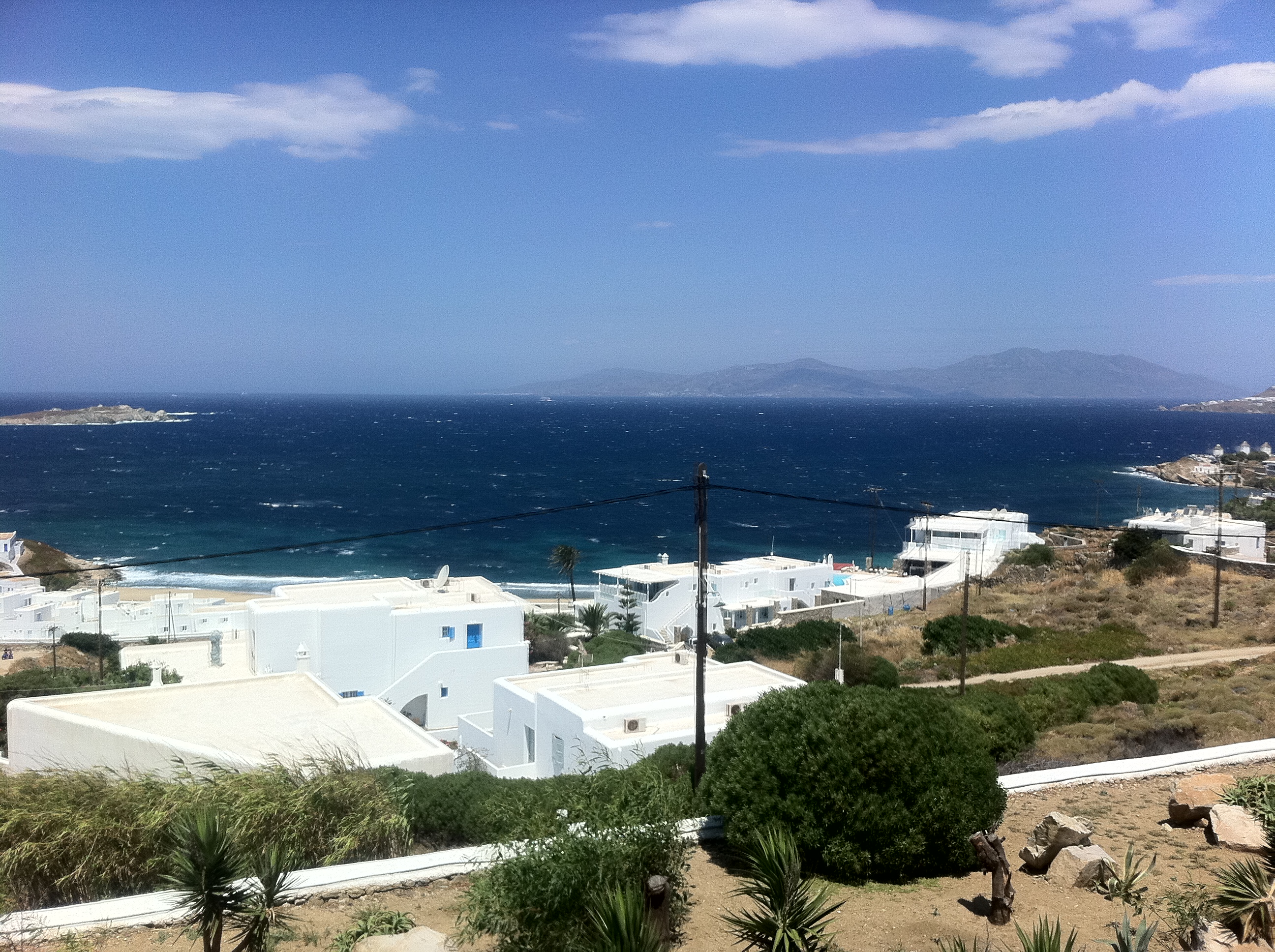
Stories from Mykonos, Part Three

The last installment of essays and photos from my trip…

Cycladic Torpor

We get lazier as the week progresses.   The first few days were excursions on ATVs, shopping in town, and late nights out at the clubs.   Now we arrange morning meet-up times to get the free hotel breakfast before 10:30, and we order lunch by the pool.

We are loud, unmannered Americans, and the European guests glare at us from their chaise lounges.   Until we are upstaged by the arrival of the Australians.

Delos

We take a ferry to Delos, an archeological site.   Everyone has their vouchers, courtesy of the Germans.   They made arrangements with their local travel agent, and they have timetables and tour information loaded on their smartphones.

Delos was an important religious and trading center from the ninth century BCE to the first century CE.   Apollo, the Sun God, was born here.   We visit his birthplace, which was once a lake, but it was dredged by French archaeologists because of malaria.   The area is now a boggy pine forest, but there is still a towering palm tree that the ancient Greeks planted to commemorate Apollo’s birth.

We walk through the city streets guided by Joanna, a diminutive tour guide with a voice that carries.   She shows us the House of Dionysus.   There is a mosaic in the atrium pool depicting the god returning from the Far East, saddled on a lion.

Lions are a common motif throughout the ruins.   They’re in tile patterns on walls, and there are famous marble lion statues warding Apollo’s birthplace.    There were no city walls or military defenses for Delos.   It was sacked by Greeks in 88 CE as part of a revolt against the Romans.

There is an amphitheater that seated 5,000, and a plumbing system that brought water to all parts of town.   Delos was a multicultural community, and tolerant of many religions.  Egyptians built temples here, and Delos was the site of the first synagogue on Greek soil.   Today, there’s a snack bar that serves fresh squeezed orange juice, but not much anything else.

Everyone wants to browse the gift shop, but the woman who runs it is on vacation so the shop is closed.   In the middle of tourist season?   We are surprised and a little bit ticked off.

This is the principal difference between Europeans and Americans.   To Europeans, working is something you do between vacations.   To us, vacations are what you do between working.
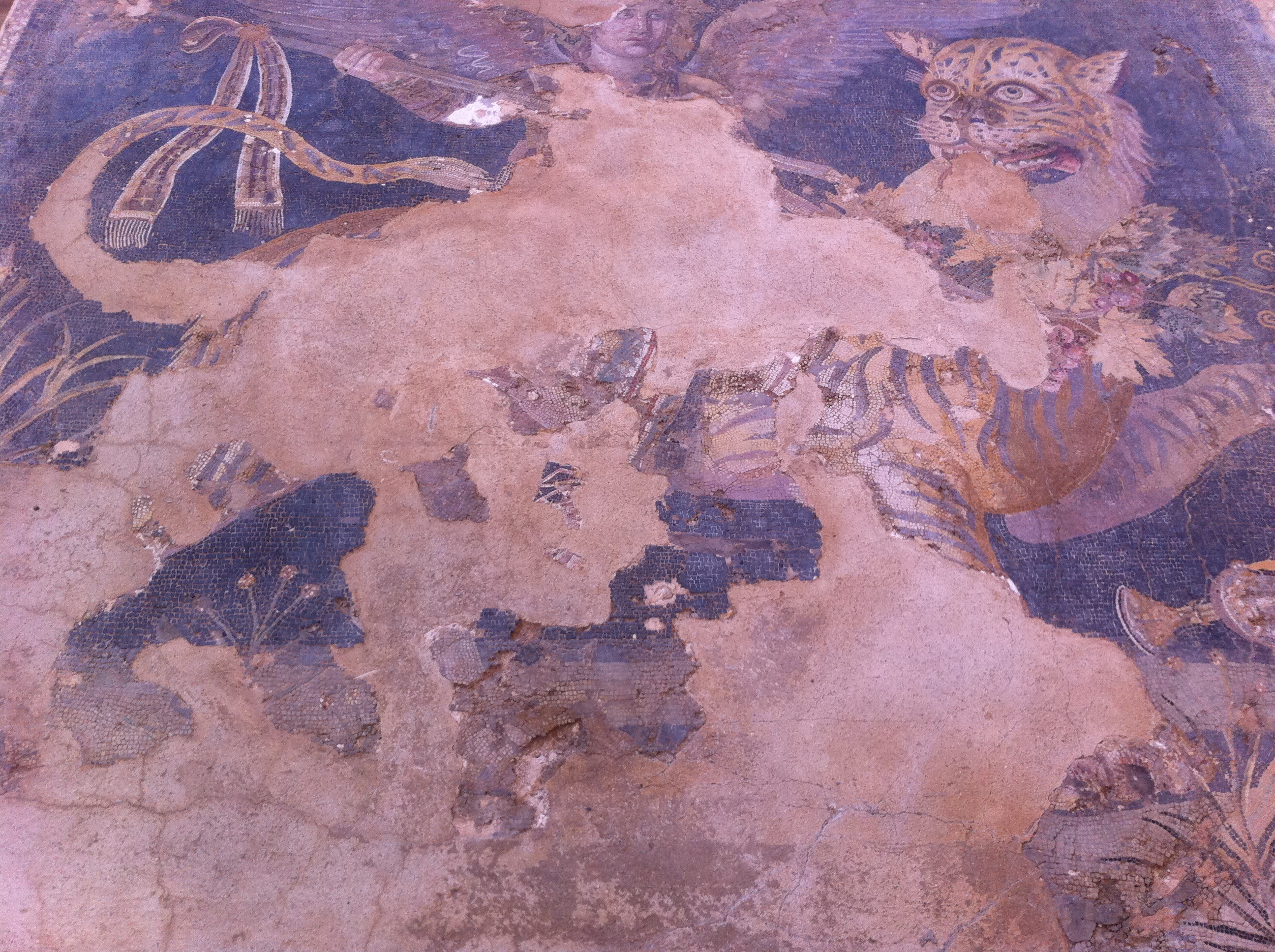
Mosaic from Delos’ House of Dionysus
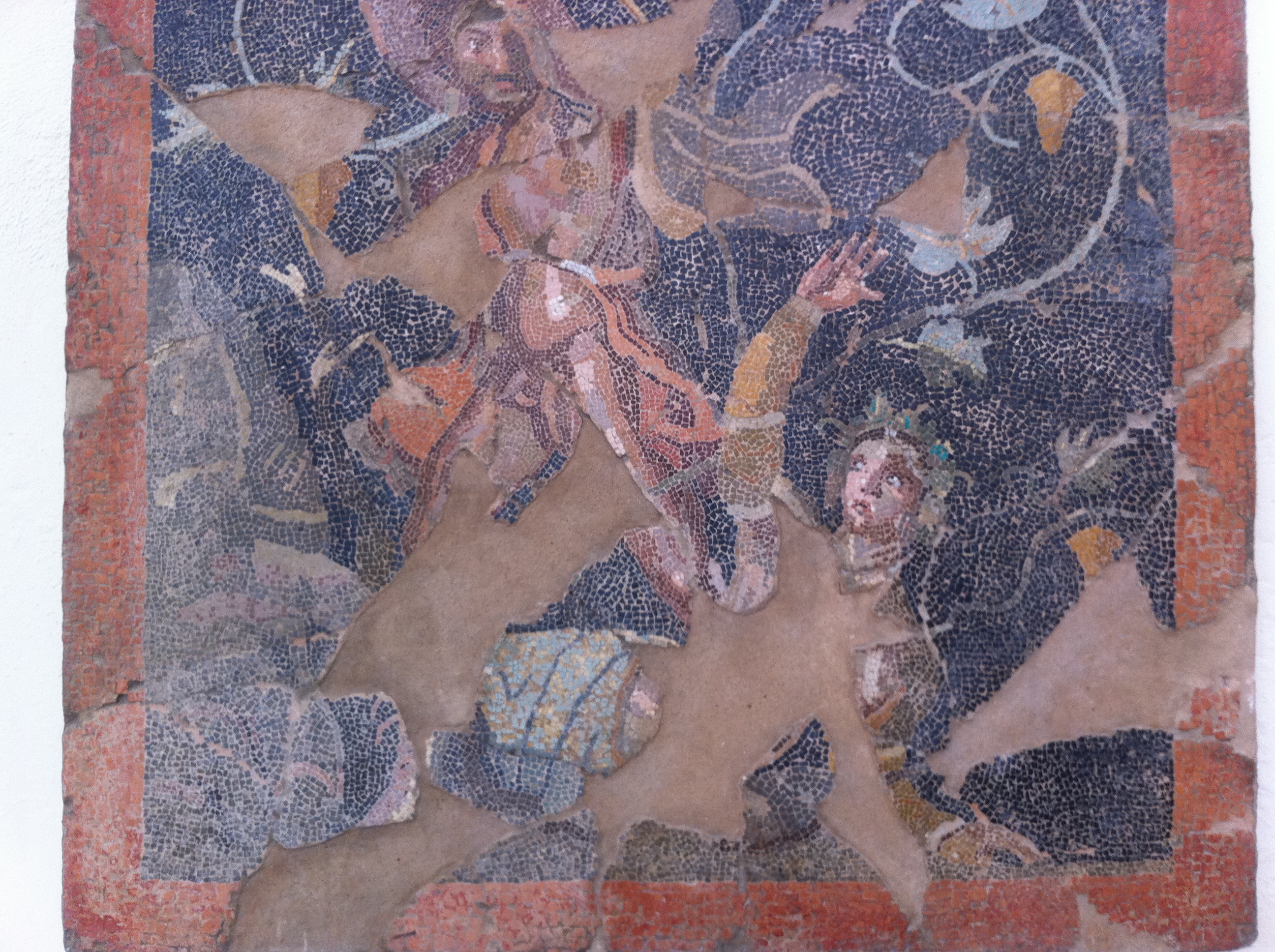


Another Delos mosaic depicting the myth of Apollo and Daphne

Stories from Mykonos, Part Two

A continuation of my impressions from Mykonos, Greece…

The Waiter Dmitri

Everyone loves the hotel’s head waiter Dmitri.   Dmitri is tall and handsome and very reassuring.   He rubs our backs while he’s talking to us, and he speaks in a soft and gentle voice.   He tells us that he works six months in Mykonos, and the other six months he’s a ski instructor in Austria.

We ask Dmitri many questions about Mykonos’ nightclubs.   He takes great pains to be as thorough as possible with his answers, and if we ever appear confused, he draws us maps on little scraps of hotel stationery.   He can’t say the word lesbian without lowering his voice to a whisper.   This is Dmitri’s only fault as far as I can tell.   I think his mother must be very proud of him.

Lost

When we travel as a group, we rely on the Germans.   They have an innate sense of direction, like carrier pigeons, and it takes German efficiency to navigate the island’s unmarked streets and the labyrinth of pedestrian walks in town.   Only once did they lead us in the wrong direction, but we ended up at a beautiful amphitheater surrounded by flowering trees.

The city plan was designed to confuse pirates.   All we want is ice cream and a taxi cab.   We find a transgender gypsy wearing a medieval crown, sitting on a stoop, reading fortunes.   We see stray cats everywhere.   We want to take them home and give them a better life.   At restaurants, the cats beg at tables like street urchins.   They will eat the fish, the lamb, and the bechamel on the moussaka, but they won’t eat the squid or the octopus.

There is a famous pelican in town.   A man drives him around in the carriage of his scooter.   One morning we saw the pelican sitting on the terrace of a restaurant, and the owner came out and cursed and shooed the bird away.   We thought it was extreme and impolite until we realized that he didn’t want the pelican shitting all over the place.


Stories from Mykonos, Part One

My partner and I celebrated our 10th anniversary in Mykonos with seven of our friends.   I’ve been writing some short essays about the trip and decided to share them here over the next few weeks.  Names have been changed as a courtesy to the involved parties.

Here’s Round One…

Arrival

We are seven arriving at Athens airport on staggered international flights.   Four of us have a six hour layover until boarding time for the little jet to Mykonos.   Anxious for adventure, we check-in our luggage and get a cab into the city.

The heat is oppressive, and the sun is scalding.  There is no air conditioning in the cab.

Such things would be outrageous in New York City, but we are in Greece, and jetlag-drunk.   We want to See, See, See.   Athens is hosting an Olympics.   The Special Olympics.   Our friendly, patriarchal driver tells us so.   He drops us in the Plaka district with advice to take the Metro back to avoid the traffic.

We wander up a staired lane in search of a taverna with a view of the Acropolis.   There are dozens of places with outdoor seating, each with a Maitre D’ foisting a menu on us and promising free beer.   We are shielded by urban skepticism.   At the top of the lane, looking up, up, up, we see it—a corner of the Acropolis wall.   It’s a good enough view considering how far we’ve come, and there’s a shaded taverna nearby.   Foods that we could order at any New York diner taste fresher and more ethnic:  Greek salad, tzatzichi, chicken souvlaki.  We learn how to say thank you in Greek.

“Efharisto!”

We find an air conditioned cab for the trip back to the airport.   The cool air is luxurious and our young driver with thick black hair is a sight more favorable than the man who took us into town.   But he swears a lot, annoyed with the redirected traffic pattern around the Olympic events (even though he steers through roped off streets like most of the other drivers).   Our older driver would have told us anything we wanted to know about the ancient city.   This one wants to be somewhere else, with his girlfriend maybe, or watching a soccer game with his friends.   Someone overtips him anyway.

First night out

At the hotel, we are greeted by the Germans, our eighth and ninth companions, a couple.   They have reserved a table at the restaurant.

After bread and wine and shared appetizers, most of us feel renewed.   At eleven, a proposal to go into town for nightclubbing is seconded, thirded, fourthed and fifthed.   We have made shopping trips for this occasion–designer jeans, patterned shirts, graphic tee’s, and for the women, espadrilles—and we have worked out, dieted, and tried new skin products for the past six months.

The walk into town is a steep downward slope with speeding mopeds, ATVs and buses, and no sidewalk.   We wind along the waterline to find the club the hotel waiter recommended.   At midnight, we are early arrivees, but the music is exhilarating, and we dance like teenagers.   Later, the club is mobbed and we take to tables and the tops of booths.

Exiting the club is a sensuous experience.  We squeeze through walls of men with well-built, overheated bodies.   Around the corner, there is an alley behind a church which is the designated cruising spot.   A Dutch tourist asks one of our single friends if he wants to go back there because his “balls need to be drained.”  Our friend declines.

We are arm-and-arm and joyful walking to the taxi stand in the early morning.   People are out on the streets like the scattering of a big parade.   Groups of young women teeter on the cobblestones in high heels and mini-mini skirts.   From a cafe, a lesbian couple watches us with Cheshire cat smiles.

The taxi line is ten parties deep, but there is a drunken British couple to talk to.   They started drinking when they arrived yesterday afternoon.   We crowd into a cab in two human layers.   A flirtatious friend asks the driver: “Where are you from?”   Everyone laughs riotously.  Someone blurts out:   “We’re on an island.  You think he commutes in from Bulgaria?”   The point is:   we’re not in NYC anymore.


Is Dumb the New Smart?

A little social commentary, a little writerly update this week…

Is Dumb the New Smart?

It’s actually a political/pop culture trend that started under the George W. Bush administration, and the concomitant rise of celebrities like Paris Hilton.

But it reached its zenith with Sarah Palin and her recent commentary on Paul Revere. He made his famous ride, gun in hand, to warn the British:   we Americans have the right to bear arms.   Remember from history class?

Education is passe, intellectual inquiry is for assholes, and everything you needed to know, you learned at Sunday family suppers, between Church and rifle practice.

For a recent pop culture counterpart, see Charlie Sheen.

Writing Brief

In writing news, my manuscript wends its way to a climax and denouement (isn’t that a great word?).   I just finished up a murder scene (mwah, ha, ha, ha).

Excitement is building for Lambda’s 2011 Writers’ Retreat.   I’ve made my flight arrangements and sent in my photo/bio.

Lambda started a listserv for Fellows so we can share transportation and get to know each other.   I’m already amazed (and a bit intimidated) by the list of authors.   Lots of writers to learn from.


From Lambda to Omega

I just got accepted into Lambda Literary Foundation’s 2011 Writers’ Retreat for Emerging LGBT Voices!!

It’s a weeklong immersion program, and I’ll be in the genre fiction track with  eight to ten writers, under the tutelage of prolific crime/sci fi author Claire McNab.

The retreat takes place at UCLA, so my trip to Los Angeles will hopefully also give me a chance to catch up with long-neglected West Coast friends.

In the meantime, I’m finishing up my rebuilt fantasy manuscript, and–with contradictory sentiment–can report that I am 50 pages away from completion.

On one hand, I’m encouraged that this massive rewrite—which often seemed too big, too high, too labyrinthine—is really, truly in my reach.   On the other hand, I find myself wallowing a bit in anticipatory grieving.

I’ve fallen in love with my characters, even the difficult ones who slyly hid their motivations, missed their scene cues, and argued continually with my direction.   With the end—the curtain call—in sight, I realize soon I’m going to leave them piled under many files in a ‘Documents’ folder, maybe to be visited from time to time, but no longer a part of my daily life.

The other day I re-read my manuscript, not to proofread or edit, just to re-experience what I had written, and get to know the characters and the story again.

With months ahead of writing, workshopping and incorporating feedback, it seems silly to say, but it’s going to be hard to say goodbye.