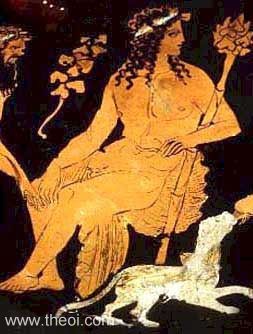
Lately, I’ve been thinking a lot about Dionysius.
My work-in-progress POSEIDON AND CLEITO features him as a supporting character. Perhaps, true to his nature, his portrayal eludes me. At times, he demands the spotlight, and his appearances send the story into disarray. At other times, I try to coax out of him his reason for being in the narrative, and he’s elusive about his purposes and his motivations.
It would be easier if he could be pinned down as a good guy or a bad guy, thus moving the story forward by either helping or hindering the hero Poseidon. So far, Dionysius gets in some jabs at the hero, and creates some chaos. But the tension is fairly low-wattage. For an epic story, there needs to be big conflict moving things along, on the magnitude of life or death situations. Dionysius seems to just want to introduce emotional tension – desires, loves, jealousies, and some mild contempt.
I need to study and understand this guy some more. So I figured I would do a Q & A piece with him this week. Readers: meet Dionysius.
ANDREW PETERS: Thanks so much for joining me at andrewjpeterswrites.com.
DIONYSIUS: My pleasure. It is an honor to be recognized by such an accomplished literary talent. Your website is exquisite.
AP: Thank you. I hadn’t meant to bring this up in our interview, but since you mention it, I wonder what you make of the Internet and our modern digital age.
D: I love the freedom of it. You can meet so many people and never leave home. I love Facebook and Twitter.
AP: I imagine you have many followers.
D: I do. From all parts of the world. I love exchanging pictures. I can send you some, if you like. I have galleries and galleries with photos from all of my parties. I understand you enjoy handsome men.
AP: Well yes, but I’m married.
D: Then you can share them with your husband. You’ll both enjoy them.
AP: You’re probably right about that. But, if I may, let me ask you some questions about your story, and this novel POSEIDON AND CLEITO—
D: It’s coming along terrifically, isn’t it?
AP: Actually, I’m having some problems. And they mainly have to do with you. Let’s start at the beginning. Can you tell me about your background?
D: My father was the God of Thunder. My mother told me he struck a lightning bolt in her tummy, and along came me.
AP: I don’t mean to start things off argumentatively, but an on-going question in the story is whether or not you are truly who you say you are. Could you shed some light on that? I mean, are you really the son of a god?
D: I never knew my father, so all I can say is what my mother told me. As a child, I was curious about him, but my mother would only say their affair was brief.
She was a restless sort, like me. She wanted to travel the world, and she kept company with many men. She left me in the care of a childless couple when I was very young, and they raised me as their own.
AP: Do you have magical powers?
D: Magical powers, no. Talents, yes, I’ve been told. I’ve a good signing voice. I’m well-skilled in all sorts of carnal pleasures. I can turn a phrase, make people laugh. I adore organizing parties.
AP: Charisma seems to be your secret weapon. And there’s something a bit mysterious, or spell-binding, about that. Everyone you encounter falls in love with you.
D: That’s very generous of you to say, though I think it’s an exaggeration. I have been exceedingly fortunate to experience a lovely array of companions. But not everyone, I think you know, falls under my ‘spell,’ as you put it.
AP: You’re talking about Poseidon?
D: Yes.
AP: What is it between the two of you?
D: We look at life from different perspectives. He sees things in absolutes. I don’t see the point in putting a label on things.
AP: You get under each others’ skin on a number of occasions.
D: He can be a bit uptight. And judgmental.
AP: In the story, he calls you careless, selfish, and dishonest. Yet you continue to try to win him over, while he’s always trying to hold the reins on you. Could there be a love/hate attraction going on there?
D: I think you’ve unmasked me. Love/hate attractions are my favorite kind. They kindle the greatest passion. Though, concerning Poseidon, I don’t think we’re destined to be lovers. He is much too conventional.
AP: He comes across as a bit homophobic at times. What do you make of that?
D: I detest homophobia. I think people who deny pleasure, of themselves or others, have terrible personal problems.
AP: You see it as a psychological illness?
D: Most definitely. When a mind becomes fixed in such a way, seeing ugliness where there is plainly beauty, there are all kinds of ramifications. I see it as a form of self-hate.
AP: This leads me to another topic that’s been confusing me. You have female lovers and male lovers. Would you describe yourself as bisexual, 50/50, or do you find yourself leaning more one way or the other?
D: I like the term pansexual. Men and women are different, but they are equally intriguing to me. In a sense, men are more of a challenge, and I enjoy a challenge. So perhaps I’ve spent more time chasing men than women.
AP: That’s interesting. In fact, it seems to me your greatest love affair turns out to be with a man.
D: I hope you’re not referring to Poseidon.
AP: No. The young artist. Cleito’s protégé.
D: I have a deep affection for him.
AP: Enough to settle down, and swear off your affairs?
D: I’m the kind of man who needs to be introduced to new things. I get that from my mother. There’s a traveler’s spirit in me that has to be nourished. If I settle down, that spirit will die. I don’t think that would be good for either of us.
AP: Could you have an open relationship? I mean, where you are emotionally faithful to one partner while having sex outside of the relationship?
D: If I understand you correctly, I think I’ve been doing that my entire life.
AP: All right. Let’s get to the crux of the story. The two title characters are searching for their place in the world, and it’s a story about overcoming obstacles, and pursuing one’s dreams. Where do you see yourself fitting into that theme? Do you have dreams and goals for yourself?
D: Was my publicist drunk when you arranged this interview? I had no idea things were going to turn so serious.
Well, let me put it to you this way. When I wake up each day, sometime after noon, I see the world full of shining possibilities. I never know who I might meet, whether I will be feasting that night under the stars with a group of newfound friends, or singing for my supper on some street corner in a strange city. In either case, I’ve always found that the world provides for me.
AP: What is it that you want?
D: Happiness.
AP: Have you ever thought of taking up a profession?
D: Hmmm…not really. I’ve a fondness for the performing arts. Maybe directing. But I’m really much better suited for lively conversation, and inebriation.
AP: OK. I’ll turn to some modern topics. What do you think of gay marriage?
D: I favor abolishing marriage completely. I see it as entirely unnatural.
AP: What about polygamy?
D: That’s even worse than traditional marriage. Not only do you chop off your manhood, but it gets cut up in equal parts for each of your wives.
AP: Gays in the military?
D: I believe there should be unfettered sexual contact within all vocations.
AP: That’s all the time we have today. Thank you Dionysius.


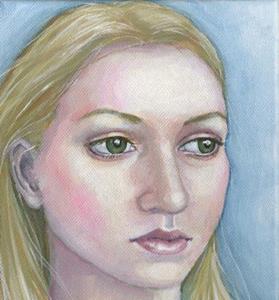

 Here’s a younger, leaner Poseidon. It’s a famous bronze statue circa 5th century BCE Greece. I bought a copy of it in Mykonos. He looks more athletic, less musclebound, in these earlier renderings.
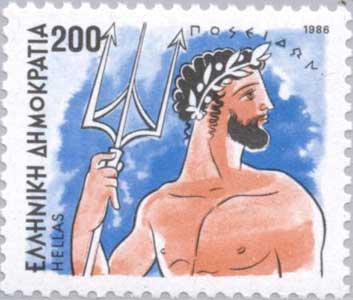 Here’s Poseidon on a Greek postage stamp.
 I like this illustration by artist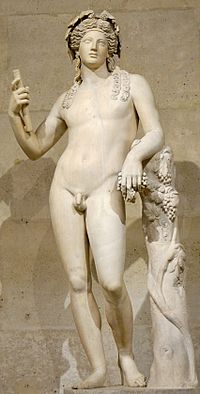

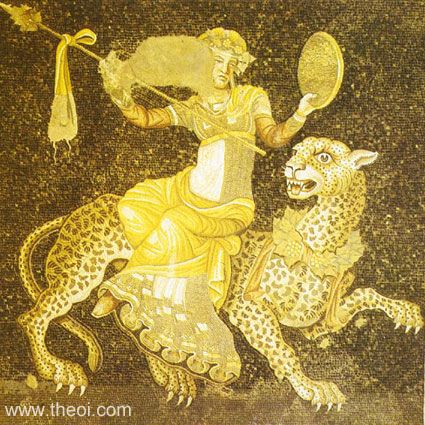
 This is a glass cameo from the 1st century ACE, at the Petit Palais in Paris. Dionysius (Bacchus) is the little child, and the description says the older man in the picture is a satyr, giving Dionysius grapes.
