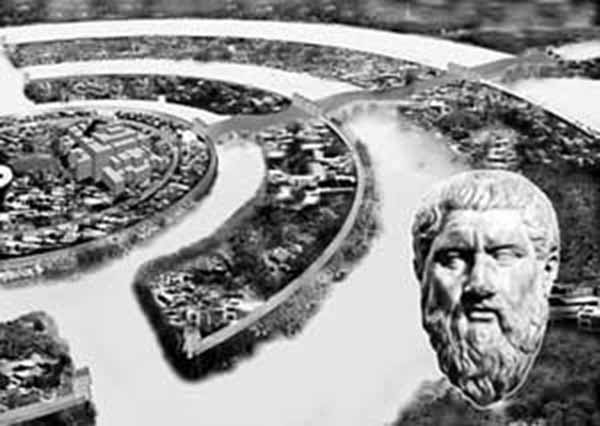
Songs, Poetry and Images Inspired by Atlantis

Suffice it to say, my fantasy series-in-progress travels well-trod literary territory. My interest in Atlantis came late in life—just five years ago—and prior to my research, my only frame of reference was Jules Verne’s 20,000 Leagues Under The Sea and the ubiquitous nautical namesakes–Atlantis car washes, Atlantis diners. There’s even a gay cruise line called Atlantis.

My hope is to bring a fresh perspective to the legend while remaining faithful to classic mythology. My favorite texts on the subject are Lewis Spence’s History of Atlantis, Edith Hamilton’s Mythology and Frank Joseph’s The Atlantis Encyclopedia. The latter is literally an A to Z reference book and a fascinating read.

Here’s some poetry, lyrics and imagery I found to keep me inspired.

Atlantis

Being set on the idea

Of getting to Atlantis,

You have discovered of course

Only the Ship of Fools is

Making the voyage this year,

As gales of abnormal force

Are predicted, and that you

Must therefore be ready to

Behave absurdly enough

To pass for one of The Boys,

At least appearing to love

Hard liquor, horseplay and noise.


Should storms, as may well happen,

Drive you to anchor a week

In some old harbour-city

Of Ionia, then speak

With her witty sholars, men

Who have proved there cannot be

Such a place as Atlantis:

Learn their logic, but notice

How its subtlety betrays

Their enormous simple grief;

Thus they shall teach you the ways

To doubt that you may believe.


If, later, you run aground

Among the headlands of Thrace,

Where with torches all night long

A naked barbaric race

Leaps frenziedly to the sound

Of conch and dissonant gong:

On that stony savage shore

Strip off your clothes and dance, for

Unless you are capable

Of forgetting completely

About Atlantis, you will

Never finish your journey.


Again, should you come to gay

Carthage or Corinth, take part

In their endless gaiety;

And if in some bar a tart,

As she strokes your hair, should say

“This is Atlantis, dearie,”

Listen with attentiveness

To her life-story: unless

You become acquainted now

With each refuge that tries to

Counterfeit Atlantis, how

Will you recognise the true?


Assuming you beach at last

Near Atlantis, and begin

That terrible trek inland

Through squalid woods and frozen

Thundras where all are soon lost;

If, forsaken then, you stand,

Dismissal everywhere,

Stone and now, silence and air,

O remember the great dead

And honour the fate you are,

Travelling and tormented,

Dialectic and bizarre.


Stagger onward rejoicing;

And even then if, perhaps

Having actually got

To the last col, you collapse

With all Atlantis shining

Below you yet you cannot

Descend, you should still be proud

Even to have been allowed

Just to peep at Atlantis

In a poetic vision:

Give thanks and lie down in peace,

Having seen your salvation.


All the little household gods

Have started crying, but say

Good-bye now, and put to sea.

Farewell, my dear, farewell: may

Hermes, master of the roads,

And the four dwarf Kabiri,

Protect and serve you always;

And may the Ancient of Days

Provide for all you must do

His invisible guidance,

Lifting up, dear, upon you

The light of His countenance.

WH Auden

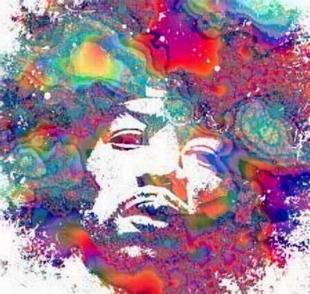
Moon Turn the Tides Gently Away

So down and down and down and down

and down and down we go.

Hurry my darling we mustn’t be late

for the show.

Neptune champion games to an aqua

world is so very dear.

“Right this way,” smiles a mermaid,

I can hear Atlantis full of cheer.


I can hear Atlantis full of cheer…

I can hear Atlantis full of cheer…

Jimi Hendrix
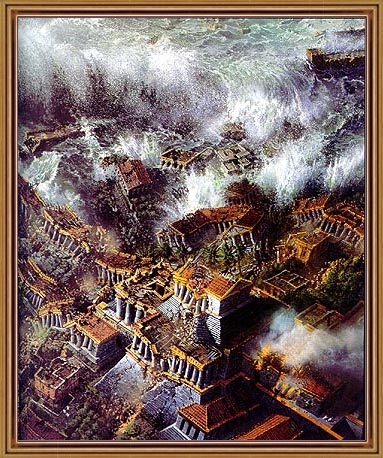
Atlantis – A Lost Sonnet

How on earth did it happen, I used to wonder

that a whole city—arches, pillars, colonnades,

not to mention vehicles and animals—had all

one fine day gone under?


I mean, I said to myself, the world was small then.

Surely a great city must have been missed?

I miss our old city—


white pepper, white pudding, you and I meeting

under fanlights and low skies to go home in it. Maybe

what really happened is

this: the old fable-makers searched hard for a word

to convey that what is gone is gone forever and

never found it. And so, in the best traditions of

where we come from, they gave their sorrow a name

and drowned it.

Eavan Boland
In Search of Retold Stories

I love writing retold stories.

It may seem like a cop-out to take a proven successful plot and characters, tweak them and call the story your own. But to me, if your story entertains, what’s the big deal?

You could probably make the case that all contemporary fiction is derived from ancient mythology, folktales, or parables–there are no original stories out there even though everyone sets out to be fresh and original. The advantage of a novel that is unapologetically re-imagined is there’s an immediate connection with a readership who liked the story the first time and are curious to check it out a second.

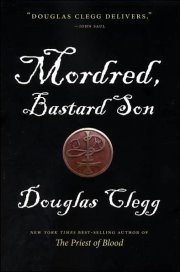
I just finished a phenomenal book: Douglas Clegg’s Mordred, Bastard Son, which is drawn from the King Arthur legend.

I had to reorient myself to the source material since my only recollection of Mordred was a snivelling, effete Roddy McDowell singing: “The Seven Deadly Virtues” in the musical Camelot. Creepy stuff. I may have come out years earlier if I hadn’t seen the show.

Luckily, Clegg’s Mordred is an entirely different guy. He was an entirely different guy in the earliest King Arthur legends, Clegg points out in his Foreword. Already I was hooked. We gays have always gotten a bad rap.

Clegg’s Mordred is a misunderstood young man condemned to a life of hiding by his father’s hideous transgressions. Arthur raped Mordred’s mother and stole the sword Excalibur from its sacred place with The Lady of the Lake. A nice thread in the story is Mordred’s finding his place in the world as a gay man. Pre-Medieval Brittanica is not particularly homophobic–it’s still a land of pagan sensibilities–but there aren’t many boys like Mordred while he’s growing up. He’s lonely, curious and frustrated by his attraction to boys he meets that he can never have. Then his mentor Merlin hands him an impossible challenge: he must remain physically pure until he reaches manhood (at approximately 18) or he will lose his potential to master the magickal arts.

The rich development of Mordred is what makes the book so enjoyable and engrossing. He’s a well-intentioned kid constantly thwarted by the people who are supposed to love and protect him.

There’s a love story with the Knight Lancelot who’s the most freely re-imagined character from the conventional tale. Clegg’s Lancelot is the best friend of Mordred’s

father, and he helped Arthur steal Excalibur and try to kill Mordred’s pregnant mother so his bastard son wouldn’t be revealed. When Mordred meets him, Lancelot is estranged from Arthur, living as an outcast, steeped in guilt and desirous of a male companion.

Here Clegg almost lost me. I’ve always thought of Lancelot as the epitome of male heterosexuality. But as I settled in to the latter half of the book, the romance between Mordred and Lancelot was awfully compelling. Lines like: “You’re my hunter, and I’m your stag.” probably make other people cringe, but set things up right and I’ll swoon right in my seat on the train.

Clegg also writes one of the best depictions of magic (magick) I’ve read. It’s inspired from nature–the elementals–and has more in common with native religion than the wand-brandishing wizardry of Harry Potter or the archaic incantations of Lord of the Rings.

The only thing that disappointed was the projected sequels to the book appear to have disappeared unless Clegg and/or his editors are taking their sweet time (it’s been four years since Mordred came out).

Gregory Maguire is of course my favorite author of retold stories. Beyond his humor and his capturing of otherness, he’s a master of setting–the dark but quirky land of Oz, early Renaissance Amsterdam in Confessions of an Ugly Stepsister, and the Italian countryside of the 16th century Borgia family in which he places his re-imagined Snow White in Mirror, Mirror.

So anyone have suggestions for reimagined legends while I wait for Gregory Maguire’s next novel to come out (and perhaps, in vain, for a sequel to Mordred)?

Meanwhile, I’ll be going dark next week while on va-cay in Provincetown.  Wishing good times for all this late summer.

Favorite Writing Quotes

I turn to wisdom from renowned authors from time to time. You know—those moments when I’m stalled at the computer, my brain clawed open, unable to patch together the simplest thought, my inadequacy a tightening noose around my neck asphyxiating me to a painful spiritual death. We all need hope. We need to believe we’re not in this alone.

Here are some of my favorite words of inspiration.

Why do writers write? Because it isn’t there.  – Thomas Berger

Writing is easy; all you do is sit staring at a blank sheet of paper until the drops of blood form on your forehead.  – Gene Fowler

A writer never has a vacation. For a writer life consists of either writing or thinking about writing.  – Eugene Ionesco

What no wife of a writer can ever understand is that a writer is working when he’s staring out of the window.  -Burton Rascoe

A writer is somebody for whom writing is more difficult than it is for other people.  -Thomas Mann

Writing is not necessarily something to be ashamed of, but do it in private and wash your hands afterwards.  -Robert A. Heinlein

Writing a novel is a terrible experience, during which the hair often falls out and the teeth decay.  -Flannery O’Connor

There are three rules for writing a novel. Unfortunately, no one knows what they are.  -W. Somerset Maugham

The secret to being a writer is that you have to write. It’s not enough to think about writing or to study literature or plan a future life as an author. You really have to lock yourself away, alone, and get to work.  -Augusten Burroughs

[To write] you most likely need a thesaurus, a rudimentary grammar book, and a grip on reality. Prayer might work.  -Margaret Atwood

The first 12 years are the worst.  -Anne Enright

Marry somebody you love and who thinks you being a writer’s a good idea.  -Richard Ford

Remember: when people tell you something’s wrong or doesn’t work for them, they are almost always right. When they tell you exactly what they think is wrong and how to fix it, they are almost always wrong.  -Neil Gaiman

Did Atlantis Exist?

Here’s a shocking departure from my usual bloggerings.  In returning to my Stories from Atlantis series, I’ve had my source material on my mind and figured I’d share some thoughts about it here.

I’ve set aside the angel project.  My brain got wrapped around a street lamp, a plot and structure street lamp.  The manuscript is in the intensive care unit in critical condition.  That’s the last bad metaphor I’ll use and the last thing I’ll say about it.

Everyone thinks they know something about Atlantis—it sunk in the sea, its citizens took a space ship to another planet, or it’s protected beneath the ocean in a bubble.  Nowadays, Atlantis is regarded as myth and legend, but that wasn’t always the case.  In the 19th century and early 20th century, many respected archeologists and geologists believed they could find evidence of the ancient civilization.  In the 1930s, “psychic” Edgar Cayce told people he communicated with Atlanteans during hypnotic trances.  Cayce wrote a number of books about his paranormal conversations, and they were a lot less interesting than you might imagine.

Atlantis is part of our collective unconscious, a Jungian concept.  The collective unconscious is a cerebral storehouse for universal ideas, inherited over generations.  It’s the place for archetypes and myths, the flood story for example, or Ponce de Leon’s Fountain of Youth.   In modern terms, you could say it’s the source of urban legends.

Psychology and “hard” science have only become distinct relatively recently.  It was always a curiosity of mine how scientists sought to prove the veracity of Atlantis before the age of cold, rational science.

The classic source material comes from Plato who wrote about a technologically advanced society pre-dating the Greeks by 9,000 years.  His description placed the ancient continent west of the Pillars of Heracles (the Strait of Gibraltar), so Plato “purists” went looking for evidence in the Atlantic Ocean off the coast of North Africa.  Some, like British archeologist Lewis Spence, argued that the Canary Islands are vestiges of a much larger land mass that sunk.  Only its highest mountain peaks remain above the water.

There’s a school of thought that says Plato was referring to the island of Santorini in the Mediterranean Sea where pre-Greek Minoan civilization thrived for years until it was destroyed suddenly by a volcano.  Others have placed Atlantis in Indonesia or even North America.  Cayce was “told” that the Atlanteans used to live in the Caribbean—the Bimini Islands.

While Spence never produced much in the way of compelling evidence, he launched a cultural diffusion theory that was wonderfully evocative.  Comparing a host of ancient African, Central American and North American cultures, he noted a variety of similarities in language, religion and architecture (e.g. the pyramids).  How could this have happened when cultures were separated by the unpassable Atlantic Ocean?  Spence insists it was because there was a continent in the middle of the ocean facilitating travel.  Spence believed that bull sacrifice was an important Atlantean tradition that was passed on to many cultures, even evident today through the popularity of bull fighting.

I’m predisposed to doubt just about everything, but it’s tempting to believe that Atlantis was real.  If I was to believe, the most compelling explanation comes from geology.  By Plato’s account, Atlantis disappeared around 10,000 B.C.E.  That was the tail end of an ice age.  So, it’s possible to imagine that while much of Europe was covered in glacier, some people migrated south to warmer climes and traveled a land bridge from coastal Spain to an island.  There, with better terrain and an abundance of food, they developed a thriving society.  But with global warming, ocean levels rose.  The island was washed away.  Maybe there were survivors who brought their language and traditions to other parts of the world.  Maybe we’re all descendants of the Atlanteans.

For more about Lewis Spence, check out this.

Dragging myself back to blogdom

I’ve been a terrible procrastinator lately.  When I started this site 9 months ago, I made a commitment to post at least once per week, every Wednesday.

I had a good excuse last week.  We had friends in town from Germany, and it would’ve been pretty rude to shoo them out of the guest bedroom so I could get on the computer.   But they took a trip down to DC for most of this week.  My only excuse for neglecting my site (and my writing) is needing some time to warm up before I get back in the game.  My manuscript has also more or less collapsed and will need to be gutted and rebuilt from floor to ceiling.  I’m feeling a tad sorry for myself.

So while my prose is gummed up, I thought:  why not some poetry?  Here’s a piece I just wrote while thinking about my re-write, both thematically and I guess personally.

I am driftwood in the ocean,

Hostage to its welter and swell,

I lift with foolish hope on the crest of waves,

To drag back in a tractionless wake,

Caught in the Universe’s laws of motion,

An object at rest prefers to stay at rest.


I never had a problem swimming with the current,

A school of fish is a happy place,

The undertow can drown,

And sharks attack in open water,

I thought that I was bold,

But I never ventured further than I could swim to shore.


I did not choose to wallow here,

It was what I saw, what I heard that chose,

A startled witness,

I did not want to see, too late,

The truth scalds like alchemy,

Changing who you are from the inside out.


I’ve become now petrified wood,

The ocean cannot keep me,

I plummet like a depth charge, crushed by psi’s,

It may be safer on the ocean floor,

An object at rest in a primordial bath,

Waiting for an organic spark to re-emerge.