Groundhog Day!!

A Fat Groundhog

A post on the groundhog, in honor of our most under-celebrated holiday.

(I didn’t get the day off from work.)

This curious little holiday inspired a search for trivia.    Such as, did you know that Groundhog Day derives from the celebration of Imbolc, the traditional Gaelic Irish nameday for the first day of Spring?    I didn’t even know that a groundhog is the same thing as a woodchuck, and I certainly didn’t know that woodchuck comes from the Algonquin name for the animal ‘wuchak,’ and not from the fact that it likes to gnaw on wood.    (It doesn’t.  That’s a beaver.)

I could go on, and I will go on.

Famous Groundhogs

We all know about Punxsutawney Phil, who was immortalized in the Bill Murray film “Groundhog Day.”    But there’s also Wiarton Willie, an albino groundhog that lived to age 22 (d. 1999), and was immortalized as a beloved statue in his hometown:  Wiarton, Ontario.    There’s General Beauregard Lee, a southern gentleman groundhog, who has received honorary doctorate degrees from the University of Georgia AND Georgia State University.

There’s also a famous groundhog from Staten Island with the (lame) name Staten Island Chuck.    He just predicted an early spring while New York City is reeling from a record-breaking winter snowfall.    Uh-huh.

Groundhog Poetry

Groundhogs have been inspiring poets for centuries.    Here’s a strangely gory, but moving, and, somehow, epic ode by American poet Richard Ghormley Eberhardt.

THE GROUNDHOG

~

In June, amid the golden fields,

I saw a groundhog lying dead.

Dead lay he; my senses shook,

And mind outshot  our naked frailty.

~

There lowly in the vigorous summer

His form began its senseless change,

And made my senses waver dim

Seeing nature ferocious in him.

~

Inspecting close maggots’ might

And seething cauldron of his being,

Half with loathing, half with a strange love,

I poked him with an angry stick.

~

The fever arose, became a flame

And Vigour circumscribed the skies,

Immense energy in the sun,

And through my frame a sunless trembling.

~

My stick had done nor good nor harm.

Then stood I silent in the day

Watching the object, as before;

And kept my reverence for knowledge

~

Trying for control, to be still,

To quell the passion of the blood;

Until I had bent down on my knees

Praying for joy in the sight of decay.

~

And so I left; and I returned

In Autumn strict of eye, to see

The sap gone out of the groundhog,

But the bony sodden hulk remained

~

But the year had lost its meaning,

And in intellectual chains

I lost both love and loathing,

Mured up in the wall of wisdom.

~

Another summer took the fields again

Massive and burning, full of life,

But when I chanced upon the spot

There was only a little hair left,

~

And bones bleaching in the sunlight

Beautiful as architecture;

I watched them like a geometer,

And cut a walking stick from a birch.

~

It has been three years, now.

There is no sign of the groundhog.

I stood there in the whirling summer,

My hand capped a withered heart,

~

And thought of China and of Greece,

Of Alexander in his tent;

Of Montaigne in his tower,

Of Saint Theresa in her wild lament.


Groundhog websites

Yes, there’s a site called Groundhog Day Literature, that says its sponsored by the “International Rodent Society.”    There’s some middling lyrics—noted, instructionally:    “to be recited or sung with gusto!”—-and a Groundhog Day haiku.
Good and Bad LGBT portrayals

I’ve been participating in a discussion board on the topic of what makes an LGBT portrayal good or bad.

The question was posed by an LGBT writer and got several of us sharing our favorite characters.  But the discussion soon drew in non-LGBT writers who were worried about their own depictions and not wanting to offend.

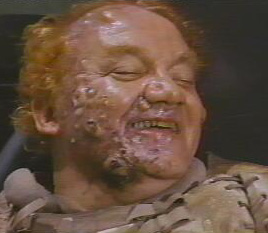
There’s a history of villainizing gay men in lit, playing to a conscious or subconscious fear of effeminacy and our “strange” proclivities.   Likely, this trend was a lot more prevalent prior to the civil rights movement.   Think about the many fey villains in Ian Fleming’s James Bond series, their apathy toward women the perfect foil to Bond’s rather active heterosexuality.   Or—from Frank Herbert’s Dune—the gluttonous, deranged Baron Vladimir Harkonnen who can barely keep a handle on his lust for his young nephews.

Another popular trope is sometimes called ‘Bury your Gays.’    How many LGBT’s in mainstream novels make it to the end of the story alive?   (especially if they are non-gender conforming and/or open about their sexuality?).   Somehow, gay tragic heroes bother me more than gay villains.    Jack Twist in Annie Proulx’s Brokeback Mountain, for example.   Practically all the “classics” have LGBT’s killing themselves or at least ending off badly:   James Baldwin’s Giovanni’s Room, Radclyffe Hall’s The Well of Loneliness, D.H. Lawrence’s The Fox, among others.

Representations have certainly gotten better, but if you believe in the concept of a collective unconscious—as I do—archetypes never really die, they go through derivations, softening perhaps, but persisting as something we believe to be true about the world.

I notice this is some of the historical fiction I read:   Turnus, the petulant prince-suitor who is mocked for his homosexual-leanings, in Ursula LeGuin’s Lavinia.   Ay, the ruthless puppet-master behind ancient Egypt’s dynastic political workings, in Nick Drake’s Nefertiti.  (He’s mentioned to be gay for no apparent reason other than to set him apart as the only gay character in the novel).

In some recent stories, LGBT villains have become less evil and more absurd.   I haven’t seen the movie, but there’s quite a fracas over the glam rock-inspired bad guy in the new Tron:   Legacy.   You can check the discussion out on AfterElton.

I know I’m veering away from literary examples (which elude me now), but there’s Dr. Evil from Mike Myers’ Austin Powers’ films and scores of queeny villains in TV’s South Park and you bet you’ll find at least a couple ridiculous or tragic (or ridiculous AND tragic) LGBT’s in any Wayans Brothers film.

I don’t think any of these depictions are horrible or bent on destroying the LGBT community (some of them are clever and funny), but I do think they’re worth examining.   And the best kind of LGBT portrayal—in my mind—is one that turns the tropes on their heads, re-imagining what we think we know.    Can a gay teen save the world, as in Perry Moore’s Hero?   Have the lives of our folktale villains been suppressed and misunderstood, as in Douglas Clegg’s Mordred, Bastard Son?   This is the stuff I want to read.

Spam-mered!

It says something when you start getting as many as 30 spam comments a day.   What it says, I don’t know exactly.

I guess I could take it as a sign of arrival.   There are shady companies across the globe that think they can benefit by drawing traffic from my humble site (unlikely as it seems).   But with my trusty Akismet Plug-In, their hyperlink gibberish is a minor inconvenience.   In fact, it’s kind of fun to scroll through the quarantined comments and, ultimately, obliterate them with a click of ‘Delete Permanently.’

I get five basic categories of spam.  About a third are advertisements for pharmaceuticals, especially “male enhancement” drugs like Cialis and Viagra.   Twenty percent are porn—99% of it, straight porn—which ticks me off.   They couldn’t even take a second to read a little about my site?   Another twenty percent is loan and credit offers.   Another twenty percent is internet or computer products.   And the rest is the most interesting category:   miscellaneous.

I’ve been spammed by companies selling kayaks in Australia, sites devoted to vulcanology, a fan site for a pre-teen Beauty Queen, and a project that collects sightings of UFO’s, among others.   Some spam comes in written in Russian, Hungarian and Chinese, so I’m not sure what they’re trying to sell, although I can understand enough of the French spam to see that they’re just as concerned about erectile dysfunction as here in the states.   The best stuff is poorly, ridiculously translated into English.   Here are some of my favorites:

On my review of Bret Easton Ellis’ Imperial Bedrooms…

“Good information but might you spoon feed it to me?”

On Writing Prompts…

“I hope you get a nice day! very good article, shaft written plus very outlook out. i am looking forward until reading frequently of your posts within the approaching.”

Many of the messages try to play to my ego, with near-incomprehensible, vague praise, in effect, trying to trick me into releasing them from spam purgatory.   It’s tempting, but I won’t compromise my integrity.

I wonder what kind of spam this post will get?

Christmas Memories

When I was little, my older brother and I had a strange tradition.   We’d put on my parents’ Andy Williams’ Christmas Show record album, get down on the living room’s hardwood floor—me wearing my Donald Duck pajamas—and spin around on our knees.   We were whirling dervishes, accelerating to the  music, and inevitably, hysterically wiping out into each other or the sofa (or both).

These kinds of behavior are hard to analyze.   Was it a protest of absurdity against what we regarded as the cornball musical tastes of our parents?    Was it a way of joining with the sentimentality of the season, on our own terms, in the least conventional way that we could fashion?

All I can say is that Christmas was a time of great excitement.  There were the toys, the candy, the cookies, the snow forts, and the crackling wood in the fireplace.  There was also the allure of miracles.  Not that I was raised with a particularly strong sense of reverence for the season.   When we  broke out the Christmas ornaments, my mother used to put up a creche, but it always seemed  as make believe as the stuffed animals and Matchbox cars I played with.   In fact, I sometimes incorporated the nativity scene figurines into my imaginary games, with the wisemen and angels leading cross-country races through the house.

Science was the greater influence growing up so the Christmas story interested me from an academic point of view rather than a spiritual one.   We lived in Buffalo, New York, and I assumed that the rest of the world was freezing cold and snowy in December.    I wanted to know how baby Jesus survived in that straw-laid crib, barely sheltered by an open stable?

Santa Claus intrigued me even more.   If he brought gifts to every single kid around the world, how long did that take?   My brother and I looked up population data and calculated how fast Santa would have to travel to do his job in one night.   Still, I believed.   If it could be done by superheroes like Flash, it could be done by Santa.

I believed up to the time that I walked in on my mom and brother talking about a world globe he had gotten as a gift.  My brother had questions about the Arctic Circle, and my mom was telling him it was all ice, no land, completely uninhabitable.   I asked:

“But how does Santa live there?”

My mom looked at me with a slight smile, no doubt touched by my innocence, but the truth was there in the awkward silence.  It had all been a deceit.

Even without Santa Claus or Jesus Christ, I always felt that there was something different going on this time of year—good will toward men, a little extra kindness, unexpected generosity.  I like gift giving (and receiving) and sometimes think that maybe that’s enough of a reason to celebrate.  Shouldn’t there be at least one time of the year where you go out of your way to give something to the people who are important in your life?

These days, Christmas morning is mimosa’s and hot cocoa while my partner and I unwrap our presents.  Sometimes we’ll watch an animated film by Disney or Hiyao Miyazaki.   Often, we’ll find ourselves back in bed for an afternoon nap.   There are a few tasks to do like phone calls, cleaning up the breakfast dishes, and taking out garbage bags full of wrapping paper.  But mostly it’s laying around in our pajamas and not caring for a day if we make it out of the house.   That’s something worth looking forward to and reason enough for me to celebrate this time of year.

World AIDS Day

As part of the post-Stonewall generation, I grew up at a time when AIDS was matter-of-fact.   That’s not to say there wasn’t stigma or misinformation.   In school, I listened to friends joke pretty brutally about it.   AIDS was something gay men got deservedly, and no one knew anyone who was gay.   I barely understood that I was gay myself.

In gay literature and films of the 1980’s and early 90’s, AIDS always figured in, often as a dominant theme.   Our stories were sometimes criticized as too AIDS-focused, excluding other facets of gay life.   But really, what was the alternative?   Men getting sick and dying from the disease was the reality.    To omit these stories would have been dishonest.

My favorite novel from the time was John Weir’s The Irreversible Decline of Eddie Socket.   It’s been compared to Salinger’s Catcher in the Rye and concerns a young man who finds out he’s HIV positive and goes on an adventure in New York City, a sort of last hurrah.   In those days, no one lived long with AIDS.   I didn’t personally know anyone who had contracted it, but the terrifying cinematic images—emaciated men in hospital beds with gory lesions—were branded in my consciousness.

The first gay film I ever saw, in secret, sneaking off to a late night showing at an indie theater in Manhattan, was Longtime Companion. I cried through the last thirty minutes of the movie, but it wasn’t as depressing of an initiation to gay life as it might sound.   I saw men caring for each other.   I saw the possibility of fighting against injustice.   I saw hope.

The AIDS epidemic has changed and accordingly, so have gay men’s stories.   I was surprised and encouraged by a recent statistic.   The life expectancy for someone diagnosed with AIDS has increased to 30-40 years such that on average, many people with AIDS will live well into their 60’s, some even longer, approaching a healthy lifespan.

Yet AIDS continues to impact our lives.   The number of newly infected men has stayed flat from year to year.   In some urban areas, as many as one in five gay men are positive.   There’s been a lot of focus on transmission rates among young guys, but there are new diagnoses in virtually every age group so it’s not just a problem for the younger generation.

From my experience, I don’t think that the major factor is that guys no longer care or that they are choosing to get infected (“bug chasers” was the media hype a few years back).   HIV is sexually transmitted, and sexual behavior is stubbornly resistant to change.   Those who criticize gay men for being “promiscuous” or lacking self-control might ask themselves:  is it healthier to fear sex or to enjoy sex?

Eroticizing safer sex is the best solution in my opinion.   Finding a cure is of course even better, but for now we need realistic approaches, gay-affirming approaches, versus shame and fear campaigns.

This year’s World AIDS Day theme promotes “Universal Access and Human Rights.”   These are issues that impact people everywhere, but they’re hugely different if you live in a western country or in places like sub-Saharan Africa.   Access to treatment is a problem in the United States.   For the majority of people living with AIDS globally, it’s a tragedy:  about half of people living with AIDS have access to the medicine they need.   Think locally, act globally.   We’ve got a long way to go.