Atlantis Found in Dona Ana Mudflats?

Totally unsnarky here.   If you’ve wended your way through my site, you know one of my little peculiarities is a fascination with the legend of Atlantis.

There was big archeological news this week:   a U.S. research team believes they have substantial evidence to place the lost city’s location 60 miles inland in Southern Spain, beneath the Dona Ana National Park, a vast marshland.

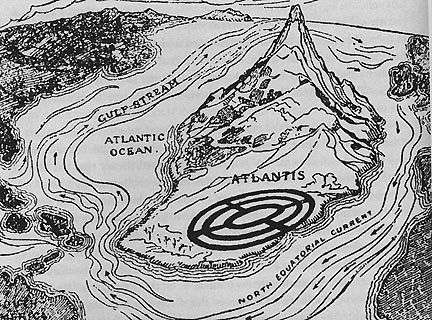
Here’s National Geographic’s depiction of what Atlantis looked like before it was covered in mud.

The most compelling indicator is the proximity of several “memorial cities” in the area.   They’re believed to have been built by survivors, and are similar in design to Plato’s description of Atlantis’ urban layout, which he wrote about in 360 B.C.E..   The theory is thus:  Atlantis was buried by ocean and debris from a tsunami, and its refugees built replicas with concentric walls and mounted temples to preserve the memory of their fabled great city.   Here’s a link to Reuters’ article about the find.

I just watched the National Geographic special last night—a little hokey as these things tend to be, and pretty short on archeological “evidence.”   They used aerial photography and underground radar to create a gloppy sketch of a ringed wall below the earth, and it’s carbon-dated as up to 5,000 years old.   But for real proof, they will have to excavate—a very gradual endeavor since the site is also filled with underground pools of water.

So, such “finds” tend to come up every few years.   In 2009, an anonymous group of “undersea archeologists” released grainy photos that became a brief Internet sensation.   They claimed the pics, taken at an undisclosed location in the Caribbean Sea, revealed city structures, including Egyptian style pyramids, that predated recorded history.

In 2000, ruins of an ancient city were found in the Black Sea, off the coast of Turkey.

Also in 2009, an Internet rumor spread that you could see urban grid lines in the Atlantic Ocean off the north coast of Africa, a lost city buried under water.   It turned out to be a “digital artifact.”

Is the Dona Ana site a publicity stunt for National Geographic or a promising lead to uncovering our greatest enduring legend?   Time will tell, and meanwhile, “my” Atlantis slugs along:   getting deeper into revising Act II.   Anyone want to finance a sabbatical so I can finish this thing off?

The writer as researcher

Revising my novel has taken me through many days of re-reading what I wrote,  aftershocks of beta reader feedback, soul-searching, re-drafting an outline, and now, gently putting new words down on the page.

I’ve realized what I also need to do is to get clearer in my head (and then the pages) my portrayal of male/male relationships in the fantasy world wherein the action takes place.

Of course, I have some liberties with fantasy.  I could create a world with far-flung notions of male sexuality.  But the story is also re-told myth, with an ancient world–predominantly–pre-Hellenic sensibility. Thus, there’s some squaring to be done with what we know about the ancient Greece.

There are common misunderstandings about the attitudes and practices surrounding male sexuality in ancient Greece.  On the surface, the society tends to be associated with rampant homosexuality, portrayed in parody and snarky comments–“Oh, you know what the Greeks were like…”

Earlier in my career, I facilitated anti-homophobia workshops.  One of my most memorable experiences was when I presented in front of a group of teachers, during the segment of the workshop on cultural relativism, cross-cultural and cross-historical attitudes toward homosexuality.  A young teacher, watching me intently and nodding his head along for quite some time, raised his hand and asked, with full sincerity, “Didn’t the ancient Greeks support gay marriage?”

The answer, of course, was no, certainly not as we understand “gay marriage” today.

From a modern viewpoint, many of the artistic relics–naked men on vase paintings, the kouros (idols of male beauty), and depictions of the phallus–make it seem like a society obsessed with the male form, hence, obviously very gay.  This leads to a misinterpretation of male sexuality and gender roles of the time.   In actuality, ancient Greek society was highly patriarchal, with segregated roles for men and women.  Men ruled the public realm.  Women were the keepers of the home.  The idealized man was strong, fearless and dominant.   Effeminacy was ridiculed such that a man’s reputation could be ruined if he was called out as “acting like a woman.”

Thus the abundant visual depictions of men are better understood as a reflection of male-centrism politically and culturally.  The naked male image was not meant to arouse, generally.

Still, there were nuances.  Whereas many patriarchal societies enforce a heterosexual imperative, at least in public life, in ancient Greece, exclusive heterosexuality was not a requirement of male privilege.  Many of the most powerful, respected, celebrated men of the time engaged in sex with other men, particularly during the pre-Hellenic era when same-sex pairings were a widespread tradition, at least among the upper class.  The context of male/male relationships was what mattered.

Most of what we know about homosexuality at the time comes from artwork and literature depicting the specific practice of ‘paiderastia,’ which involved discrete roles for the older, more experienced partner, the ‘erastes,’ and his younger, typically adolescent lover, the ‘eromenos.’   Such relationships had social, educational and/or political components, vis-a-vis a tutor and his pupil or a noble man and a youth from lesser aristocratic family.  In some cases, these sort of couplings began with rituals similar to a marriage—the presentation of gifts (dowry) to the eromenos, animal sacrifices and feasts.  The eromenos could choose whether or not to accept the offer of his erastes, unlike girls who rarely had say in who they married.

I’d love to know more about peer-to-peer homosexual relationships of the time, which certainly happened, but are hard to turn up in the literature.  Likely, they were less socially sanctioned since they conferred none of the advantages that were prized at the time:  child-bearing or status advancement.

Turning Japanese

I came up with this post title, realized it was a masturbation reference (from the Vapors’ 80’s hit of the same name)–which I’ve been doing a lot lately, using onanism puns on my blog that is,  but I couldn’t think of a better title so there it is.

This week, I decided to write a little poetry on the train.  The Notes app on my iPhone lends itself to short form verse, so it’s all Haiku–a 17th century Japanese poetry style.

I believe the thing with Haiku is visual imagery.   Traditionally, the poems are written vertically with an ink pen and sometimes accompanied by a painting, or, they can be inscribed on monuments.   I tried to stick to imagery but took some liberties.

Train Haiku

A morning train,

Chirpy chatter, Nooks, and texts,

And I, cocooned.

~

When I was younger,

I thought you’d burn your eyeballs,

Staring at the sun.

~

Little cat pounces,

Tail licks the air, fore-paws clamp,

She’s caught a house fly.

~

When he’s listening,

He nods fast like he agrees,

But inside, he doesn’t.

~

I dreamt of Tokyo,

Where you can leave your bike out,

And no one steals it.

~

January snow,

The sky is clotted with gray,

A frozen footprint.

~

Waiting for the train,

Bundled in coat, scarf and hat,

Her ears whisper songs.

Outlining: How I hate thee

There’s a division among fiction writers: those who outline their projects and those who wing it.

The outliners say they could never organize their plots, sub-plots or character arcs without drawing out the architecture of their story, separate from the narrative.

The non-outliners say their process is more spontaneous, and necessarily so. They need to let the story happen to them, and they consider outlining a tedious chore that results in an uninspiring, paint-by-numbers project.

(I suspect that non-outliners often overstate their freedom from outlining. To be a successful writer, you need—at least—to submit a plot synopsis at some point in the publishing process. And unless you are a certified genius, which few of us are, I don’t think it’s possible to keep all the many details of a 60-100K word story laid out logically in your head).

I consider myself a reluctant outliner. I absolutely abhor it, and I only fall back on outlining when I start losing track of my story, usually around 20-30K words. Even then, I’m resistant to outlining further than I’ve written, a sort of outline-as-you-go technique. I don’t recommend this approach. While it satisfies my need to write unfettered, with a childlike sense of possibility, I’ve blindly hit walls on many occasions because I’m not committed to the way ahead.

There are many outline resources.  Here’s a familiar romance outline:

Boy meets boy

Boy loses boy

Boy gets boy back again

Or,

Hero has a problem

Hero tries to fix the problem (usually through three tries)

Hero overcomes the problem

These broad sections of the story coincide with the dramatic structure: Act I, Act II and Act III. Or you can do Act I – V if you want to include falling action and denouement.

The first plot diagram was created by German playwright and novelist Gustav Freytag and has become known as Freytag’s Pyramid.  Here it is in its simplest form (swiped from Wikipedia).

Its a helpful way to visualize the dynamic of rising tension, or stakes.  As novel writing how-to author Jack Bickham puts it: the further along your story goes, the worse shape your hero should be in (paraphrased). A good example is Harriet Beecher Stowe’s Uncle Tom’s Cabin. The hero Uncle Tom, a mid-19th century American slave, gets passed from owner to owner, one worse than the next, and ends up in the hands of super-villain Simon Legree.

For epic fantasy, the standard structural guide is Joseph Campbell’s monomyth or The Hero’s Journey, which is a much more detailed outline.   I found this interesting chart about it at Wikipedia.

There are entire courses on mastering the construction of this kind of story.

So, what do I do with all of these resources? Study them for awhile and hope that some of the information synchs up in my head subconsciously so I hopefully will never have to study them again. I once tried a technique suggested by Beckham: use an index card for each scene of your story indicating:

Story question

Conflict

Disaster

I was supposed to tack each card up on a bulletin board in sequential order. Then I got bored with it, and the cards got buried on my desk.

The next morning, my cat had jumped up on the desk, batted everything around and scattered the index cards all over the floor. At least she thought the exercise was a fun idea.

Writing prompts

I haven’t shared much of my creative writing in awhile so I thought I’d post a couple of my favorite pieces from a writing group I participated in a few months back.

This was a common exercise:   someone picks out a random word and you have about ten minutes to take off from there.   It’s fun, it loosens up your brain-—my sometimes glacially-compacted vocabulary-—and it helps you find your voice.   In my case, that voice tended to be ironic and absurd.

TRAUMA

She named the twins Trauma and Drama.   No one ever knew exactly why.   There were stories and explanations.   She used to be a stage actress.   The girl’s father was foreign—from Guam or something like that.   And this—the lamest—from my ever understated mother:   “She was a little eccentric.”   Trauma and Drama.   I knew why she came up with those names.   The woman was batshit nuts.

Trauma and Drama followed me through kindergarten, grade school and all the way to junior high.   I always thought of them as neglected porcelain dolls.   They were identical.   Straight black hair.   Skin the color of dishwater.   Big black pupils that took up all of their eyes.   They always looked like they were about to cry, but they never did, at least I never saw them crying.   You couldn’t help but be fascinated by them, and I noticed they only had three outfits that they alternated between themselves through the week:   one gray, one blue, one pink over-sized shirt, all the same style, each embroidered around the collar with tiny hearts, that they wore through all the seasons, paired with a pair of dingy, baggy jeans.   I wondered how they decided who got to wear which one each morning.

Kids used to laugh a little at them when they walked into the lunch room or came out on the playground, always hand-in-hand.   I think they spooked the teachers.   They never got called on in class, and wherever they were sitting, the teacher seemed to wander to the other side of the room.   Sure, they got teased, but they stuck together.   Trauma and Drama.   They were all each other had.

GRACE

“There but for the grace of God,” Grandma said when the big birch tree split open in a lightning storm and missed hitting the house by an arm’s reach.

“There but for the grace of God,” she’d say three, four, five times during the nightly news.   Stories about the police finding missing children or hunger relief arriving in some far off country or the hero of the week who dove into the icy water to rescue the passenger from a car that flew off a bridge.

She also said it when some guy would hold the door open for her at the mall.   Or when the weatherman predicted rain on a sunny day.   Or when she found her reading glasses wedged beneath the sofa cushion.

I’ll tell you:  it all got a little tired living with Granny.   And it made me wonder what is there left for her to proclaim to be a miracle.? My lord—she’d seen it all!   And doesn’t such a reckless overuse of a proclamation cheapen the real acts of grace, the real miracles when they actually happen?   Taking all these thoughts together, I’ve come to the conclusion that religion is a load of bunk.