What does it mean to be post-gay?

I’m missing the Pride festivities this year.   I’ll be in Mykonos, Greece, having a more private Pride celebration—my 10th anniversary with my partner—along with close friends and family.

Last year’s Pride month had me thinking about growing older in the Gay community. This year, I’m stuck on the concept of “the post-gay generation,” which has gotten some chatter lately.

It’s come up through reactions to the Broadway revival of Larry Kramer’s 1980s AIDS saga The Normal Heart, or—more to the point—the revival of Kramer calling out the younger generation as “tragic” and “apathetic.” Then, there was the responding, angry “Open Letter to Larry Kramer” by J. Ricky Price from the youngish queer media site TheNewGay.net.

To be precise, Kramer and Price don’t use the term post-gay generation per se in their interviews or letters, but the issues and questions surrounding this new identity are evident through their exchange.

Are Gen Y-gays unappreciative of the extraordinary work their forebears accomplished to make life better for them?

Do Baby Boomer-gays place too much emphasis on sexual identity and politics, to the exclusion of the many interesting facets of being an individual?

Is it necessary to identify as gay, at all times, first and foremost, to push the civil rights movement along?

Are young gay men who prefer to stay outside of gay politics and the gay community feeble assimilationists, and likely self-hating?

As a Gen Xer, my views on all these debates are, predictably, somewhere in the middle.

But first, what does post-gay mean?  According to the Urban dictionary:

The notion that homosexuals should be able to define their identities by something other than sexual preference.

OK.   Doesn’t sound so new, or terrible for that matter.   This is the Urban Dictionary, after all, so I’ll even forgive the specious, antiquated terminology like “homosexual” and “sexual preference.”   I believe people should be able to identify however they want, and if a young man sees his gayness as secondary or tertiary to say…being an artist…or being Black…or having an eclectic mix on his iPod…that seems perfectly reasonable.

The problem I see with the term post-gay—-which is the same problem I see with “post-racial” or “post-feminist”—-is it seems to imply putting something in the past, as though certain experiences, histories, or I guess identities are no longer important or relevant.

I could but won’t argue the relevancy issue, since I think it’s pretty obvious.   Instead, I’ll frame the post-gay debate in the context of our broader post-identity culture (which is not the sole creation of Gen Y).

We live in a world where becoming skin color “blind” is considered to be a state of enlightenment.   Our most visible female politicians may invoke sexism when their qualifications are questioned, but their platforms say nothing about promoting the status of women.   It makes sense that many gay men are gravitating toward “neutral” identities that make navigating the decreasingly identity-conscious, decreasingly community-conscious world easier.   It’s not precisely assimilation, I don’t think, or social conformity.   It’s more about individualism trumping group identity.

There’s something sad in that, but every generation has demanded the right to identify on its own terms, not just to spite their older detractors, but because that’s how we find ourselves in the world.

At 18, I was a retro Dead Head.   Five years later I was a gay-liberationist graduate student in Doc Martens.   At 41, I’m a gay writer slash social worker cum humanist-atheist cum social justice enthusiast.   Maybe our identities get longer the older we get.   I’d never use the label post-gay.   Maybe gay-plus.

andrewjpeterswrites.com goes dark next week due to vacation!!


Is Dumb the New Smart?

A little social commentary, a little writerly update this week…

Is Dumb the New Smart?

It’s actually a political/pop culture trend that started under the George W. Bush administration, and the concomitant rise of celebrities like Paris Hilton.

But it reached its zenith with Sarah Palin and her recent commentary on Paul Revere. He made his famous ride, gun in hand, to warn the British:   we Americans have the right to bear arms.   Remember from history class?

Education is passe, intellectual inquiry is for assholes, and everything you needed to know, you learned at Sunday family suppers, between Church and rifle practice.

For a recent pop culture counterpart, see Charlie Sheen.

Writing Brief

In writing news, my manuscript wends its way to a climax and denouement (isn’t that a great word?).   I just finished up a murder scene (mwah, ha, ha, ha).

Excitement is building for Lambda’s 2011 Writers’ Retreat.   I’ve made my flight arrangements and sent in my photo/bio.

Lambda started a listserv for Fellows so we can share transportation and get to know each other.   I’m already amazed (and a bit intimidated) by the list of authors.   Lots of writers to learn from.


Randomness

Squeezing in a quick post this week while I’ve been writing around the clock, mainly for work (grant proposal) rather than my own projects (sigh).

I thought I’d just talk about some random things that inspired me this week…

1. Thor, the movie.

I’m usually disappointed by big budget, action/adventure Hollywood films, but Thor was so good, on so many levels.

First level—a fantasy world that is not a thinly veiled allegory for America, at its freedom-loving, platitude-wagging, jingoistic best.   (I love freedom too, but I prefer it with a touch of subtlety).

Second level—a hero who starts off as a (believable) jerk, and ends up as a (believable) hero.   Chris Hemworth plays it just right:   a swaggering, single-minded hunk when he needs to be, and a broken outcast, later, who quickly gets himself back on track.   Bravo.

Third level—Natalie Portman.   There is no role too cliche or doofy that she can’t make work.

2. An Archie comics character comes out.

I haven’t read the series since, erm, 1985, but I’m feeling the joy.   Positive LGBT media representations!!

3. Beta readers.

Just got myself a new one and—wow—she’s good.   Not all writers are good critiquers, and the opposite is true as well.   But this new online friend (I can’t reveal her name because she’s shy) really made my week with incredible, thoughtful feedback on a short story I’m getting ready to submit.   Thank you (you know who you are).

4. French Open Tennis.

The most obscure Grand Slam event is also, kinda, my favorite.   Because it’s an underdog kind of event, and it’s weird playing on clay, and there’s longer rallies, and spins, and strategy, and it takes place in Paris for chrissake!

This year it’s an open field on the women’s side, and, arguably, up for grabs between the top three seeded men. And two of my favorite longshot female players are still in the draw: Marion Bartoli and Li Na. Awesome.

The Power Within to Overcome Bullying

In the movement to stop gay bullying and suicide, there have been video campaigns, efforts to change school policies, and many powerful stories—both courageous and tragic—that have brought attention to the treatment of gay students.

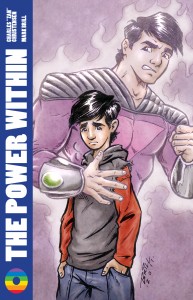
Doing their part are Charles “Zane” Christensen and Mark Brill, a writer/artist team from Northwest Comics, who created The Power Within.

The comic focuses on Shannon, a shy, artsy kid who dresses and acts differently from his peers and gets teased and threatened for it.   Making things worse, his parents and teachers blame him for the bullying.   They say if he didn’t behave so strange, he wouldn’t bring it on himself.   Shannon is scared, alone and at a dangerous breaking point.

But in his imagination, he has a superhero alter ego who can stand up to the bullies and give back what they’re giving.   It’s a fantasy that gets Shannon through the day, but as his torment at school escalates, he faces the question:   will it be enough to survive?

According to Christensen, the goal of the comic is to send a positive message to bullied teens.   While bullying and suicide are complex issues, Christensen believes The Power Within can make a difference to kids who feel like outcasts and may be on the verge of doing something desperate.

The series is dedicated to Rutgers University Freshman Tyler Clementi who took his life after classmates distributed a secret video of him making out with another boy.   Way too many gay teenagers face such situations of humiliation and harassment, and Christensen says that—while support from caring adults helps—often the solution is kids finding the personal strength to be who they are.

It’s a good approach that is backed by social science research.   Gay men who are self-accepting are less likely to attempt suicide, or to encounter problems such as unsafe sex or drugs. Self-acceptance ultimately comes from “within,” but environmental influences can have an impact, including positive examples of LGBTs in the media.

Christensen wants to get The Power Within into school classrooms and libraries so that as many young people as possible can access it.   He’s acquiring donations—big and small—to cover the cost of printing so kids can get them for free.

He’s set the goal of raising $3,000 by May 20th, and you can help by visiting his page at Kickstarter.

On another front, activists are battling regressive school policies that make it even harder to address anti-gay bullying.

The Tennessee state legislature is pushing through a bill that requires public schools to refrain from discussing homosexuality. Dubbed the “Speak No Gay” Law, the legislation—championed by state senator Tracey Campfield (R)—is insidiously positioned as a “neutral” policy on homosexuality, allowing parents to decide when (or if) they want their child to learn about diversity.   But if the school’s policy is gays do not exist, how do they deal with gay kids who are getting bashed?

So much could be said about the absurdity and wrong-mindedness of the law.  But instead, I’ll share the inspired campaign to fight it.

Started as a media project to repeal California’s anti-gay Prop 8, FCKH8.com created a very clever and entertaining response to Tennessee legislators.   Every time you tweet or Facebook the video, 25 cents will be donated to the Tennessee Equality Project which promotes LGBT rights.

Here’s the video.

Fuck  fuck  fuck.   Gay  gay  gay.   See:   it’s fun!


To Fight Injustice and Serve All Mankind: Prism Comics

Pride Comics award-winning Pride High series

I haven’t been so excited to share a discovery since I found out about pioneering Hungarian gay activist Karl-Maria Kertbeny.

Founded in 2003, Prism Comics is a not-for-profit organization that supports LGBT comics, creators and readers, through education, promotion and resources for publication.   They operate a full-featured website with profiles of 390 comics creators, Webcomics–a collection of featured series, forums, and a shop where you can purchase hundreds of titles.

LGBT-themed comics have been around for quite awhile, at least on the spicy fringe, vis-a-vis Tijuana Bibles and Tom of Finland.   But the mainstream industry has a long history of censoring queer content, and adding to a homophobic climate via negative portrayals, or killing queer characters off in violent, degrading ways.

According to Prism Co-President David Stanley, attitudes towards LGBTs have been slow to change, and controversy still comes up when queer characters and storylines are introduced.

For example–in 2009–Marvel Comics’ X-Factor series revealed a romance between teammates Shatterstar and Rictor.   Former Marvel writer Rob Liefeld, who created the Shatterstar character 18 years ago, vociferously opposed the storyline, saying:   “Shatterstar is not gay.  I can’t wait to someday undo this,” and insisting the move was “contrived” and “bad for fans.”

Stanley and others—including current X-Factor writer Peter David—interpret Liefeld’s response as homophobic, and liken it to a parent’s refusal to accept the inevitable development of his child’s autonomy, in this case coming out as bisexual or gay.   Shatterstar started out as sexually ambiguous, and the awakening of his feelings for Rictor was a reasonable progression—and one that many LGBT fans can relate to—since sexual confusion and repression frequently precede acknowledging a queer identity.

Moreover, defenders of Shatterstar’s coming out ask:   isn’t there a double standard here?  Comics heroes are frequently handed down from writer to writer—including many of Liefeld’s other creations—and there isn’t an outcry when a hero discovers his non-gay leaning.   Stanley feels Liefeld’s reaction to Shatterstar’s evolution amounts to a belief that warrior-type heroes can’t be gay.

Ironically, Shatterstar is modeled after ancient Spartan soldiers, of whom there is widespread acknowledgement of homosexuality.

Shatterstar and Rictor kiss in X-Factor #45

While industry giants like Marvel and DC have very gradually become more inclusive of LGBT themes, it’s heartening to see the LGBT comics community thriving due—in large measure—to the growth and freedom of e-publications.   Prism Comics is a portal to an astoundingly diverse world of talented queer comics.   Their interests and styles run the gamut—political commentary, everyday sarcasm, superheroes, anime, erotica and many more.

Beyond its website, Prism participates in ComicCons with booths and panels.   Refreshingly humble about his organization’s influence within the industry, though passionate about it, Stanley says having a presence at these events fosters a more welcoming climate for LGBT writers and fans alike.

“We create a space for creators and fans to feel comfortable being themselves amongst their fellow comic book geeks.   I think it’s a bit comforting to know you can go to a convention and find one booth where there are openly gay people selling books with LGBT characters or subjects.”

Here’s some of the artwork/strips at Prism that caught my eye…

Bevis Musson’s Queen of Diamonds Promo


Bangkok-based Chaturon Konghin’s Boy Love cover

Anti-Bullying Comic by Charles Christensen and Mark Brill

Note:   The title of this article is not a statement of Prism Comics’ mission.   It’s from the Saturday morning cartoon The Superfriends, one of my childhood favorites.