For #Werecat4 Release Week, I have a special feature today I’m calling Inside the Character’s Studio.
I love interviewing characters from my books. It’s fun, and it actually gives me more insight into the fictional people I cooked up in my brain. A little while back, I interviewed Cleito from Poseidon and Cleito at History Imagined, and I previously wrote a George Wayne interview with Jackson Dowd, the main character from Werecat, when his first book came out.
This time, I decided to do the interview from the perspective of the iconic James Lipton of The Actor’s Studio in order to challenge Jacks (and myself) with Lipton’s penetrating questions. So, I bring you James Lipton sitting down with my very own Jacks to give you a peek at the star of Werecat and the story itself.
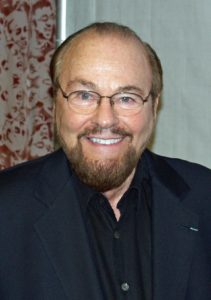
James Lipton by David Shankbone, retrieved from Wikipedia Commons
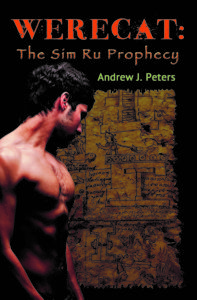
The just released, final installment of the Werecat series.
Lipton: Jackson Dowd made his literary début in 2013 with the release of an e-novelette entitled The Rearing. That slim volume became a launching pad for the sensation known as Werecat, which has delighted paranormal fans and garnered critical acclaim from Kirkus and media outlets throughout the sci fi/fantasy and gay fiction world. In 2016, Werecat was a Readers’ Choice finalist in The Romance Reviews’ awards.
Following The Rearing, Jackson appeared in The Glaring, The Fugitive, and just this week, the long-awaited fourth and final book: The Sim Ru Prophecy. He is some parts anti-hero, some parts Everyman, and of course most notably, some parts man and beast. While shifter and mutant characters have a longtime tradition of providing allegory to the challenges of real life social outsiders such as LGBTs, Jackson, or Jacks as he likes to be called, is both fantastical creature and an ‘out’ gay man. It is my pleasure to bring into The Character’s Studio, for the first time, the hero of Werecat, Jackson Dowd.
[Wild studio applause]
Dowd: [grins, waves] Thanks.
Lipton: Thank you for taking that existential leap of faith to join us today. How does it feel to get that kind of reception?
Dowd: [bows head, peeks out, bows head again] Good. It’s pretty surreal.
Lipton: You grew up in a small, paper mill town in Pennsylvania. What was that like for you?
Dowd: Yeah, well, my dad worked at that paper mill. And my grandfather did as well. If you’ve ever driven through central Pennsylvania, you can smell the factories from miles away. It’s pretty much a fading industry, and where I grew up, it was one of those blue collar, Middle America kind of towns where you knew if you didn’t get out, it was going to be pretty hard. I mean, most people relied on the factory for work, and it was shrinking every year. Y’know, jobs going overseas.
I can’t say I had great memories of growing up. I wasn’t into football, or cars, or girls, so most of the time I felt like a social oddity. I had a few friends, and I was pretty good at school. When I got a scholarship to a college in New York State, it kinda felt like winning the lottery. I had my bags packed before I even graduated high school, and I was already thinking: I’m getting out and I’m never looking back.
Lipton: Which of your childhood experiences has stayed with you the most?
Dowd: [razzes] I guess I didn’t think of it that way at the time, but I do have one. My mom kept a lot of old photos, and when I was younger, in elementary school y’know, I used to love going through them. It was kind of a lonely age for me. I’m an only child. My parents both worked. So after school, I had the house to myself, and I found this big box of photographs in my parents’ bedroom closet. I knew I wasn’t supposed to go in there. Would have caught hell if they found out, but it became kind of this obsession for me.
Anyway, she had photos of a lot of people I knew, like my grandparents, aunts, uncles, and old photos when she was a kid, when my dad was a kid. They were high school sweethearts so that was kind of interesting seeing how different they looked when they were in school. But the photo I loved the best was this really fragile antique photo of this woman I had never met. It was one of those old black and whites, where this woman was posed all formal sitting down and dressed up in this blouse with a big, frilly collar and a ribbon around her neck. Y’know, the kind of photo where you can picture the photographer with one of those big, old cameras with a curtain that you pretty much step into to take a shot. LIke a family heirloom, y’know. It was really fascinating to me because just about every photo my mom had was from family weddings or baby photos, y’know, stuff like that, but this woman looked nothing like us. She had fine, straight hair, high cheekbones, a darker complexion. The only thing that was written on the back in fancy handwriting was the name: Barbara. She looked like a Native American, and I don’t know, at the time I invented this story in my head that she had been a maid or something to my great grandparents. Which is really, totally ridiculous because both my mom’s and my dad’s families were dirt poor as far back as I ever knew.
So one night, it was a Saturday night I remember because that was “family time” and the only night when my dad was in a decent mood to do things with us, my mom brought out the box of photos to the kitchen table so we could all go through them. And she starts telling all these stories about them, and I’m pretending like I’ve never seen them, though I never heard her stories about this and that, and I’m like going nuts inside waiting for her to get to that woman’s photo and finally have an answer to who the hell she is.
And I remember really clearly: she gets to the photo, picks it up really gently, looks it over for a couple of seconds, and then she sets it aside, face down. And now I’m really dying because, y’know, after all this time, sitting through all her stories, she’s not going to say a peep about the strangest photo in her entire collection?
So I get the balls to ask her: “Who’s that?” And, y’know, it’s one of those moments where you feel like you saw something you shouldn’t have, almost as bad as walking in on your parents having sex. But I saw my mom looking so embarrassed, so torn up that I had asked that question about Barbara. And she glances at my dad, and he’s looking like he doesn’t know what to say either, and I’m wondering: did this Barbara do something horrible? Like murder somebody? But then why would you keep a picture of her?
So finally, my dad says, in his serious ‘parent’ voice: “That’s Nana’s mother.” We always called my mom’s mom Nana, and I guess she had died about a year before we pulled out those old photos. And I swear my first thought was my dad must be putting me on since for one thing, why was it so hard to say that? And meanwhile, I’d never seen anyone in our family who looked like that. But I couldn’t say anything at the time. I was just sort of gobsmacked, y’know, and I let it pass. Though I’ll always remember that moment because it was one of those things where you can never look at your parents in the same way again, and it stirred up these raw emotions. Like I was embarrassed along with my parents, but at the same time, I felt really happy, and maybe this was more in my head than anything else since I never even met Barbara, my great grandmother. But I felt like I finally had a connection to someone in my family for the first time, that who I was made sense.
Lipton: Your family never spoke of your Native ancestry?
Dowd: Nope. Well, a few years later, I guess when I was in middle school, Barbara came up somehow when I was visiting my cousins and my aunt, my mom’s sister, and my aunt said something about Barbara having been Cherokee. But that was another one of those confidential, hush hush conversations, and my cousins, they were two older boys, they joked about it in a mean way, saying that I must have been the one who got the Cherokee blood because I was queer and weak. I was always picked last when we played street hockey or kickball in the neighborhood. That kind of kid.
But my parents always said they were German and Irish.
Lipton: What does being a werecat mean to you?
Dowd: [shifts around in seat, shrugs] I guess it means everything and nothing at the same time. I mean, I’m the same person I always was I guess you’d say on the inside. Before and after my feline soul was reared, and I got the shifter ability, I’ve always thought the same way, had the same kinds of interests, so it’s not like I became this totally different person.
Though this is going to sound like a contradiction, and it’s hard to explain that at the same time, an entirely new life started for me that night I became a werecat. It was terrifying at first. I mean, I had come to terms with being a freak because I was gay, and here the universe handed me another, even huger dose of freakdom. But, y’know, that was just another journey you get through. Meeting other werecats, getting used to my feline half, eventually it became not such a big deal. And it is kind of everything since it’s who I am, the way I see the world, the way I relate to the world and other people, I guess my outlook expanded pretty majorly compared to before, understanding now what it’s like to live as human and what it’s like to live as a hybrid. It forced me to grow up fast, to figure out how to take care of myself, so I became a lot more confident, less afraid. A lot of werecats say that it’s a gift, and I’d agree with that. I wouldn’t change it for anything in the world.
Lipton: What sound, or noise do you love?
Dowd: [laughs] I guess my favorite sound is laughter.
Lipton: What sound, or noise do you hate?
Dowd: I’m not so crazy about silence. Y’know, when you’re with someone and one or the other of you can’t say what’s on your mind, maybe because you’re angry or scared to say it, and this cold, silence just grows between you. I usually walk away or try to make the other person come out with it.
Lipton: What is your favorite word?
Dowd: [silent, smiles] Yes.
Lipton: What is your least favorite word?
Dowd: [laughs] No.
Lipton: If heaven exists, what would you like to hear god say to you at the pearly gates?
Dowd: [smiles] “You did a good job, Jacks. Now here’s the way to the clothing-optional beach, and by the way, the guys are hot, and you’ll never age.”
Lipton: Thanks for coming Jackson Dowd.
You can buy the latest installment of the Werecat series: The Sim Ru Propecy in paperback at Amazon and BN.com, or get the e-book at KDP Exclusive.
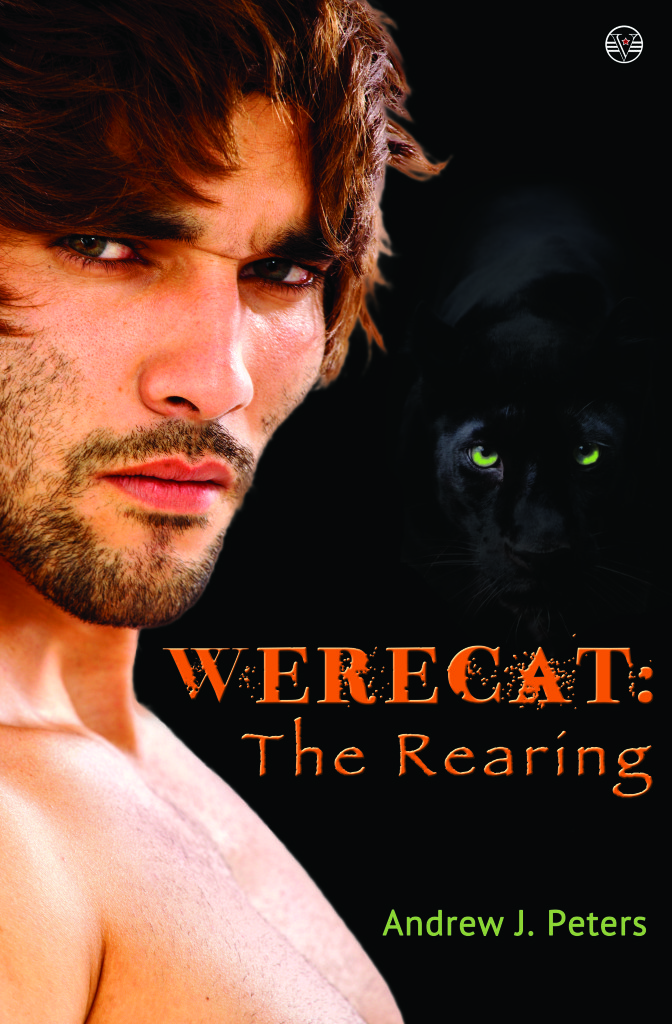
Also, the first book in the series: The Rearing, just went permafree at retailers like Amazon, Kobo, iTunes, and BN.com.