Study of Book Reading Preferences of LGBT People

I’m plugging a new study by Lambda Literary Foundation and St. Cloud State University. They’re surveying LGBT people about their book reading preferences (i.e. print books vs. e-books) in order to find out how to best reach LGBT readers.

I included the full press release below, and you can do the survey here.

I did it. It was fun. 🙂

The study caught my eye as an upcoming author who is batting around different ideas for marketing my work. As I filled out the survey, I realized how much my reading and book-finding habits have changed, in a really short span of time actually.

If you asked me two years ago, 100 percent of the books I read would be print. If you asked me one year ago, I’d say about sixty percent of the books I read were print. Today, that percentage has dwindled to about ten percent. I read books on my Nook almost exclusively.

And as a result, I’ve become a much different book-buyer and browser. I used to go to bookstores about once a month. Now, the last time I went to a book store was three months ago; and the last time before that was probably another three months back.

It’s sad on one hand, I think, for those of us Gen Xers who used to love browsing a bookshop, getting pulled in by an interesting book cover, and feeling like we were supporting Literature and independent booksellers with our purchases. Those shops are few and far between.

On the other hand, there’s something really encouraging about the growth of e-books and on-line bookselling. On-line booksellers offer sooo much more variety, and inventory.  I’m often looking to read something specific, like ancient world fiction or gay fantasy. Searching on-line, I can usually pull up dozens of those kind of titles pretty quickly, and there are published reviews and reader reviews and sample chapters to help me decide which ones to buy.

I think the great thing is that readers can find “niche” literature like LGBT fiction much easier than they could five or ten years ago.

Here’s the press release from Lambda:

Lambda Literary Foundation and St. Cloud State University
Conducting International Study
of Book Reading Preferences of LGBT People
  

St. Cloud, Minnesota – What type of books do LGBT people like to read? How and where do they find the books that they like to read? Lambda Literary Foundation (LLF) and St Cloud State University Collection Management Librarian Rachel Wexelbaum are conducting an international study on the book reading preferences of 21st century LGBT people to help answer these questions.

This is the first large-scale study of LGBT book readership conducted in the age of EBooks and mobile devices. Librarians, writers, publishers, educators, counselors, and others are often operating on assumptions of what types of books LGBT readers prefer, how they find those books, and how they read them, based on pre-Internet reading habits. The results of this survey will help determine how best to reach LGBT book readers.

To take the survey now, click here. 

For more information about this study, please contact Rachel Wexelbaum atrswexelbaum@stcloudstate.edu.

 

Some Thoughts on Gay Olympians

Australian Olympic Diver Matthew Mitchem

I’m not a huge sports fan, but I am a big Olympics fan. It’s an event that strikes several chords for me: athletes represented from around the world, good drama, the pageantry, the epic-ness—all things that may have a lot to do with my literary (and gay) sensibility.

I root on the underdogs, who in most cases do not represent the U.S. (bad American, I know). This year, I’m enthralled by the extensive tennis coverage on Bravo.

A nice sidestory to the event is the record number of out gay athletes, who were recently profiled by Huffington Post. Twenty-three have been identified, more than double the number at the Beijing games.

Some still say that’s a ridiculously paltry number, considering there are 11,000 athletes total. That calculates to .02 percent. They’re also mainly women and mainly White. The guys – Australian 2008 Gold Medal diver Matthew Mitcham has the highest profile – compete in individual sports, giving credence to the conventional wisdom that it’s harder to come out in a team environment.

Per the message boards, the main issue under debate is: “Why is this story important anyway?”

Including and beyond the religious bigots, a lot of people say an athlete’s sexuality has no place in media coverage. Fans are interested in athletic ability and competition. We don’t need to know what an athlete does in her/his “private” life. Win a gold medal, and then you earn the right to the media spotlight. By profiling gay athletes, it’s actually hurting the cause of “mainstreaming” queer lives; we’re just like everyone else.

That’s a quick condensation of the message boards.

I don’t believe that LGBT athletes have a moral imperative to come out, but I do feel strongly that it’s a wonderful thing when they do. And I think the hypocrisy of the anti-coming out argument is exposed in due course when you consider how many athletes use their platform for personal causes, whether it be cancer research, disability awareness, ethnic/cultural pride, or whatever.

A great example is tennis player Andy Murray. He plays for Great Britain, but is quite ‘openly’ Scottish. Should he shut his mouth about that? (Yeah, just try to get him to do that).

Girls, Girls, Girls

A bit of false advertising, but I couldn’t resist.

This is not my foray into porn spamming, and I’m not writing rock-n-roll odes.

You might be asking yourself: what does a gay male writer know about girls?

Not much romantically, although there was that confused period in my adolescence. I’ve made my apologies to my former girlfriends, and I don’t think any lasting harm was done.

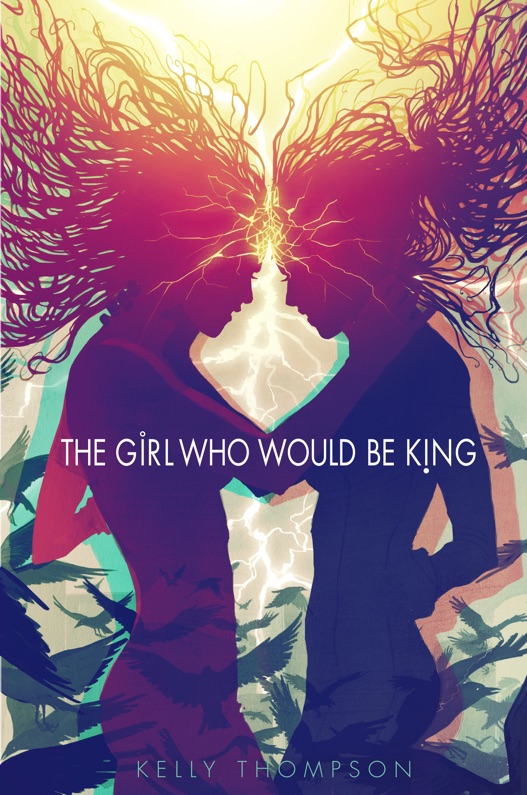
This was just my sneaky way to share an important project that brings much needed, strong female lead characters to young adult fantasy, in this case the superhero(ine) genre.

Cover art by Marvel comics cover artist Stephanie Hans

Author Kelly Thompson has launched a dynamic Kickstarter campaign to promote her self-pubbed novel THE GIRL WHO WOULD BE KING. There are amazing packages for donors at all levels, including: signed print copies of the book, cool artwork by Thompson (who is a kickass artist in addition to an author), and access to a fan forum for live chat that takes you behind the scenes of the story.

I made a pledge. You can too.

Beyond the excellent girl-empowering story she has to tell through TGWWBK, Thompson explains that her campaign is a way of bringing quality cross-genre literature to readers — a challenge within the traditional publishing model.

As an author who has run up against similar frustrations with a hard-to-categorize YA novel, I am exceedingly impressed by Thompson’s creativity and vision. She reached her original Kickstarter goal in like a day, and is well on her way to a stretch goal of $25K. The campaign ends July 25th.

Now for a musical interlude.

Embedly Powered

I love this song, and have been listening it to it a bit obsessively since I discovered it at the end of an episode of the HBO series “Girls.” Besides a really pleasing soundtrack (Bryan Ferry, Siouxie and the Banshees, Tom Tom Club – yeah, I’m showing my age), the writing and acting are hilarious, poignant and outrageous – keeping things so off-balance that you can’t stop watching. The series also resonates with me personally because my early twenties were a similar kind of horror show, with some great times thrown in.

WeReCaTs!!

Alex the Werecat by Anna Rosenrot

So andrewjpeterswrites.com has been looking more like andrewjpeterssleeps.com lately, but truly, I have been doing a lot of writing off-line. Over 30K words in fact. It’s a project that was inspired in part by Allison Moon’s tasty werewolf series TALES OF THE PACK.

Lesbian werewolves: meet gay werecats.

Some of my friends have been quick to point out the comic possibilities of such a theme: high strung, fastidious queens who perch above the world throwing shade at their “inferiors.” I’m not taking it from that angle, for better or for worse. The series that’s coming together is dark and sexy and aims to explore what might really happen if man and feline could be merged. Some of you have seen my posts on my beloved tiger-striped tabby ChloĂ«. I’m fascinated by cat psychology, as well as human psychology, so I hope to delve into those aspects, while keeping the tone gothic, humid and romantic.

Werewolf stories have a pretty big fandom, but who likes werecats? The literature is rather sparse. A Barnes & Noble search of “werecats” turns up fifteen titles, three of which are studies of an array of demonic creatures – vampires, werewolves and the like. Jami Lynn Saunders has a werecat horror series that comprises four of the other titles. The rest are paranormal romance (Sally Bosco’s WERECAT CHRONICLES for example) from a female heterosexual point of view.


Werecat films are few and far between. The only one that has some notoriety, from thirty years ago, is CAT PEOPLE, with Nastassja Kinski, Malcolm McDowell and a title song by David Bowie.

Poster from the 1982 movie

Then of course, there are the comics and RPGs. Thundercats tends to be the major reference when I tell people I’m writing a werecat story. (Regrettably).

So what do you think? Are werecats a long-neglected theme rife with literary possibilities? Is the subject too cheesy, too wannabe-werewolves for success? I’m writing this story either way, but I’m curious how people feel about werecats?

On Various Things YA

Two recent happenings in the sphere of LGBT Young Adult books caught my interest, and I thought I’d share them here.

First, Lambda Literary Foundation announced they are starting a new venture for young adult readers on May 1st called My Story Book Club. According to their press release on their website:

As part of our LGBT Writers in Schools program and our growing mission to promote the acceptance of LGBT works, their authors and LGBT students in schools, we are launching a national online book club for LGBT youth. Lambda Literary Foundation, in partnership with the Gay/Straight Educators Alliance and the National Council of Teachers of English, aim to provide readers 14 years-old and up the opportunity to read and discover LGBT works in the safe and protective atmosphere of Goodreads. 

The forum will feature youth moderators and a monthly Q&A with an author as well as typical features like discussion boards, polls, and playlists. Upcoming guest authors include Cris Beam of the trans-themed I AM J, Sara Ryan (“two girls in love” EMPRESS OF THE WORLD) and Charles Rice-Rodriguez (Latino, gay coming-of-age CHULITO). All three of those titles are on my ever-growing ‘to-read’ list. Their reviews are stellar, and I love that My Story Book Club will be showcasing diverse queer fiction.

Elsewhere, a blog post by sci-fi YA author Paolo Bacigalupi on Kirkus Reviews, has generated a lively discussion about the place of queer characters in future dystopias. In considering the question of why there aren’t more gay and lesbian characters in the genre, Bacigalupi suggests that gay experiences are better portrayed through allegory than overt characterization, because it’s hard to imagine a future more “dystopic” than modern gay queer living.

Bacigalupi says his goal in writing a dystopia about being gay would be to “rattle” complacent straight readers into awareness and understanding. His criteria for a good dystopian story are that it be “insurgent.” The story should “illuminate the horrors right before our eyes,” and “build empathy and humanity.”

The statement he makes that became a bit of a lightning rod is:

“So instead of writing a story about being gay, create one about being straight. Create a world where heterosexuality is a shocking desire.”

Bloggers like Rebecca Rabinowitz were quick to respond that obliterating queer characters from dystopian tales confuses the point Bacigalupi purports to make, and I would agree.

Imagine Cormac McCarthy’s THE ROAD taken from the viewpoint of a gay father who is determined to protect his son in a post-apocalyptic world of starvation and cannibalism. The possibility of gay parenting transcending terrifying obstacles seems to meet Bacigalupi’s criteria of insurgency, empathy and humanity delightfully well. It makes readers re-think their notions of fatherhood, and provides a powerful queer representation for young adults.

(Allright, THE ROAD isn’t a YA novel, but it was the most accessible title I could think of).

Would a gay THE ROAD have a wide enough access point to reach the “complacent straight readers” Bacigalupi talks about? Probably not. But for many of us authors and fans of LGBT YA, I think, that perennial debacle–making LGBT stories “palatable” to a non-LGBT audience–is kind of tired and irrelevant. We like our queers in outer space, in Medieval-inspired fantasy lands, as well as confronting dilemmas of modern living. A fresh setting is nice, but the fact that we exist, and can exist everywhere is the greater part of our engagement in literature.