When your literary heroes turn out to be jerks

This post was pre-empted by my two-part young adult librarian panel.  So, not exactly catching the wave of outrage toward Bret Easton Ellis, but something I wanted to post none-the-less.

I’ve had it with Bret Easton Ellis.  I’m disavowing my fanhood, and will no longer buy his books.

I defend free speech, am pretty sympathetic and forgiving of human fallibility, and I don’t expect more intelligence from celebrities than I do from anyone else.

But Ellis went off on a ridiculously irresponsible tear, for which he has been totally unapologetic.

It started with his Twitter observations on the TV series Glee, and continued with his commentary on the It Gets Better campaign.

“why is it that every time I watch an episode I feel like I’ve stepped into a puddle of HIV?”

Then, in response to angry replies…

“Okay, okay, I get it. I’ll stop riffing on H.I.Glee…”

Later, on It Gets Better…

“I hate that s**t about ‘It Gets Better.’ It doesn’t. Retool it. Say ‘You Get Stronger.’ The narcissism of gays is out of f**king control…”

I rarely watch Glee, though I support the concept and am personally and professionally surrounded by Glee-heads (Gleeks?). And I respect thoughtful debate over It Gets Better.

But Ellis “riffing” on gay people being gross, diseased and selfish–from his platform, to his fans–is wrong. At this point, I don’t care if he has personal issues to work out. He’s not a 13 year old discovering social media for the first time. Talk about those issues in therapy.

Ellis is a brilliant writer, but as a person, he stinks. I wish I knew less about his personal opinions, but I do. There’s no turning back. To lay out money for his books just feels disingenuous.

He’s a complex, seductive kind of villain. I kind of want to root for him, and I do hope he gets his shit together.  Maybe one day he’ll realize that his personal struggle—that squeamish, threatening feeling provoked by two guys kissing, singing showtunes or otherwise being ‘effeminate’—really does get better.

But there are plenty of other authors producing good stuff, while maintaining a professional public persona, doing what they’re supposed to do:  keeping a boundary around their personal issues.

Atlantis Found in Dona Ana Mudflats?

Totally unsnarky here.   If you’ve wended your way through my site, you know one of my little peculiarities is a fascination with the legend of Atlantis.

There was big archeological news this week:   a U.S. research team believes they have substantial evidence to place the lost city’s location 60 miles inland in Southern Spain, beneath the Dona Ana National Park, a vast marshland.

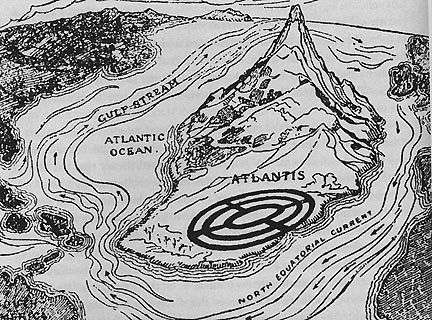
Here’s National Geographic’s depiction of what Atlantis looked like before it was covered in mud.

The most compelling indicator is the proximity of several “memorial cities” in the area.   They’re believed to have been built by survivors, and are similar in design to Plato’s description of Atlantis’ urban layout, which he wrote about in 360 B.C.E..   The theory is thus:  Atlantis was buried by ocean and debris from a tsunami, and its refugees built replicas with concentric walls and mounted temples to preserve the memory of their fabled great city.   Here’s a link to Reuters’ article about the find.

I just watched the National Geographic special last night—a little hokey as these things tend to be, and pretty short on archeological “evidence.”   They used aerial photography and underground radar to create a gloppy sketch of a ringed wall below the earth, and it’s carbon-dated as up to 5,000 years old.   But for real proof, they will have to excavate—a very gradual endeavor since the site is also filled with underground pools of water.

So, such “finds” tend to come up every few years.   In 2009, an anonymous group of “undersea archeologists” released grainy photos that became a brief Internet sensation.   They claimed the pics, taken at an undisclosed location in the Caribbean Sea, revealed city structures, including Egyptian style pyramids, that predated recorded history.

In 2000, ruins of an ancient city were found in the Black Sea, off the coast of Turkey.

Also in 2009, an Internet rumor spread that you could see urban grid lines in the Atlantic Ocean off the north coast of Africa, a lost city buried under water.   It turned out to be a “digital artifact.”

Is the Dona Ana site a publicity stunt for National Geographic or a promising lead to uncovering our greatest enduring legend?   Time will tell, and meanwhile, “my” Atlantis slugs along:   getting deeper into revising Act II.   Anyone want to finance a sabbatical so I can finish this thing off?

Unearthed: A Pioneering Hungarian Gay Activist

I’m proud of my Hungarian heritage, and I’m proud of my gay heritage.

So when I read the White Crane Institute’s February 28th Gay Wisdom for Daily Living, my jaw dropped, I scrolled up and down my iPhone screen, ridiculously captivated and–eventually–grinning ear-to-ear.

Who knew that a 19th century Hungarian was a pioneer for gay rights?  I love it, and I’m posting the article more-or-less in its entirety.

Gay Wisdom for Daily Living is an amazing newsgroup for gay history junkies.  You can sign up for it here, and you’ll receive an e-mail every day with several short biographies of influential LGBT’s who were born, died or did something exceptional on that date.   The obscure ones are my favorites, and there’s often archived poetry, diary entries, etc. in the daily posts.

Egészségetekre!

Karl-Maria Kertbeny
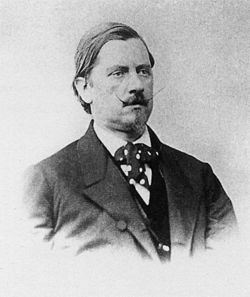
824 – on this date Karl-Maria Kertbeny or Károly Mária Kertbeny (born Karl-Maria Benkert) (d. 1882) was born in Vienna, the son of a writer and painter.  He was an Austrian-born Hungarian  journalist, memoirist  and human rights campaigner who coined the word homosexual.  The Benkert family moved to Budapest  when he was a child — he was equally at home in Austria, Germany  and Hungary.

As a young man, while working as a bookseller’s apprentice, Benkert had a close friend who was homosexual.  This young man killed himself after being blackmailed by an extortionist.  Benkert later recalled that it was this tragic episode which led him to take a close interest in the subject of homosexuality, following what he called his “instinctive drive to take issue with every injustice.”

After a stint in the Hungarian army, Benkert made a living as a journalist and travel writer, and wrote at least twenty-five books on various subjects.  In 1847, he legally changed his name from Benkert to Karl-Maria Kertbeny (or Károly Mária Kertbeny), a Hungarian name with aristocratic associations.  He settled in Berlin in 1868, still unmarried at 44.  He claimed in his writings to be “normally sexed,” and there is no direct evidence to contradict this, despite the skepticism of subsequent writers.

Nevertheless, from this time on he began to write extensively on the issue of homosexuality, motivated, he said, by an “anthropological interest” combined with a sense of justice and a concern for the “rights of man.”

In his pamphlets, Kertbeny argued that the Prussian sodomy law, Paragraph 143 (which later became Paragraph 175 of the penal code of the German Empire), violated the “rights of man.”  He advanced the classic liberal argument that consensual sexual acts in private should not be subject to criminal law. Recalling his young friend, he argued strongly that the Prussian law allowed blackmailers to extort money from homosexuals and often drove them to suicide.

Kertbeny also put forward the view that homosexuality was inborn and unchangeable, an argument which would later be called the “medical model” of homosexuality.  This contradicted the dominant view up to that time, that men committed “sodomy” out of mere wickedness.  Homosexual men, he said, were not by nature effeminate, and he pointed out that many of the great heroes of history were homosexual.  With Heinrich Hössli and Karl Heinrich Ulrichs, he was among the first writers to put these now-familiar arguments before the public.

During 1869, in the course of these writings, Kertbeny coined the word “homosexual” as part of his system for the classification of sexual types, as a replacement for the pejorative terms “sodomite” and “pederast” that were used in the German- and French-speaking world of his time.  In addition, he called the attraction between men and women “heterosexualism”, masturbators “monosexualists”, and practitioners of anal intercourse “pygists.”

After publishing his two important pamphlets, Kertbeny faded from the scene.  If he was homosexual, he was never prepared to say so.  In 1880, he contributed a chapter on homosexuality to Gustav Jäger’s book Discovery of the Soul, but Jäger’s publisher decided it was too controversial and omitted it. Nevertheless, Jäger used Kertbeny’s terminology elsewhere in the book.

Kertbeny did not live to see the wide acceptance of his terminology or his ideas. He died in Budapest in 1882 at age 58.

His gravesite was traced in 2001 by sociologist Judit Takács who conducted extensive research on his life. It is located in Kerepesi Cemetery in Budapest, the final resting place of numerous prominent Hungarians of the nineteenth and twentieth centuries. The Gay community set a new tombstone on it, and since 2002 it has been a recurring event at Hungarian Gay festivals to place a wreath at his grave.

Weekly News Round-Up

Last Friday, author Perry Moore was found dead in his West Village apartment: “Perry Moore Dies at 39.” He was best known as a producer for the Chronicles of Narnia series, but he also wrote the award-winning YA superhero novel HERO, which was expected to sprout a sequel.

I loved Moore’s account of what inspired him to write the novel.   In a 2007 NYT’s article, he explained that he was so affected by Marvel Comics’ decision to kill off NorthStar, the only gay character in the X-men series (or elsewhere), he undertook a one man social action, inserting post-it notes into bookstand comics with messages like:   “Can a superhero be gay?” and “Ask yourself:   Equal Rights?”

His novel was a more conventional endeavor to change the comic industry’s portrayal of gays.   A self-described lifelong comic ‘geek,’ Moore especially wanted his book to reach young readers, struggling to come out, as he once was himself.

HERO was published in 2007, but I just caught up with it last summer.   It was at first a wee difficult for me to get into—not being a fan of comic-genre zaniness—but the sweet coming out story at its center, and equally sweet romance sub-plot, won me over.   I also appreciated that the superhero Thom Creed is a jock with a decidedly non-jockish power:   he can heal wounds and mend broken bones by touch.   Subverting the hetero, masculine archetype makes me smile.

The other news that caught my interest this week is international, mega-bookseller Borders filing for bankruptcy and announcing the closure of 30 percent of its stores.

For several years, Borders has been in steady decline, for many reasons, given balance in MSNBC.com’s “Borders’ Loss May Be Others’ Gain in Book Wars.” Michael Norris, an industry analyst, calls Borders’ string of market and management-related wounds a case of “Murder on the Orient Express.”

At first glance, it’s the story of ‘brick and mortar’ booksellers being unable to compete with on-line sales and e-products, dynamics that were factors, but there’s also the impact of the economic downturn on retailers generally to consider.   And some have pointed to the company’s ineffective business model, such as this interesting perspective by former employee Giles Hash.

What does this mean for authors?  Not much, and everything seem to be the popular answers.

Amazon, Barnes and Noble, and independent bookstores shouldn’t have much of a problem picking up Borders’ customers.   Print sales are declining, but e-books are exploding.   How much the latter compensates for the former is a question I was unable to answer from my one week research stint.   It’s clear that profit margins are lower for e-publishing, but many e-books are share-protected, leading (possibly?) to more individual readers making purchases.

The undisputed losers are the publishers.   Some are owed as much as 40 million by Borders, and with their debtor in bankruptcy, they might be lucky to recoup two-thirds of their debt.   Sucks for them, and the impact trickles down—fewer and lower advances for authors, greater risk aversion, and an increased burden on authors to promote their books.   Though these trends have been in play for quite awhile.

Finally, the biggest joy of running a website is receiving fan mail, most of which, it turns out, comes with hyperlinks to male enhancement pills and creams.   Here’s an unexpected treat from last week, in response to my post on Groundhog Day.

“I just installed an in-wall computer in my bathroom with a pull out keyboard tray and, with all do respect, this is the first blog I read while taking a number 2. This is getting bookmarked because it will always have a place in my heart, and bathroom. Thanks for the great read.”

Thank you, “Darline.”   Glad to be of service.

The writer as researcher

Revising my novel has taken me through many days of re-reading what I wrote,  aftershocks of beta reader feedback, soul-searching, re-drafting an outline, and now, gently putting new words down on the page.

I’ve realized what I also need to do is to get clearer in my head (and then the pages) my portrayal of male/male relationships in the fantasy world wherein the action takes place.

Of course, I have some liberties with fantasy.  I could create a world with far-flung notions of male sexuality.  But the story is also re-told myth, with an ancient world–predominantly–pre-Hellenic sensibility. Thus, there’s some squaring to be done with what we know about the ancient Greece.

There are common misunderstandings about the attitudes and practices surrounding male sexuality in ancient Greece.  On the surface, the society tends to be associated with rampant homosexuality, portrayed in parody and snarky comments–“Oh, you know what the Greeks were like…”

Earlier in my career, I facilitated anti-homophobia workshops.  One of my most memorable experiences was when I presented in front of a group of teachers, during the segment of the workshop on cultural relativism, cross-cultural and cross-historical attitudes toward homosexuality.  A young teacher, watching me intently and nodding his head along for quite some time, raised his hand and asked, with full sincerity, “Didn’t the ancient Greeks support gay marriage?”

The answer, of course, was no, certainly not as we understand “gay marriage” today.

From a modern viewpoint, many of the artistic relics–naked men on vase paintings, the kouros (idols of male beauty), and depictions of the phallus–make it seem like a society obsessed with the male form, hence, obviously very gay.  This leads to a misinterpretation of male sexuality and gender roles of the time.   In actuality, ancient Greek society was highly patriarchal, with segregated roles for men and women.  Men ruled the public realm.  Women were the keepers of the home.  The idealized man was strong, fearless and dominant.   Effeminacy was ridiculed such that a man’s reputation could be ruined if he was called out as “acting like a woman.”

Thus the abundant visual depictions of men are better understood as a reflection of male-centrism politically and culturally.  The naked male image was not meant to arouse, generally.

Still, there were nuances.  Whereas many patriarchal societies enforce a heterosexual imperative, at least in public life, in ancient Greece, exclusive heterosexuality was not a requirement of male privilege.  Many of the most powerful, respected, celebrated men of the time engaged in sex with other men, particularly during the pre-Hellenic era when same-sex pairings were a widespread tradition, at least among the upper class.  The context of male/male relationships was what mattered.

Most of what we know about homosexuality at the time comes from artwork and literature depicting the specific practice of ‘paiderastia,’ which involved discrete roles for the older, more experienced partner, the ‘erastes,’ and his younger, typically adolescent lover, the ‘eromenos.’   Such relationships had social, educational and/or political components, vis-a-vis a tutor and his pupil or a noble man and a youth from lesser aristocratic family.  In some cases, these sort of couplings began with rituals similar to a marriage—the presentation of gifts (dowry) to the eromenos, animal sacrifices and feasts.  The eromenos could choose whether or not to accept the offer of his erastes, unlike girls who rarely had say in who they married.

I’d love to know more about peer-to-peer homosexual relationships of the time, which certainly happened, but are hard to turn up in the literature.  Likely, they were less socially sanctioned since they conferred none of the advantages that were prized at the time:  child-bearing or status advancement.