Yes Gay YA

On Monday, Young Adult (YA) fantasy authors Rachel Manija Brown and Sherwood Smith posted an article on Publishers Weekly’s Genreville blog about their experience trying to sell a post-apocalyptic novel that featured a gay Japanese character.

An agent offered representation on the condition that they change the character from gay to straight, or remove him from the manuscript and/or omit references to his sexual orientation.

The character in question had a boyfriend, and according to the authors, the relationship was depicted in-line with those of the non-gay characters, i.e. no graphic sexual content, basically PG-rated.

I encourage people to read the entire article, which provides an excellent call to action for agents, editors, authors and readers who support LGBT portrayals in YA.

It’s a topic that has come up before, most recently when author Jessica Verday pulled her story out of the YA fantasy anthology Wicked Pretty Things, because the editor asked Verday to change the gender of one of her main characters to depict a non-gay relationship.  The incident sparked the creation of the fansite GayYA.org to promote LGBT portrayals in YA.

Brown and Smith make the point that their experience is not an isolated incident, and they invoke the heterocentric tendencies of the publishing biz.  Certainly, some  LGBT YA gets published, but it’s a tough mountain for authors to climb, in an industry where the slope is insanely steep regardless of what you’re writing about.

Author Melinda Lo wrote a great article on the subject:  “How Hard is it to Sell an LGBT YA novel?”  Therein, she makes the sensible point that LGBT YA will always be tougher to get published than non-LGBT stories simply because the readership will always be smaller.  Most readers aren’t LGBT.  The number of non-LGBT readers who are interested in LGBT books is relatively small.  Thus, the bar is higher for those of us who write LGBT characters.  Our stories must be spectacular and resonate with a “wider” (meaning:  non-LGBT) audience.

Lo says she never felt any pushback from the publishing industry in writing her first novel (ASH) with a lesbian heroine, but many authors do.  So for authors of LGBT YA, it’s not just the added burden of writing a novel that will appeal to LGBT and non-LGBT readers alike (does anyone ever ask authors who write books with heterosexual characters:  could you make your story more appealing to an LGBT audience?).  It’s the added burden of having to sift very finely through the heap of agents and publishers, to find one who is willing to get behind a high quality LGBT novel because they believe that LGBT portrayals are important, even if it’s a tougher sell to non-LGBT readers.

I don’t think this is a problem that gets solved on an agent-by-agent or an editor-by-editor level (nor do Brown and Smith argue that point).   It’s about increasing the visibility of LGBTs generally so that the publishing industry sees us as the vital market that we are.

Beyond that, we need to educate publishing folks about our community.  An interesting issue to be explored is:  do LGBTs – and LGBT teens specifically – read more than their non-LGBT peers?  My experience working with LGBT youth points to yes.  As a routine evaluation of young people’s developmental assets and needs, we ask kids at my agency how many hours each week they spend reading.  Youth at our drop-in center consistently score higher on this measure than youth in comparable, non-LGBT specific youth programs.

It’s just a preliminary indication, based on a small sample, but it makes intuitive sense to me.  LGBTs frequently turn to reading for escapism, to reduce stress or to validate their marginalized experiences.  It’s a positive coping mechanism.  I’ve shared before that as a closeted gay teen, I sought out any gay lit I could find; in the 80’s it was gritty stuff by William Burroughs and Paul T. Rogers, so I can imagine how much more affirming it would have been for me to have the breadth of LGBT YA titles that are available today.

But it’s time for those titles to get out into the mainstream so that more readers know about them.
Back to the Grind

I’ve been tight-lipped here for a little while, owing to a walloping on a couple of fronts.

I’m teaching my first ever college class this semester, balancing that with my full time job, and trying to widely hedge my bets on an agent for The Seventh Pleiade.

(You can all put down your bets on how soon the mental breakdown will arrive).

So, on the agent front, I’ve got some folks reading my full manuscript. Cross your fingers!  Querying/pitching is pretty torturous, but at least this time around I am getting some response.

Also on my mind lately:   Lambda’s announcement about changing guidelines for its 24th annual awards.

Responding to strong criticism about restricting nominations to self-identified LGBT authors and poets, Lambda’s Board re-opened the field to all writers, excepting three categories that recognize authors in stages of their careers: debut, mid-career, and lifetime achievement.

I’ve got a heap of mixed feelings about the announcement.   On one hand, exclusion rarely feels right to me.  When authors — LGBT or not — write fresh and honest stories about queer people, they are part of a united fight against censorship and marginalization, which are still very real obstacles in publishing.   Increasing the number of good queer portrayals is something to be lauded whether the author is non-LGBT, like George R.R. Martin (Song of Ice and Fire), or gay, like YA author David Levithan (Boy Meets Boy, Wide Awake).

On the other hand, I believe there is a need to celebrate queer authorship specifically, to have an occasion where people step up to the podium and validate that being a queer author matters.   It’s not just about the content of our work.   Queer authorship is a tradition, a history, a common struggle, and a triumph.   By celebrating queer authors, we celebrate more than simply queer themed work, as though it were a genre of fandom, like sci fi or romance.   We’re celebrating, and creating, community.

According to Lambda’s Executive Director Tony Valenzuela, the organization does not anticipate the policy change to have an impact on the number of queer authors nominated.   There were no restrictions on nominees for most of the Lammy’s history (notwithstanding the period of 2009-2010, when a 2009 policy was in effect restricting most awards to LGBT authors).

In correspondence with Valenzuela, he pointed out to me that queer authors have always competed extremely well, even dominating the competition.   Says Valenzuela:   “I don’t see that changing anytime soon.”

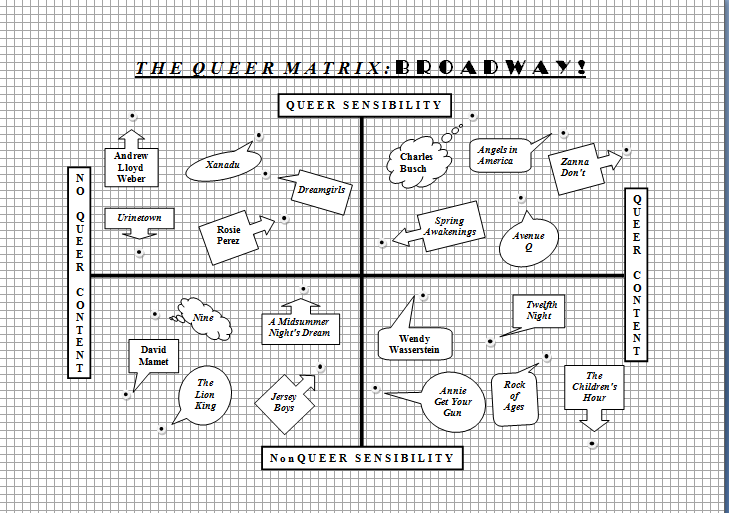
A Broadway Queer Matrix for Jurgen

This was a tough one, which I submit with a heavy caveat.

When it comes to theatre, musical theatre in particular, I think any work could be considered queer.

Beyond the clichés—gay men love show tunes, stage divas, and melodrama—what I mean to say is that it’s a medium in which performance can trump the playwright’s intention.  A queer character can be played as villainous, heroic, insipid, wise, stereotypical or multi-textured, depending on the actor’s point of view.  Queer subtext can be suppressed or inserted based on the director’s or the actors’ preferences.

The same choices are there for film or television screenplays, but I find there to be a greater degree of nuance and experimentation in theatre.

Theatre has also been a welcoming community for queer artists, all the way back to its creation in ancient Greece.  Sophocles, one of the greatest Greek tragedians (e.g. Oedipus, Antigone, etc.), has been biographized as queer by historian Thomas Hubbard in Homosexuality in Greece and Rome.  While queer themes were not commonly overt in the time period, we know of plays that told the stories of male/male relationships, including Sophocles’ intriguing title:  “The Lovers of Achilles.”

Furthermore, theatre is a queer concept in itself:  you can wear a mask and take on a completely different identity from your real life.

So, enough of taking myself too seriously, here’s what I came up with.

Per Jurgen, I put some thought into Shakespeare, a steady source of queer and non-queer literary debate, and picked out two plays which present queer themes in different ways.

Of course, there’s lots of cross-dressing in Shakespeare productions, and the steady device of a woman falling in love with another woman who is disguised as a man.  The Merchant of Venice is one example.

Here, I chose Twelfth Night.  But I put Twelfth Night in the Queer Content/NonQueer Sensibility quad because all the fun, experimental stuff gets sorted out in the end, with Viola marrying the Duke.  Heteronormativity wins out again.

In contrast, I’ve always thought of A Midsummer Night’s Dream as queerly ambiguous, even though all the characters are in opposite-sex couplings.  There’s Puck, the fey master of ceremonies, and a disintegration of social conventions—characters falling in love with people they shouldn’t.  I couldn’t quite put it on the upper half of the Matrix due to Puck’s famous apologetic Act V speech:

“If we spirits have offended, think but this, and all is mended…”

But a lot has to do with the delivery, I think.  Is he really sorry that he interfered with the young, starchy aristocrats’ lives?

andrewjpeterswrites.com goes dark next week while I’m attending Lambda Literary Foundation’s 2011 Writers Retreat for Emerging LGBT Voices!   

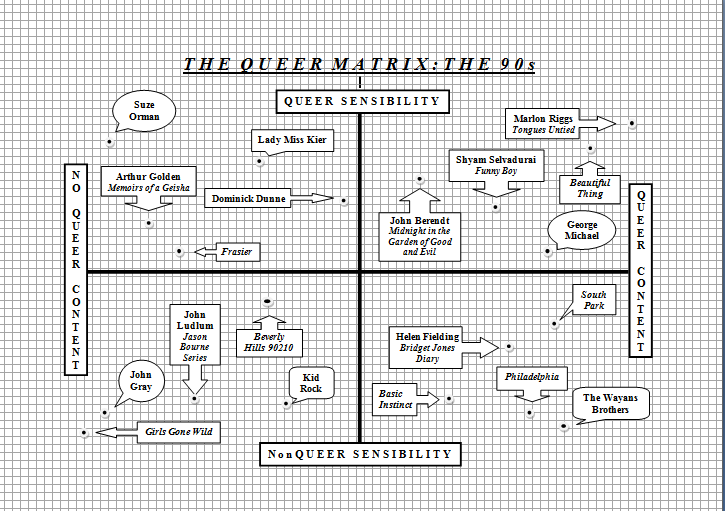
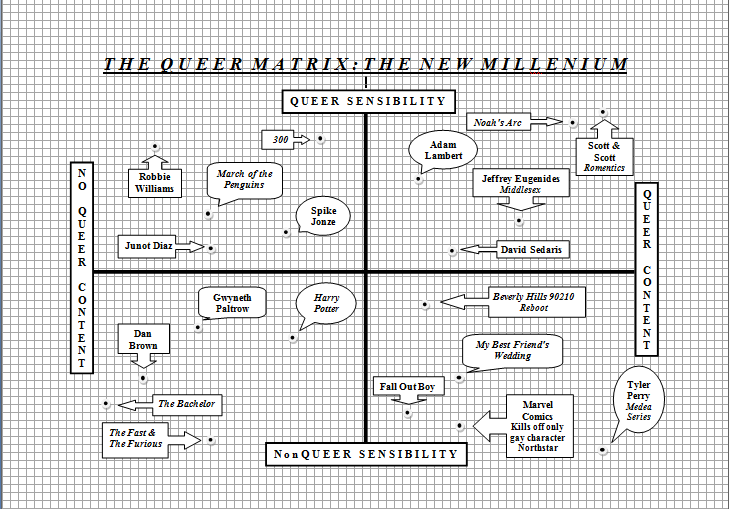
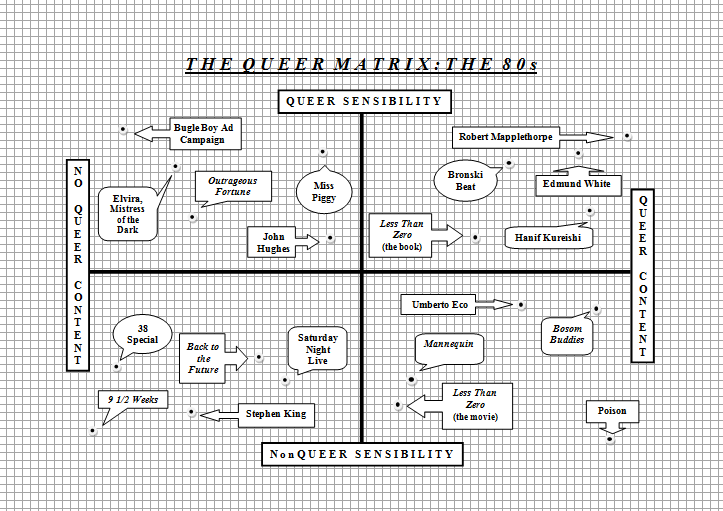
The Queer Matrix Through the Decades

Hoping not to prove you can have too much of a good thing, I’m continuing my queer ponderings this week, visual arts-style, with new Queer Matrices.

I spent way more time on these than I’d like to admit, but the results are quite a bit more polished than last week’s laughable mock-up.  I guess I was the last to know:  you can’t do diddly in Paint.

Some definitions first…

The X axis is Queer Content, which could include portrayals of same sex love and relationships, homoeroticism, gender bending, trans experiences, drag, or any representation of queer culture, politics and/or community.

No Queer Content is the absence of any of these.

The Y axis is Queer Sensibility.  The way I define it is looking at the world with a queer lens, through which homoeroticism and same sex love are celebrated, transexuality is transcendent, queer oppression is illuminated and indicted, and heteronormativity is challenged, subverted, and asked to please leave the building.

Non Queer Sensibility is the opposite, meaning looking at the world with a non queer lens, through which heteronormativity is centralized, traditionalized and/or assumed, a gender binary is de rigueur, and opposite sex relationships are the default setting.

Now we’ll take a look at Queer Matrices through the decades…


So what’s next?  The Queer Matrix:  Boy Bands?  Disney?  Punk Music Icons?  I’m open to entertaining suggestions.

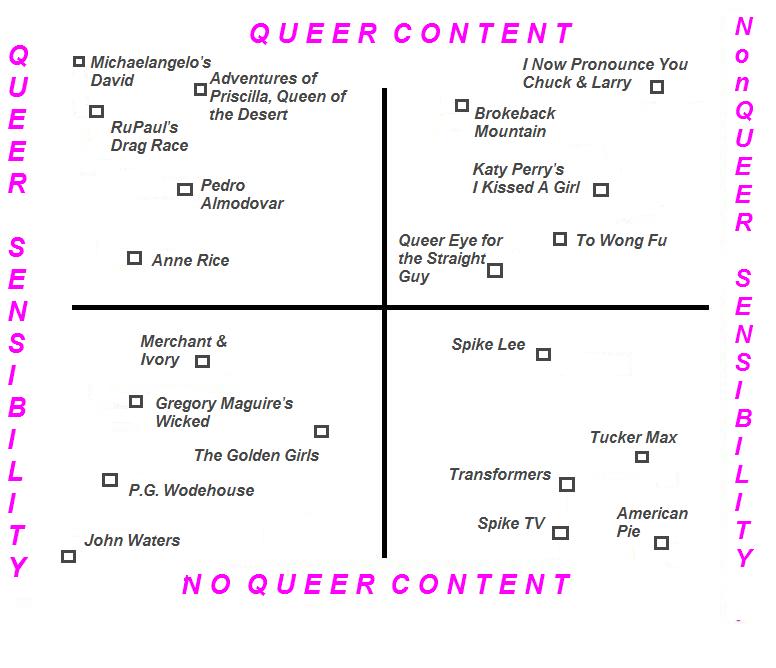
The Queer Matrix

I recently had a discussion with another writer about the concept of a queer sensibility.

Our conversation brought up profound questions that have been heavily considered and debated elsewhere–quite smartly in this article I found by poet/filmmaker Charles Jensen.

What is a queer sensibility?

Can a work of fiction, art, or film be queer, if it doesn’t portray queer sexuality?

Is there a non-queer or heteronormative sensibility?

Can a work of fiction, etc. that portrays queer sexuality be considered non-queer?

I believe a queer sensibility exists, and it goes beyond a homoerotic aesthetic or an explicit portrayal of same-sex love. For me, it’s the kind of thing I know when I see it.

I respect that many queer and non-queer folks disagree with me.  There’s an argument to be made against labeling creative work queer, or non-queer; and it’s not my purpose to elevate one over the other.  Sensibility is by definition personal and subjective. But here’s what this got me thinking about just for fun.

What creative works  have little to no queer content, but I still consider queer?

What creative works portay queerness, but still feel essentially heteronormative?

These ponderings led to—I present—the QUEER MATRIX.

Certain to piss off lots of people, the Queer Matrix is a way of understanding popular media from, well, a lens of queerness.  It’s a take on New York Magazine’s Approval Matrix, which is the first thing I check out whenever I have a copy.  But it’s a rather piteous derivative, artistically.  I made it in the only graphics program I know:  Paint.