Two Reading Events Coming Up in June!

I guess I have caught the reading bug. I recently signed up to participate in two events in June.

First, I’ll be reading part of my short story “The Trouble with Finklesteins” at the REZ Reading Series June 6th event, 7:30 pm – 9:00 pm, held at Odradeks Coffee House (82-60 Austin Street by the LIRR), right in my neighborhood of Kew Gardens. The REZ Reading Series is a monthly program sponsored by Sullivan Street Press. Their June event will feature local authors from the Queens-based Newtown Literary. I wrote “The Trouble with Finklesteins” a few years back when I was in a contemporary short fiction phase. No feline shapeshifters or ancient worlds, the story focuses on the strained relationship of two thirty-something women and the terrible secret one of them is hiding.

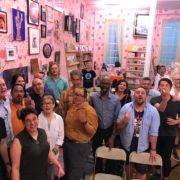
Then, I’m back again reading from The Seventh Pleiade at an exciting, new venue with an ultra-cool name: Bureau of General Services – Queer Division, on June 9th 3:00 pm – 5:00 pm. BGSQD in SoHo (Strange Loop Gallery, 27 Orchard St., New York, NY, 10002) is “a queer bookstore and event space” that hosts regular literary happenings. Their June 9th event features seven Bold Strokes Books authors representing a wide variety of fictional work. You can check out the event below:

Bold Strokes Books Authors Panel at BGSQD

Both events are free. Come out and see me!!

Share this:
Share this page via Email Share this page via Stumble Upon Share this page via Digg this Share this page via Facebook Share this page via Twitter

SAVE THE DATE: Rainbow Book Fair April 13th

I am excited (and just a wee bit terrified) to announce that I will be doing a short reading from my upcoming novel The Seventh Pleiade, as part of a panel of Bold Strokes Books authors at the Fifth Annual New York Rainbow Book Fair.

New York Rainbow Book Fair


The Bold Strokes Authors Panel is from 2:00-2:40pm.

Come on down to hear me read! Friendly faces in the crowd will be much appreciated.

For information about the Rainbow Book Fair, including a list of exhibitors and a schedule of events, click here.


Share this:
Share this page via Email Share this page via Stumble Upon Share this page via Digg this Share this page via Facebook Share this page via Twitter

My On-Line Interview – The Next Big Thing Project

Here’s the skinny, my “next big thing,” as prompted by author John Copenhaver last week:

What is the title of the book?

Werecat: The Rearing

DSC_1329


Where did the idea come from for the book?

It started as an experimental piece. I got turned on to shapeshifter and vampire stories only recently, and, as with most everything I read, those stories made me think: how could I write a great story in that vein from a totally queer point-of-view? Not just with gay or lesbian sidekick characters – I wanted to create a gritty, sexy love story between two men that was central to the plot, and really central to a fantasy world. I’m also fascinated by cats, so writing the fantasy aspect came pretty naturally to me.

What genre does your book fall under?

Urban fantasy

What actors would you choose to play the part of your characters in a movie rendition?

I actually blogged about that subject before my book got picked up by a publisher. What writer doesn’t daydream about casting her/his work? For Werecat, it’s extra fun because I think feline shapeshifters would have to be sexy and dark. I imagine an underground world populated  by hot, scruffy men, high-shouldered and lean, sort of a throw-back to the grunge or heroin-chic model trend of the 90′s. They would have to have great eyes too.

My main character Jacks is a lost, rebellious college drop-out, and I’d be delighted to cast François Arnaud from the Showtime series The Borgias in that role. Jacks’ love interest Benoit would have to be smoking hot with a dangerous vibe. My first pick is Michael Fassbender. Then there’s a supporting character Farzan who may or may not get in between Jacks and Benoit. Farzan is tightly-wound and kind of goofy. He makes me think of Kal Penn from Howard and Kumar.

What is the one sentence synopsis of your book?

Werecat: The Rearing is about a young man who goes to Montréal for Spring Break, gets picked up by a handsome drifter, and ends up on a terrifying and erotic journey into the world of feline shapeshifters.

How long did it take you to write the first draft of the manuscript?

Werecat: The Rearing is the first book in a series of novellas, which are 20-40K words apiece. I wrote the first draft in about three weeks.

Who or what inspired you to write this book?

Allison Moon’s lesbian werewolf novel Lunatic Fringe was a major departure point. Beyond her excellent re-imagining of werewolf mythology, her book made me think about the similarities between the shapeshifter trope and the experience of being queer, both in obvious ways like having to hide and being misunderstood, and in ways that are important to me politically and spiritually.

I think there’s something liberating about being able to inhabit two worlds. Queer people learn how to fit in, and sometimes pass within a heterosexual world, and we also cross “genders” at least in our private lives if not publicly. The Native American idea of two-spirit intrigues me – possessing both a female and a male aspect – and I could go on about that subject extensively. Suffice it to say, when I started writing about gay, feline shapeshifters, I found opportunities to explore the different facets of having a dual nature — socially, sexually, and politically.

I also worked a good bit of cat mythology – ancient world and native – into the story. Retold myth and legend is a fairly steady thread in everything I write.

Is your book out in print, upcoming from a publisher and/or represented by an agency?

NewVPBlogo72dpiWerecat: The Rearing will be published by Vagabondage Press and is upcoming in May.

Authors I am tagging next for The Next Big Thing Project:

Lydia Sharp - YA contemporary, fantasy, and romance author and blogger extraordinaire

Charlie Vazquez - Avant-garde author, poet, and master-of-ceremonies for New York City’s underground literati

Christopher Keelty – Fantasy/sci-fi author and civil rights activist

C.A. Clemmings – Author of literary novels and short fiction


Share this:
Share this page via Email Share this page via Stumble Upon Share this page via Digg this Share this page via Facebook Share this page via Twitter

Some thoughts on marriage

Reflecting on Washington State’s recent marriage law, Eric Andrews-Katz writes about the absurd position of longtime gay committed couples (“Marriage: 4th Time The Charm, Bold Strokes Books Authors’ Blog).

His story really resonated with me. Like Andrews-Katz, me and my partner got “married” in a commitment ceremony, many years before any state recognized the legal status of gay couples (2001). Our union was solemnized by the atheist leader of our local Ethical Humanist society.

Though the ceremony conferred no rights, that first marriage held much more meaning for us than our subsequent legal wedding at a New York City clerk’s office. When friends and colleagues ask me, doe-eyed and with enormous grins, “What was it like to finally get married?” I tell them: “It was kind of like applying for food stamps.”

That’s not to say that getting a marriage certificate hasn’t changed our relationship in positive ways. It was a re-commitment to our relationship. It allowed us–with greater certainty and pride–to check off that married box on government and work-related forms. We got a frame for our marriage certificate and hung it up in our bedroom.

But our 2001 commitment ceremony will always be the day we remember. It was the day of jitters: “Are we really doing this?” The day of tears. The day of dancing with friends and drinking champagne in a limo. The best day of our lives.

I guess it’s a generational thing, and I think it’s great that younger gay couples can now go through all of that in one, fully legalized fanfare.

It’s about frickin’ time. And Andrews-Katz tells a wonderful, personal story on the subject.

Share this:
Share this page via Email Share this page via Stumble Upon Share this page via Digg this Share this page via Facebook Share this page via Twitter

Hurricane Sandy Comes and Goes

Thanks to everyone for their concern during Hurricane Sandy.

My honey-bunny and I (and Chloë) are just fine. We are extremely lucky to live on high ground in Queens.

We spent a nervous evening with wind gusts shrieking around us from all four corners of our eighth floor apartment. But we didn’t lose power, and we were safe and cozy, snacking on our Halloween candy and watching RuPaul’s Drag Race, as well as Golden Girls re-runs.

How and when I will return to work is a big question mark, with the status of subways and trains uncertain. But that’s a really minor inconvenience considering the damage in other areas of the city.

My best wishes to my fellow New Yorkers during the recovery.

View of Kew Gardens, October 30, 2012. Gloomy but pretty much unscathed.

Share this:
Share this page via Email Share this page via Stumble Upon Share this page via Digg this Share this page via Facebook Share this page via Twitter

On Writers Critique Groups

A friend and I are organizing a critique group for queer writers. It’s one of the reasons my blog output has been woefully sporadic. We’re off to an exciting start with twenty-five members and max capacity of twelve for our first meeting, March 1st.

In preparation, I’ve been soaking up all the wisdom I can. There are a number of how-to books on running critique groups. Luckily for cheapos like me, there are lots of articles on-line for free.

So I gathered the general points below based on a few guidelines I found and liked on on-line forums, as well as my personal experience as a member of a critique group and as a beta reader.  I also threw in some general ideas about leading groups of any kind based on my practice and training as a social worker.

1. Orient members to the group by setting forth the purpose of the group and the format, rules and expectations.

That sounds particularly social work-y, and maybe dull and unnecessary. But I’ll give an example of how things can go awry.

I participated in a crit group that was looking for new members. We all agreed on having a laid-back screening process, something like posing a question beforehand: “tell us a little about your writing.” We decided to give the first guy who responded to our on-line posting a try.

He was excited to get feedback on the first section of his novel, and the group leader invited him to do so. We all read the piece and gave him thoughtful criticism when he showed up for his first meeting. Then, he sent an e-mail around, after the group, saying he really wouldn’t have time to participate in meetings because he needed to focus on his writing. Ugh. So why did we all waste time reading and trying to help him with his novel?

I’m sure this dumb stuff can happen in the best of circumstances, but I use it as an example of the importance of orienting members. If it had been clear to him from the start: joining the group is a commitment of X, Y, Z, he might have opted out, since really all he wanted was a quick focus group on part of his novel.

This brings up a sub-guideline: help potential members evaluate how the group fits into their lives. Is it realistic for them to read and critique 10, 20, or 50 pages in a one-week or two-week period? Do they have enough time to write so that they can submit their own work regularly?

2. Get agreement on etiquette for critiquing.

I briefly participated in the SF/F writers community Critters, and I love their guidelines (they call them “Diplomacy Requirements”) because they get into the nuances of delivering critique effectively. I’ll highlight/paraphrase just a few:

Say it’s your opinion. Use “I” statements: I’m finding this character’s actions hard to follow, vs.: This character makes no sense and will confuse readers.

Don’t try to persuade. A peer critique group is about peers giving each other advice. While it’s important to give your opinion when asked, it’s also important to be mindful of the fact you really don’t know better than any other writer. What you have to offer is a different perspective.

Another thing to consider is the balance of positive and negative feedback.

I once received a typed critique of a novel excerpt that had two short paragraphs about things the reader liked, and three pages of forceful criticism. Rationally or not, the only thing that stuck with me was the reader really, really didn’t like the story, leading me to another conclusion (rationally or not): she thinks I’m a crappy writer, leading me to shut down to anything she had to say (rationally or not).

Another point comes up from this example: taking in criticism non-defensively, which I could tackle in a separate article.  For now, I feel it  demonstrates the dangers of focusing too much on the negative. If you read a piece and have thirty-three problems to point out, try prioritizing them and share your top four or five. Less is more.

When I give critique, I try to keep the positive/negative ratio to 1:1. Some guidelines suggest 3:1. I have a hard time doing that because it takes me more words to describe why I think something isn’t working vs. why I think something is working.

Those positives are really essential though. In order for a group to be successful, there has to be a sense of hope, and commonality. Members should feel that their peers believe in their skill and promise as a writer and that they genuinely like reading their work. One article I found on “Daily Writing Tips” suggests that you open and close your critique with positive feedback.

3. Use the group to generate productivity.

Despite the admonitions of our childhood, peer pressure can be a very positive thing. In a writers group, it encourages members to make time for their writing, push themselves, and stick to commitments. You don’t have to be a Nazi about it, but a good upfront goal is for people to write more through their participation in the group.

I’m sure there are a whole lot more great tips, but that’s all I’ve got for now. What else has helped critique groups be successful for you?

Share this:
Share this page via Email Share this page via Stumble Upon Share this page via Digg this Share this page via Facebook Share this page via Twitter